








What Is LED Screen Architecture?
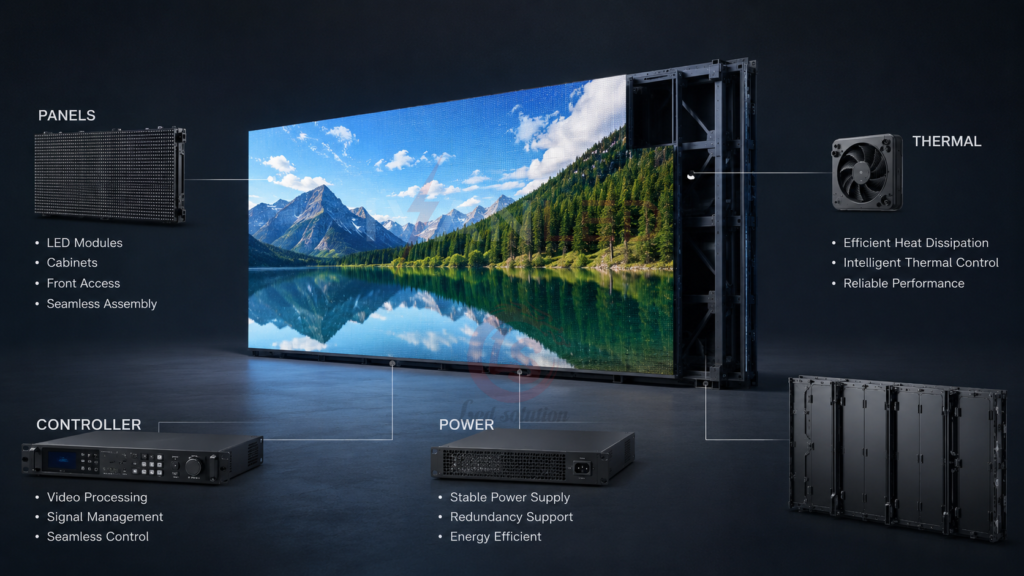
LED screen architecture is the structural and electronic framework that makes a display work. It encompasses the LED panels that emit light, the controllers that process content, the power systems that drive them, the thermal management that keeps them cool, and the mounting structures that hold everything in place.
These components work together to deliver high-quality visuals while ensuring reliability and longevity. The quality of each component directly affects the display’s performance and lifespan.
For more on display components, see our LED screen quality guide.
Core Components of LED Screen Architecture
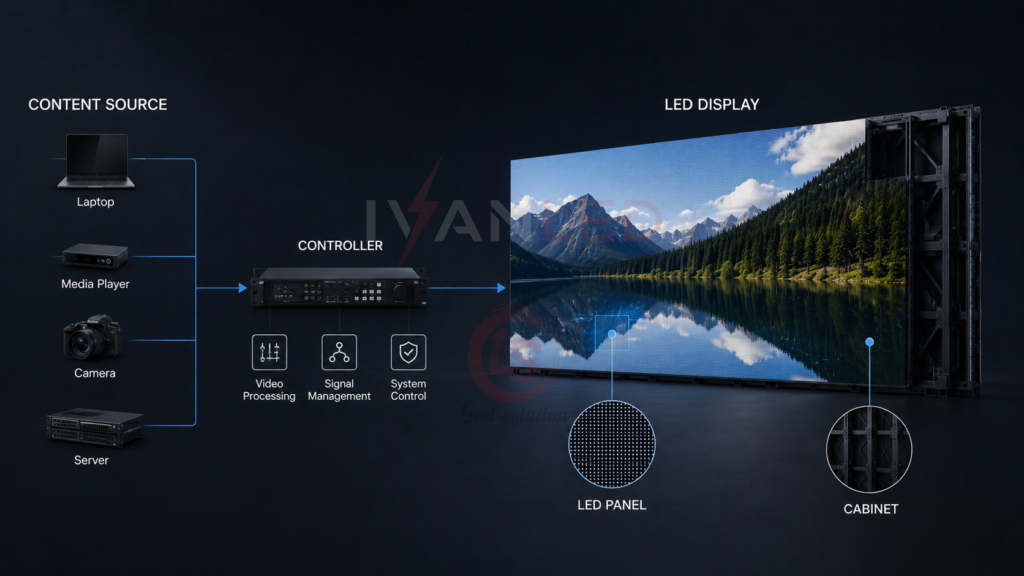
Every LED display consists of three core electronic components: LED panels (the display surface with thousands of tiny LEDs), controllers (the processing brain that converts input signals), and a content source (the media player or computer providing the content).
LED panels: Thousands of tiny LEDs grouped into pixels. Each pixel adjusts its brightness and color to create images. The panel is the visible surface of the display.
Controllers: The “brain” of the LED screen. Takes the input signal, processes it, and sends output to the LEDs. Controls refresh rate, color calibration, and synchronization.
Content source: The image or content to be displayed. Can range from computers and cloud systems to dedicated media players.
For more on controllers, see our LED display functions guide.
Types of LED Displays
Two main types of LED displays exist: direct-view LED (individual LEDs as pixels) and LED-backlit LCD (LEDs used as backlight for LCD panels). Direct-view offers superior brightness and scalability for large-format applications.
| Type | Working Principle | Brightness | Best For |
| Direct-view LED | Individual LEDs as pixels | Very high (5,000+ nits) | Outdoor advertising, stadiums, billboards |
| LED-backlit LCD | LED backlight + LCD panel | Medium (300-1,000 nits) | Retail, museums, offices |
Structural Design Considerations
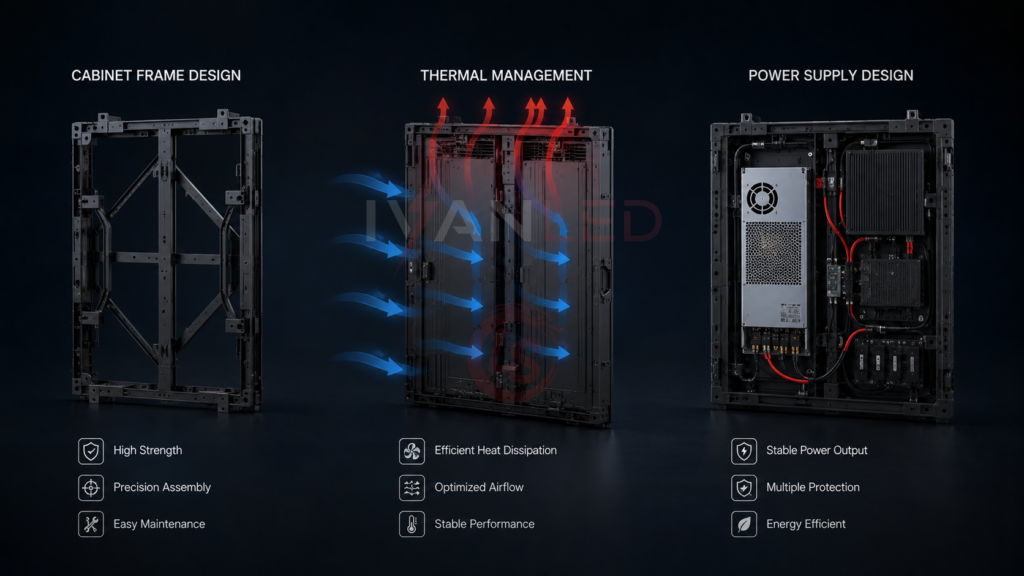
Three structural considerations are critical for LED screen architecture: cabinet and frame design (the protective casing), thermal management (heat dissipation), and power supply and distribution (stable electrical delivery).
Cabinet and frame design: The casing that stores and protects electrical parts. Made from strong materials like aluminum or steel. The design affects ease of installation, maintenance, and structural integrity.
Thermal management: LED chips release heat during operation. Proper thermal management — heat sinks, ventilation, and cooling systems — prevents overheating, protects internal components, and extends lifespan.
Power supply and distribution: Stable power supply is essential for consistent performance. Proper distribution handles the electrical load, reduces malfunction risk, and ensures continuous brightness.
For more on heat management, see our guide to slowing light attenuation.
Installation and Mounting Methods
LED screens can be installed using three primary methods: wall mounting (fixed to a wall surface), hanging structures (suspended from ceilings or frames), and standing frames (freestanding on the ground). The method depends on venue and application.
Wall mounting: Fixed to a wall surface. Best for permanent indoor installations like lobbies, conference rooms, and retail displays.
Hanging structures: Suspended from ceilings or frames. Best for stadiums, concert venues, and large public spaces.
Standing frames: Freestanding on the ground. Best for temporary installations, events, and rental displays.
Maintenance Practices
Regular maintenance — cleaning the screen surface, inspecting connections, updating controllers — prevents disruptions and extends screen lifespan. Neglect accelerates component deterioration and shortens service life.
Key maintenance practices:
- Regular cleaning: Dust accumulation traps heat and blocks light output
- Inspect connections: Loose cables or connections cause signal issues
- Update controllers: Firmware updates improve performance and fix bugs
- Calibration: Annual color and brightness calibration maintains uniformity
- Spare parts: Keep spare modules on hand for quick replacements
For more on maintenance, see our LED screen cleaning guide.
Technological Advancements in LED Architecture
Four advancements are shaping LED screen architecture: MicroLED technology (better brightness and contrast), flexible and transparent displays (bendable and see-through), quantum dot integration (improved color), and AI-powered smart features (automated optimization and diagnostics).
MicroLED technology: Better brightness control and contrast. Uses very little energy. Could eventually replace LCD-based displays entirely.
Flexible and transparent displays: Bendable or see-through forms. Enables curved designs and futuristic retail spaces.
Quantum dot integration: Improves brightness and color. Presents more realistic views.
AI and smart features: Optimizes content delivery by analyzing user behaviors and environmental factors. Automated diagnostics detect hardware issues.
For more on MicroLED, see our MicroLED technology guide.
Applications of LED Screen Architecture
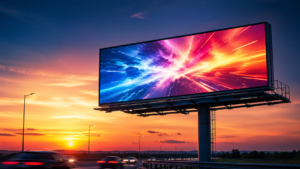
LED screens are used in commercial advertising, entertainment venues, public information systems, and residential settings. Each application requires different specifications for brightness, durability, and integration.
Commercial and advertising: LED screens for advertising stand out even in competitive settings. High brightness and dynamic content capture attention.
Entertainment industry: Concert venues and events use LED displays for visual effects. Real-time visuals and synchronized performances engage audiences.
Public information systems: Governments use LED screens for announcements, schedules, and traffic management.
Residential and personal use: From wall art to smart TVs, LED technology is used in home setups.
For more on applications, see our LED display solutions.
Common Mistakes in LED Screen Architecture Design
The most common mistake is designing the architecture without considering thermal management and power requirements. Poor heat dissipation leads to premature failure; inadequate power distribution causes performance issues and malfunctions.
Other frequent errors:
- Inadequate structural support: Failing to account for screen weight and wind load (for outdoor installations)
- Poor cable management: Disorganized cabling leads to signal interference and maintenance difficulties
- No maintenance access: Installing screens without planning for front or rear access for repairs
- Ignoring environmental factors: Failing to consider temperature, humidity, and UV exposure for outdoor installations
Expert Tips for Architects and Integrators
Tip 1: Design for maintenance access from the start.
Plan for front or rear access in the structural design. Retrofitting access after installation is expensive and disruptive.
Tip 2: Calculate thermal requirements.
Determine heat output based on screen size and brightness. Specify adequate ventilation or active cooling in the architectural design.
Tip 3: Plan for power requirements.
Calculate total power consumption and ensure the building’s electrical system can handle the load. Factor in surge protection.
Tip 4: Consider environmental factors.
Outdoor installations need IP65+ weatherproofing, UV-resistant materials, and appropriate temperature range specifications.
Tip 5: Order spare modules.
Order 5-10% spare modules with the initial purchase to ensure color match for future repairs.
Frequently Asked Questions (FAQ)
What is the lifespan of an LED screen?
Quality LED screens last 50,000–100,000 hours — approximately 5-10 years of normal use. Regular cleaning, proper ventilation, and timely repairs can extend lifespan.
Can LED screens be customized for different shapes and sizes?
Yes. LED screens are modular and can be customized for various shapes — curves, circles, and custom dimensions. Flexible and transparent displays offer even more design possibilities.
How does pixel density impact image quality?
Higher pixel density (more pixels per square meter) produces smoother displays with reduced pixelation. Pixelation is visible when pixels are too far apart for the viewing distance.
What is the difference between direct-view LED and LED-backlit LCD?
Direct-view LED uses individual LEDs as pixels, offering higher brightness and scalability for large-format applications. LED-backlit LCD uses LEDs as a backlight for an LCD panel, offering medium brightness at lower cost.
Does IvanLED offer LED display solutions for architectural projects?
Yes. IvanLED manufactures LED displays for architectural, retail, and public space applications. Browse our LED display products or contact us to discuss your project requirements.
Conclusion: Building for the Future with LED Architecture
LED screen architecture is the foundation of modern display installations. Understanding the core components — panels, controllers, power systems, thermal management, and structural mounting — helps you design displays that perform reliably and integrate seamlessly into any environment.
Our straightforward advice:
– Design for maintenance access — front or rear access saves time and money.
– Plan for thermal management — heat is the #1 lifespan killer.
– Calculate power requirements — ensure the building’s electrical system can handle the load.
– Consider environmental factors — outdoor screens need IP65+ weatherproofing.
– Order spare modules (5-10%) with your initial purchase.
At IvanLED, we manufacture LED displays for architectural, retail, and public space applications.