




What Are Curved LED Displays?
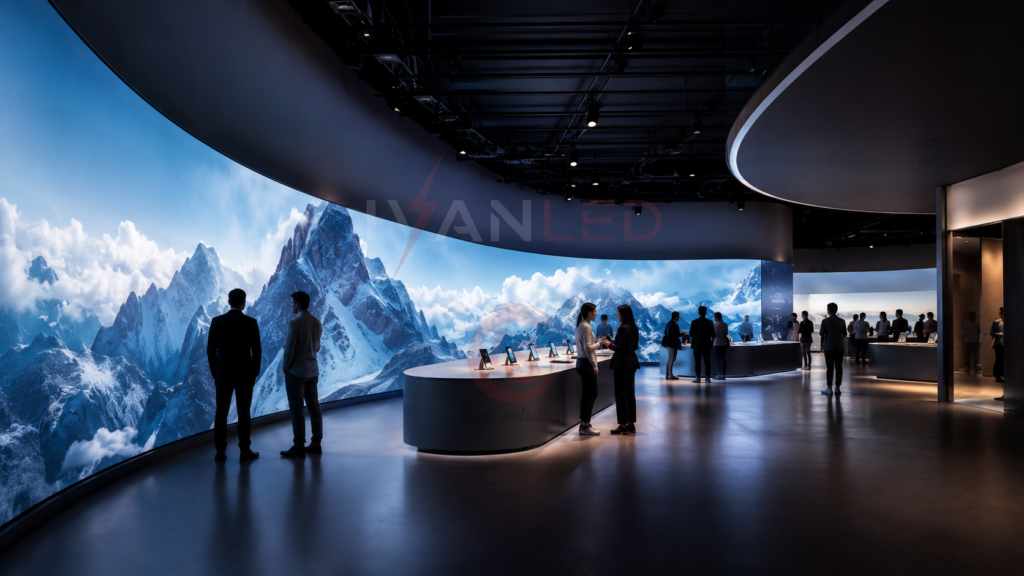
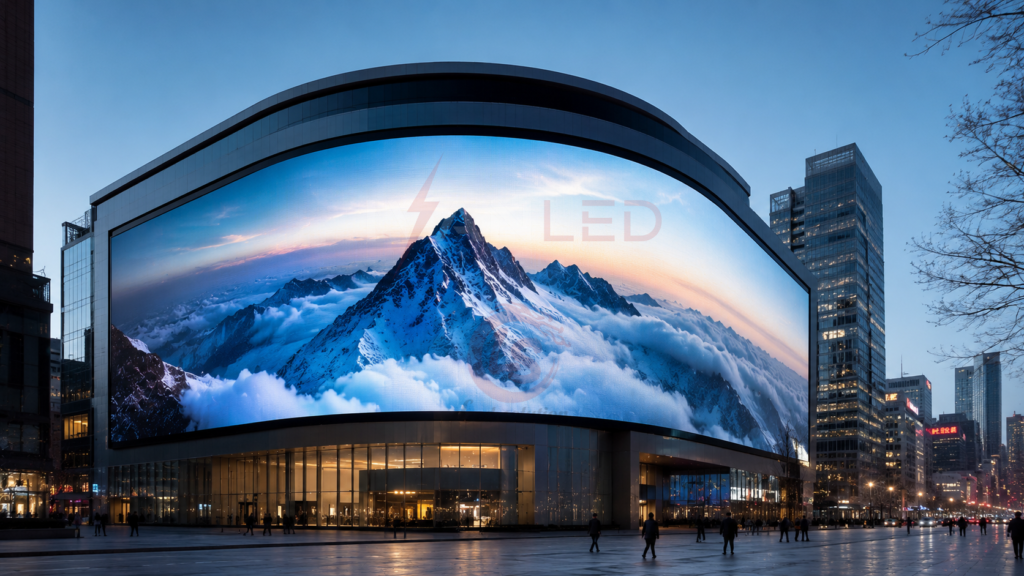 Curved LED displays are LED screens designed with a curved surface along one or more axes — either concave (curving inward) or convex (curving outward). They are built in two primary ways:
- Pre-designed rigid modules: Conventional LED modules manufactured to a specific, fixed curvature.
- Flexible modules: Bendable LED modules that can be shaped into almost any radius, then fixed with plastic or aluminum brackets to ensure stability and flatness. For more on bendable options, see our flexible LED display guide.
Common Types of Curved LED Displays
| Type | Description | Best For |
| Convex LED Display | Arc-shaped outward-curving surface | Building facades with curved outlines, attracting passersby |
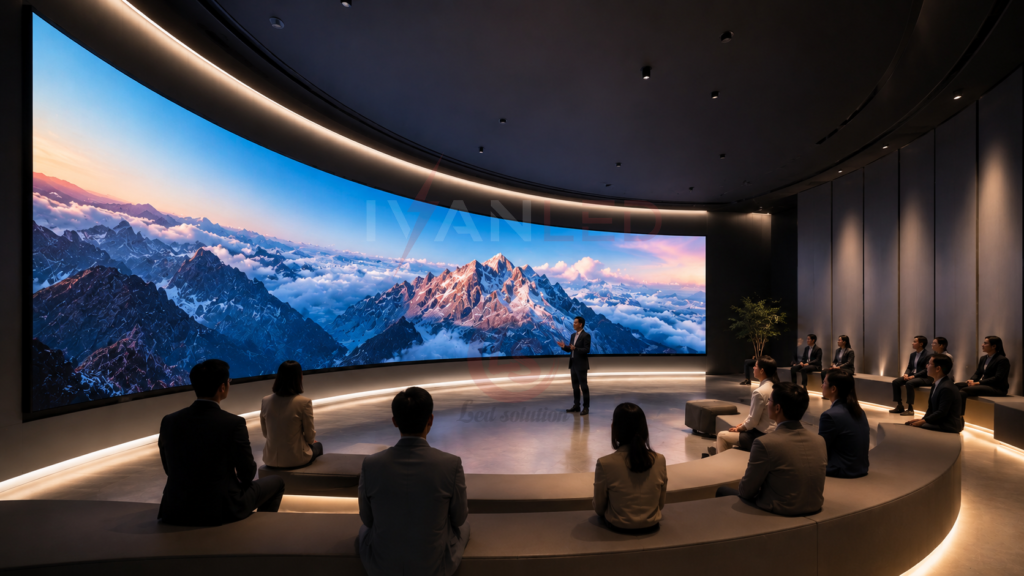
| Concave LED Display | Inward-curving surface | Interior walls, optimizing limited space |
| Wave LED Display | Continuous convex and concave surfaces | Architectural features and creative visual effects |
| Circular / Ring LED Display | 360° cylindrical display | Columns, immersive installations, no blind spots |
| Sphere LED Display | Fully spherical surface | Ultimate immersive experiences, high-impact installations |
Key Benefits of Curved LED Displays
1. Immersive Visual Experiences
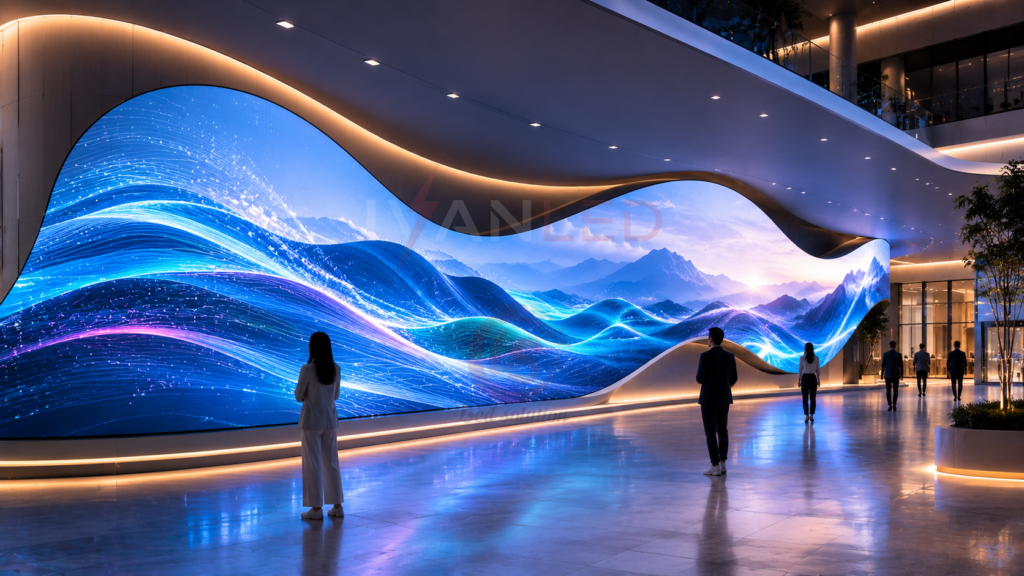
Curved LED screens create a sense of depth and immersion that flat displays cannot match. By wrapping around the viewer’s field of vision, they draw audiences into the content rather than simply presenting it. This makes them ideal for environments where engagement is paramount — retail spaces, museums, entertainment venues, and corporate lobbies. For similar applications, explore our commercial LED display solutions.2. Seamless Integration with Architecture
Unlike flat screens that often feel “added on” to a space, curved LED displays become part of the environment. They can wrap around columns, arch across ceilings, or climb multi-story facades. Architects and designers increasingly choose curved LED technology to realize visions that were previously impossible.3. Versatility and Customization
Modular designs allow curved LED screens to be configured in virtually any shape — from sweeping multi-story installations to custom wraparound displays. They can be tailored to fit specific dimensions, pixel pitches, brightness levels, and environmental conditions. Some advanced systems even offer double-sided screen capabilities, doubling engagement in high-traffic areas.4. Uninterrupted Visual Quality
Advanced curved LED technologies ensure consistent brightness, contrast, and color accuracy across the entire curved surface, eliminating distortion or gaps. Premium systems maintain seamless visuals even at extreme angles, with refresh rates exceeding 1,920Hz and fine pixel pitches ranging from P0.9 to P10 depending on application.5. Durability and Reliability
Quality curved LED displays are built with premium materials — some featuring gold wiring and weather-resistant enhancements for challenging environments. Leading manufacturers offer warranties protecting down to the individual diode level, with lifespans of 50,000+ hours.Applications Across Industries
| Industry | Application | Key Benefit |
| Stadiums and Arenas | Wraparound scoreboards, ribbon displays, fan engagement screens | Electrifying atmosphere, high visibility for all spectators — see our stadium LED display guide |
| Retail and Brand Environments | Flagship stores, product launches, window displays | Immersive customer journeys, vibrant brand showcases — explore poster LED displays |
| Corporate and Education | Lobbies, conference centers, innovation hubs | Modern communication, collaboration, and storytelling |
| Museums and Cultural Spaces | Interactive exhibits, large-scale art installations | Immersive visitor experiences, narrative engagement |
| Control Rooms and Command Centers | Panoramic data visualization, monitoring walls | Real-time situational awareness, decision support |
| Entertainment and Events | Stage backdrops, concerts, virtual production | Immersive visual environments, creative flexibility — see our stage rental LED screen guide |
| Healthcare | Experience centers, patient education spaces | Modernizing patient interactions, showcasing digital workflows |
Real-World Example: Praxis4FUTURE Healthcare Centers
Two healthcare experience centers in Germany installed INFiLED’s WP Wrap curved LED displays as part of an initiative demonstrating how technology can transform medical practice. The displays create seamlessly curved 180° LED walls that envelop visitors in an immersive environment, allowing them to engage directly with realistic medical scenarios.- Düsseldorf: 10.8m × 2.02m WP Wrap 1.56 display
- Cologne: 7.2m × 1.35m WP Wrap 1.25 display
Record-Breaking Installation: Shanghai Command Center
Absen recently delivered China’s largest indoor COB small-pitch curved LED display to the Shanghai Data Command Center — a 395-square-meter, 0.9mm pixel pitch, 264.17° curved screen with an astonishing 403 million pixels. This installation supports critical information visualization and decision-making for a leading technology firm.How to Choose the Right Curved LED Display
1. Define Your Application and Environment
| Factor | Consideration |
| Indoor vs. Outdoor | Outdoor requires higher brightness (4,500+ nits) and IP65 weatherproofing — learn more in our indoor vs outdoor LED display guide |
| Viewing Distance | Fine pitch (P0.9–P3) for close viewing; larger pitch (P4–P10) for long-distance |
| Space Constraints | Concave screens for limited interior space; convex for exterior facades |
2. Determine the Curvature and Shape
- Convex for outward-facing installations on building facades
- Concave for interior walls where space is limited
- Circular / Ring for columns or 360° viewing
- Spherical for ultimate immersive experiences
- Custom wave for creative and artistic installations
3. Evaluate Technical Specifications
| Specification | Recommended Minimum |
| Refresh Rate | 1,920Hz (3,840Hz for broadcast applications) |
| Pixel Pitch | P1.2–P2.5 for close viewing; P3–P8 for long distances |
| Brightness | 800–1,500 nits for indoor; 4,500+ nits for outdoor |
| Contrast Ratio | High contrast and HDR support for 3D/immersive content |
| Color Gamut | DCI-P3 or wider for professional applications |
4. Assess Installation and Maintenance
- Front maintenance for wall-mounted installations
- Rear maintenance for freestanding setups — compare in our front vs rear maintenance guide
- Modular design for easier transport and on-site assembly
- Mounting systems that integrate seamlessly with the building structure
5. Choose a Reputable Manufacturer
Look for manufacturers with:- Proven experience in curved LED technology (10+ years)
- Patented technologies that ensure seamless visuals across curves
- Comprehensive warranties protecting individual LED diodes
- Local support and technical expertise
- Case studies demonstrating successful installations in your industry
Frequently Asked Questions (FAQ)
What is the difference between a curved LED display and a flexible LED display?
Curved LED displays are designed with a fixed or pre-engineered curvature — either concave or convex — to match architectural shapes or create immersive viewing experiences. Flexible LED displays, on the other hand, are made from bendable materials that allow them to be shaped into almost any curvature on-site, including waves, circles, and spheres. Flexible modules are often used to build custom curved displays where the exact curvature is not predetermined.
Can curved LED displays be used outdoors?
Yes, but they must be specifically designed for outdoor use. Outdoor curved LED displays require IP65 weatherproofing, high brightness (4,500+ nits), UV-resistant materials, and robust thermal management. Always verify the IP rating and operating temperature range for your specific environment.
What pixel pitch is best for a curved LED display?
Pixel pitch depends on the viewing distance. For close viewing (under 3 meters), choose P0.9–P2.5. For medium distances (3–8 meters), P2.5–P4 is recommended. For long distances (over 8 meters), P4–P10 is cost-effective.
Are curved LED displays more expensive than flat LED screens?
Yes, curved LED displays typically cost 30–60% more than flat screens of similar size and pixel pitch due to specialized engineering, flexible modules, and custom mounting systems. However, the enhanced visual impact, immersive experience, and architectural integration often justify the premium for high-impact applications.
How long do curved LED displays last?
Quality curved LED displays have a rated lifespan of 50,000–100,000 hours (L70). With proper operation (70–80% current) and adequate cooling, they can last 8–12+ years in commercial use. Regular maintenance extends actual lifespan. For maintenance tips, see our guide to slowing light attenuation.