









Buyer Pain Points: Maintenance Access Confusion
B2B buyers sourcing LED displays face these specific maintenance access challenges:
- Installation space constraints – Wall-mounted or embedded installations may have zero rear access.
- Hidden long-term costs – A cheaper rear-maintenance screen may become expensive to service if rear access is difficult.
- Downtime concerns – For critical applications (control rooms, live events), repair speed is paramount.
- Structural limitations – Existing walls or mounting structures may not support rear-access designs.
- Supplier availability – Not all suppliers offer both maintenance types for all pixel pitches.
At IvanLED, we manufacture both front-maintenance and rear-maintenance LED displays. We help buyers choose based on their installation environment, not just price.
What Is Front Maintenance?
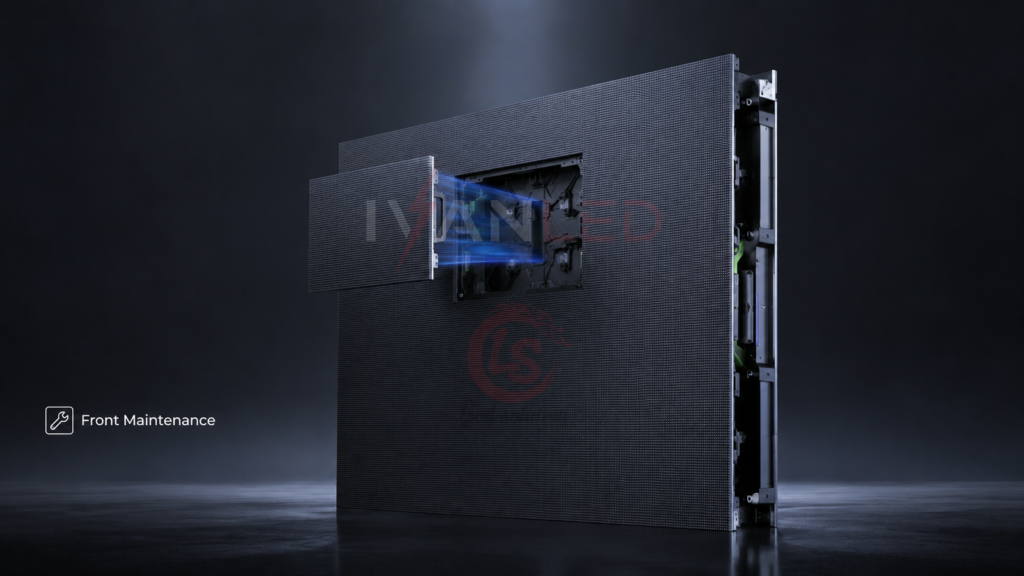
A front-maintenance LED display allows technicians to remove and replace modules, power supplies, and receiving cards directly from the front surface of the screen. This is achieved through magnetic modules, front-accessible locking systems, or specialized extraction tools.
Key applications:
- Wall-mounted indoor displays (retail, lobbies, control rooms)
- In-wall or flush-mounted installations
- Spaces with no rear access (e.g., elevators, corridors, thin walls)
- Rental displays where quick module swaps are needed
Advantages of Front Maintenance
| Advantage | Why It Matters |
| Space-saving design | No rear clearance required — ideal for tight spaces and wall-mounting |
| Quick module replacement | Modules can be swapped from the front in minutes, minimizing downtime |
| Clean aesthetic integration | Allows flush, seamless installation that blends with architecture |
| Flexible installation | Can be installed on any wall without needing a service corridor behind |
Considerations
- Higher upfront cost – Magnetic modules and front-access mechanisms are more expensive to manufacture
- Special tools may be required – Some systems need specific tools for safe module extraction
- Limited rear access – Full system troubleshooting may require more modular disassembly
What Is Rear Maintenance?
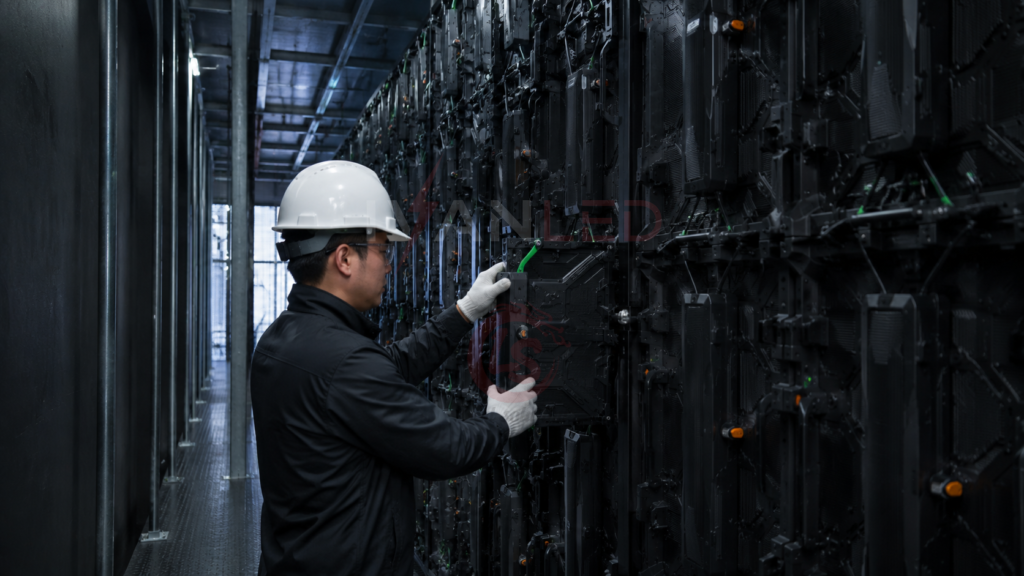
A rear-maintenance LED display requires technicians to access internal components from the back of the screen. This typically involves a catwalk, service platform, or open area behind the display.
Key applications:
- Outdoor billboards and stadium displays
- Large venue screens with rear service corridors
- Rental and staging setups (freestanding on scaffolding)
- Industrial installations with ample rear space
Advantages of Rear Maintenance
| Advantage | Why It Matters |
| Lower initial cost | Simpler cabinet and module design reduces manufacturing cost |
| Proven technology | Long-established standard with familiar servicing procedures |
| Ideal for large outdoor screens | Rear access is easier to provide in open outdoor installations |
| Simpler cabling and power distribution | Rear access allows for easier routing of cables and power supplies |
Considerations
- Requires rear clearance – Needs space behind the screen for service access
- Installation limitations – Cannot be embedded in walls or used in tight spaces
- Potential service delays – If rear access is constrained, maintenance becomes labor-intensive
- Less aesthetic integration – Often requires visible structural supports
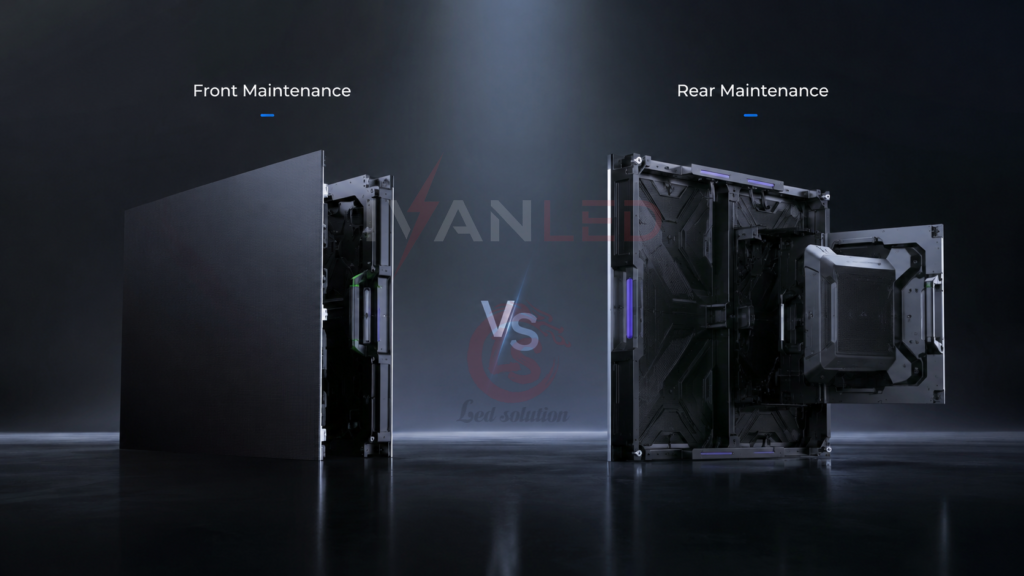
Front Maintenance vs Rear Maintenance: Side-by-Side Comparison
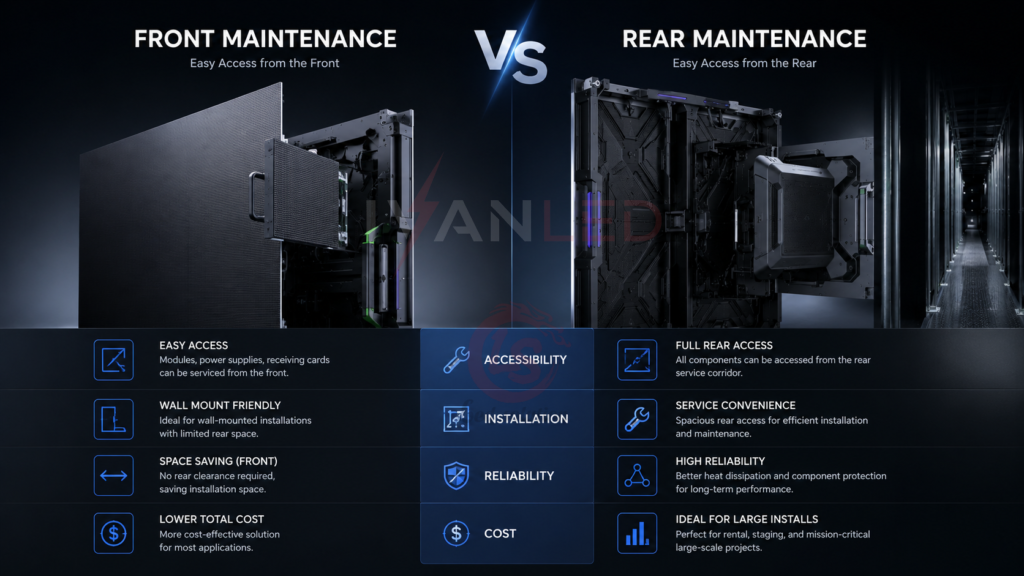
| Comparison Factor | Front Maintenance | Rear Maintenance |
| Access direction | From the front surface | From the back of the display |
| Space requirement | Minimal (no rear clearance needed) | Requires significant rear access |
| Module replacement time | Quick (minutes) | Slower if rear access is constrained |
| Installation flexibility | Wall-mount, embedded, tight spaces | Open-air, freestanding, large venues |
| Initial cost | Higher | Lower |
| Aesthetic integration | High — flush, seamless | Moderate — requires rear structure |
| Common applications | Retail, control rooms, lobbies, studios | Outdoor billboards, stadiums, rental |
How to Choose: Decision Framework for Buyers
Use this step-by-step framework to determine which maintenance type fits your project:
1. Evaluate Your Installation Environment
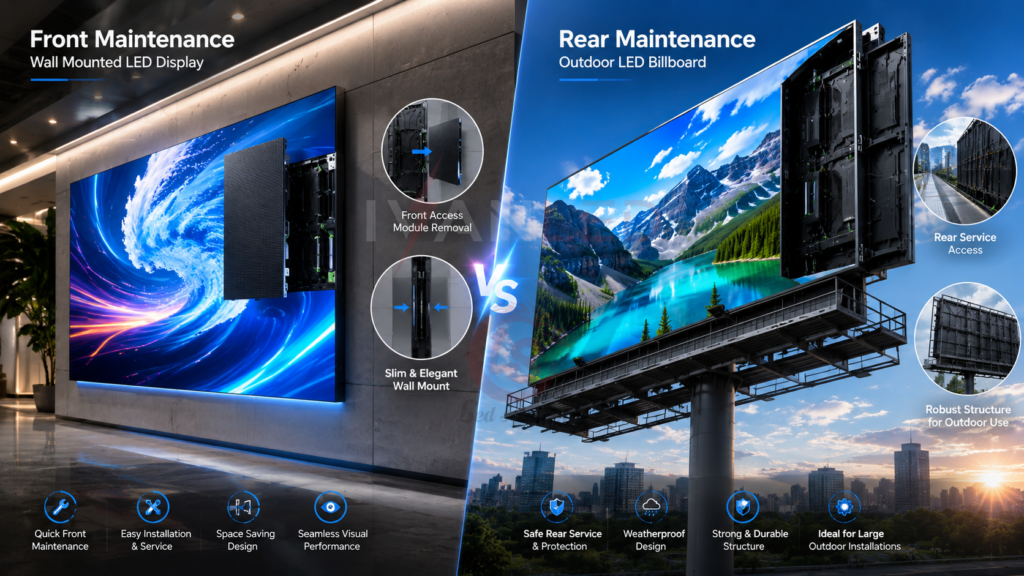
| Condition | Recommended Maintenance |
| Wall-mounted with no rear access | Front maintenance |
| Wall-mounted with rear service corridor | Either (depending on budget) |
| Freestanding with open rear space | Rear maintenance (cost-effective) |
| Embedded / flush-mounted in wall | Front maintenance (mandatory) |
| Outdoor billboard with rear platform | Rear maintenance |
2. Assess Aesthetic Requirements
- Premium retail, corporate lobbies, broadcast studios: Front maintenance is often required for a clean, flush appearance with no visible rear structures.
- Outdoor or industrial settings: Rear maintenance is acceptable as aesthetics are less critical.
3. Consider Long-Term Maintenance Access
- Will service technicians have safe and reliable rear access years from now?
- Are quick repairs critical for uptime-sensitive environments (e.g., control centers, live events)?
- If rear access may be blocked in the future, choose front maintenance.
4. Compare Total Cost of Ownership (TCO)
While front-maintenance displays have higher upfront costs, they can save on installation and long-term service costs in space-constrained environments.
| Cost Factor | Front Maintenance | Rear Maintenance |
| Initial hardware cost | Higher (magnetic modules, front-access mechanisms) | Lower (simpler design) |
| Installation labor | Lower (no rear structure needed) | Higher (requires rear platform/catwalk) |
| Service speed | Faster (front access) | Slower (rear access) |
| Building modification cost | Lower (no rear corridor needed) | Higher (may require structural changes) |
Practical Application Scenarios
| Application | Recommended Maintenance | Why |
| Retail store video wall | Front maintenance | Wall-mounted against showroom wall, zero rear access, sleek design required |
| Control room / command center | Front maintenance | Wall-mounted, mission-critical uptime, quick repairs essential |
| Outdoor billboard | Rear maintenance | Freestanding structure with service platform, cost-sensitive |
| Stadium perimeter display | Rear maintenance | Open rear access via stadium infrastructure, large screen area |
| Corporate lobby display | Front maintenance | Wall-mounted, aesthetic integration is critical, no rear access |
| Rental stage LED wall | Rear maintenance | Freestanding on scaffolding, quick assembly/disassembly priority |
| Broadcast studio background | Front maintenance | Thin studio walls, no rear access, professional appearance |
Common Maintenance Access Mistakes
- Choosing rear maintenance for wall-mounted installations – Without rear access, you cannot service the screen. This is a common and costly mistake.
- Choosing front maintenance for large outdoor screens – Front maintenance adds significant cost for large outdoor displays where rear access is easily provided.
- Not planning for service access in the future – Installing a rear-maintenance screen without a long-term service plan leads to expensive modifications later.
- Assuming all front-maintenance screens are the same – Check if modules are truly front-removable without special tools. Some designs are easier to service than others.
- Forgetting about spare module availability – Both maintenance types require spare modules. Ensure your supplier provides batch-matched spares for either design.
Expert Tips from 10+ Years in LED Manufacturing
Tip 1: If your installation has any chance of rear access being blocked in the future, choose front maintenance.
Rear access can be lost due to future construction, furniture placement, or structural changes. Front maintenance gives you long-term flexibility.
Tip 2: For rental displays, rear maintenance is more cost-effective.
Rental screens are typically set up on scaffolding with rear access. Front maintenance adds cost with little benefit for rental fleets.
Tip 3: Ask about the ease of front module removal.
Not all front-maintenance screens are equal. Some use strong magnets that require tools; others are tool-free. Test a module removal before committing.
Tip 4: Consider your technicians’ safety.
If rear access requires working at height or in confined spaces, front maintenance may be the safer choice for your maintenance team.
Tip 5: Order spare modules (5–10%) at time of purchase.
Whether front or rear maintenance, spares are critical. Modules purchased later from a different batch will have color and brightness mismatch.
Frequently Asked Questions (FAQ)
Q1: Can I choose either front or rear maintenance for any LED display?
Not all LED displays are available in both maintenance types. Smaller pixel pitches (P1.2–P2.5) are often only available in front-maintenance designs due to their thin cabinets. Larger pitch outdoor screens (P4+) are typically rear-maintenance. Always confirm availability with your supplier.
Q2: Is front maintenance more expensive than rear maintenance?
Yes, front-maintenance displays typically cost 10–25% more than rear-maintenance displays due to magnetic module designs, front-access mechanisms, and more complex engineering. However, they can save on installation labor and long-term service costs in space-constrained environments.
Q3: Can I convert a rear-maintenance display to front maintenance later?
No. The maintenance type is determined by the cabinet and module design. Converting a rear-maintenance screen to front maintenance would require replacing the entire cabinet structure — it is not cost-effective. Choose the right maintenance type at the time of purchase.
Q4: How much rear clearance is needed for a rear-maintenance display?
Typically 600–1,000mm (2–3.5 feet) of rear clearance is needed for a technician to access modules, power supplies, and receiving cards. Some designs require more space for full cabinet removal. Confirm with your supplier’s installation manual.
Q5: Does IvanLED offer both front-maintenance and rear-maintenance LED displays?
Yes. IvanLED manufactures both front-maintenance and rear-maintenance displays across a range of pixel pitches. We help buyers choose based on installation environment, budget, and long-term maintenance strategy.
Conclusion: Making the Right Choice
Your decision checklist:
- Do you have rear access? If no → Front maintenance is mandatory
- Is this a wall-mounted or embedded installation? If yes → Front maintenance is recommended
- Is this a large outdoor or freestanding installation? If yes → Rear maintenance is cost-effective
- Are quick repairs critical for your application? If yes → Front maintenance is safer for uptime
- Is your budget constrained? If yes → Rear maintenance saves initial cost
IvanLED’s straightforward advice for 2026:
– For wall-mounted indoor displays, control rooms, and retail installations: Front maintenance is the right choice. It provides flexibility, quick repairs, and clean aesthetics.
– For outdoor billboards, stadium displays, and rental fleets: Rear maintenance is cost-effective and proven.
– If you are unsure about future rear access, choose front maintenance. The upfront premium is worth the insurance.
At IvanLED, we manufacture both maintenance types and provide clear guidance to help you choose based on your specific project constraints.
Ready to specify the right maintenance access for your LED display?
👉 Contact IvanLED with your installation details. We will recommend the best maintenance solution for your project.