






Buyer Pain Points: Why Flexible LED Sourcing Is Challenging
B2B buyers sourcing flexible LED displays face specific challenges:
- Unclear technical specifications – What does “flexible” actually mean? Minimum bending radius? Durability after repeated bending?
- Reliability concerns – Will flexible modules fail faster than rigid ones? What about heat dissipation and waterproofing?
- Application confusion – Which projects actually need flexible displays, and where are rigid panels still the better choice?
- Price volatility – Prices vary wildly depending on material, pixel pitch, and customization. What is a reasonable budget?
- Supplier capability – Not all suppliers can deliver truly flexible, high-quality modules that last.
At IvanLED, we manufacture flexible LED displays with proven durability, clear technical specs, and full customization support — from design to installation.
What Is a Flexible LED Display?
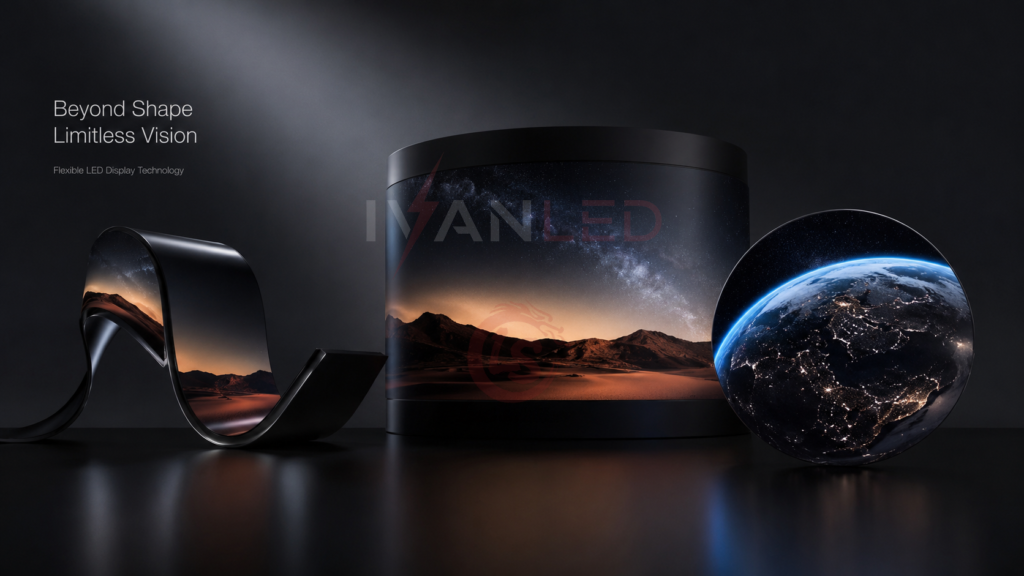
A flexible LED display (also called soft LED module) uses a specialized flexible circuit board (FPC — Flexible Printed Circuit) instead of a rigid PCB. This allows the module to bend, curve, and conform to non-flat surfaces without damaging the LEDs or solder joints.
Key characteristics:
- Can achieve concave, convex, cylindrical, spherical, and wavy shapes
- Modules are lightweight and thin (typically 5–15mm thick)
- Can be customized to specific radii of curvature
- Maintains high brightness and color uniformity even when bent
Important distinction: Flexible LED displays are direct-view LED products, not flexible LCD or OLED. The LEDs themselves emit light directly to the viewer.
Technical Deep Dive: What Makes an LED Display Flexible?
Core Components
| Component | Standard Rigid LED | Flexible LED |
| Circuit board | FR4 rigid PCB | FPC (Flexible Printed Circuit) or polyimide |
| LED encapsulation | SMD (hard epoxy) | SMD with flexible silicone or COB |
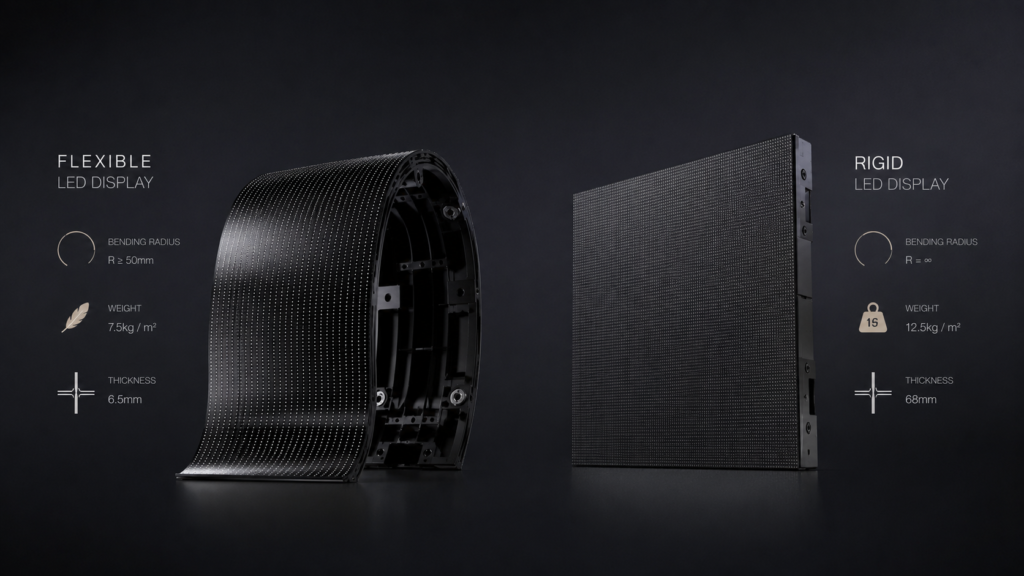
| Module thickness | 15–50mm | 5–15mm |
| Minimum bending radius | Not applicable (rigid) | 50–150mm (depending on pixel pitch) |
| Weight per m² | 15–25kg | 5–12kg |
Common Flexible Materials
| Material | Properties | Best For |
| FPC (Polyimide) | High heat resistance, excellent flexibility, durable | Indoor permanent installations, high-performance applications |
| PET film | Cost-effective, moderate flexibility, lower heat tolerance | Budget projects, short-term displays |
| Silicone encapsulation | Water-resistant, highly flexible, impact-absorbing | Outdoor or semi-outdoor curved displays, rental |
Flexible vs. Rigid LED Displays: Key Differences
| Comparison Factor | Rigid LED Display | Flexible LED Display |
| Shape capability | Flat only | Curved, cylindrical, spherical, wavy, custom |
| Minimum bending radius | N/A | 50–150mm (typical) |
| Installation surface | Flat wall, flat ground | Columns, curved walls, ceilings, uneven surfaces |
| Weight per m² | 15–25kg | 5–12kg (lighter, easier mounting) |
| Module thickness | 15–50mm | 5–15mm (less intrusive) |
| Durability (impact) | Moderate (rigid but can crack) | High (flexes under impact, less brittle) |
| Heat dissipation | Better (metal backing) | Requires design attention (FPC less conductive) |
| Cost per m² (comparable pitch) | Baseline (1x) | 1.5–3x depending on customization |
| Typical pixel pitch range | P1.5 – P10+ | P2.5 – P8 (finer pitches more difficult) |
What Shapes Can a Flexible LED Display Create?
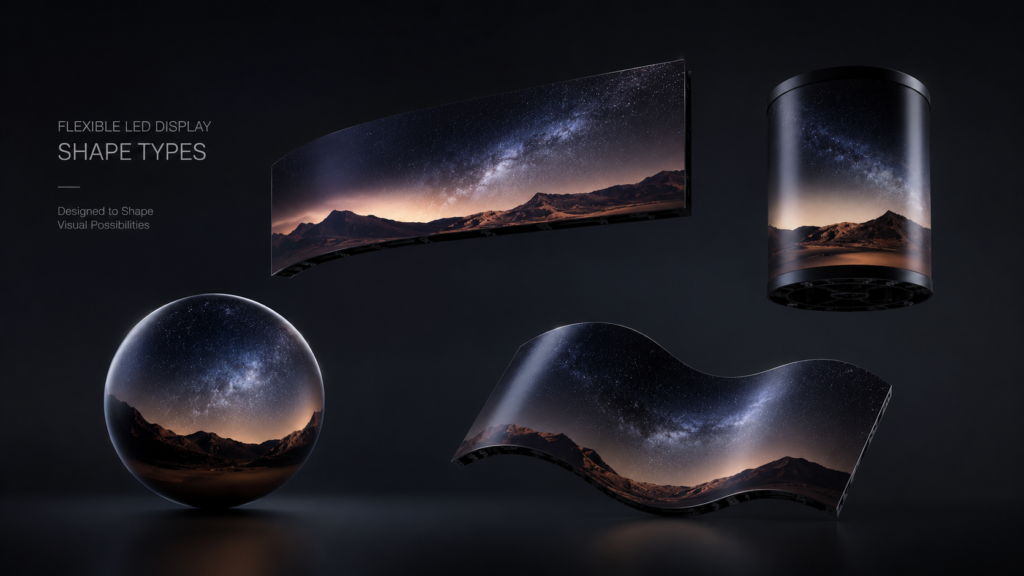
1. Curved (Concave or Convex)
The most common application. Creates a smooth arc that wraps around a surface. Used for architectural features, stage backdrops, and immersive brand walls. Can be designed to any radius down to approximately 100mm for indoor modules.
2. Cylindrical
Wraps fully around a column or pillar. Common in shopping malls, hotel lobbies, and trade show booths. Viewers can see the display from 360 degrees. Requires careful engineering to ensure seam alignment.
3. Spherical
Creates a full sphere or globe display. Used for high-impact brand installations, museum exhibits, and interactive art. Complex to design and manufacture; requires custom cabinet shapes and specialized control systems.
4. Wavy / Undulating
A non-linear, flowing shape that creates a sense of motion even with static content. Used for creative architectural installations, retail flagship stores, and entertainment venues. The wavy pattern is achieved by mounting flexible modules on a contoured substructure.
5. Irregular / Custom
Any shape — pentagon, trapezoid, ring, teardrop, etc. Modules are cut or arranged to fit the exact design. Ideal for branded environments, art installations, and themed entertainment.
Application Scenarios: Where Does Flexible LED Make Sense?
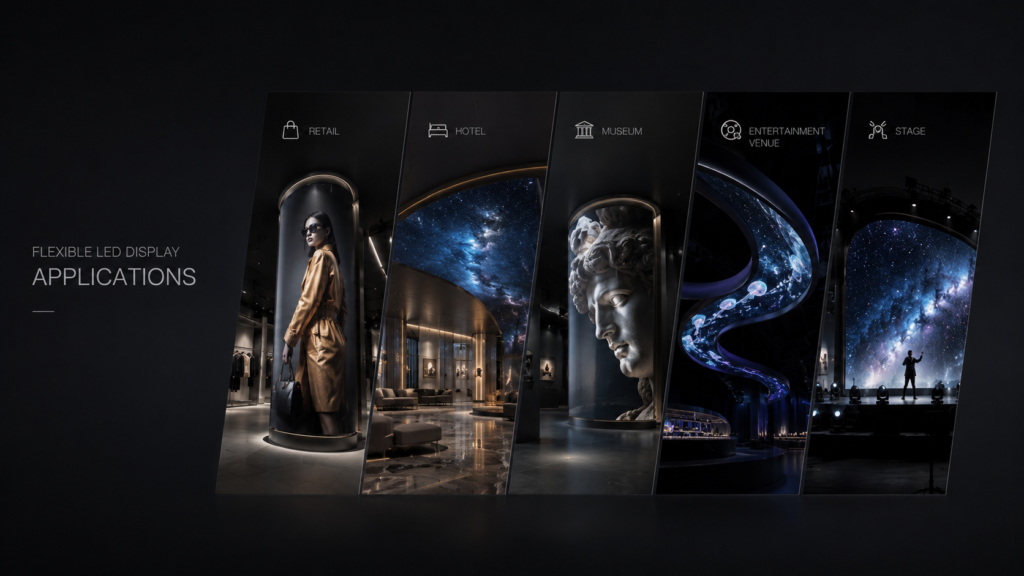
| Application | Why Flexible LED Is Recommended | Typical Shape |
| Retail / shopping mall | Attracts attention, creates immersive brand experience, fits around columns | Cylindrical, curved, wavy |
| Hotel / hospitality | Enhances lobby aesthetics, wraps around architectural features, high-end feel | Cylindrical, curved |
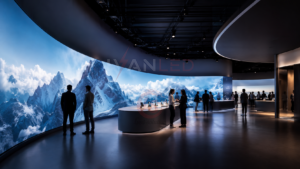
| Museum / exhibition | Creates dynamic, engaging exhibits, fits irregular spaces, immersive storytelling | Spherical, curved, wavy, custom |
| Entertainment venue / bar | Renders atmosphere, wraps around pillars or ceilings, high visual impact | Cylindrical, curved, wavy |
| Stage / event design | Custom backdrops, flowing shapes, unique visual identity | Curved, wavy, custom |
| Corporate lobby / headquarters | Brand statement piece, fits modern architecture, non-intrusive thin profile | Curved, wavy |
| Trade show booth | Creates differentiation, fits booth geometry, lightweight for transport | Curved, custom |
When Should You NOT Choose a Flexible LED Display?
- Very fine pixel pitch (P1.5 or smaller) – Flexible modules with extremely fine pitch are difficult to manufacture and maintain. Rigid panels are more reliable for high-density indoor applications.
- Outdoor direct sunlight – Most flexible displays have lower maximum brightness (1,500–3,000 nits) compared to outdoor rigid displays (5,000+ nits). For direct sunlight, rigid is better.
- High-heat environments – FPC materials dissipate heat less efficiently than aluminum-clad rigid PCBs. For hot climates or unventilated spaces, rigid may be more reliable.
- Applications where the screen will be frequently rolled/unrolled – While flexible modules are durable, repeated flexing (thousands of cycles) can eventually cause solder joint fatigue. For portable rental applications, consider specialized rollable displays.
- Budget-constrained projects – Flexible displays cost 50–200% more than rigid equivalents for the same pixel pitch. If the shape does not require flexibility, save your budget.
Factors Affecting Flexible LED Display Price
1. Pixel Pitch
Smaller pixel pitch = higher density = significantly higher cost. For flexible displays, finer pitch also increases manufacturing difficulty.
2. Material Quality
FPC polyimide vs. PET film. Polyimide is more expensive but offers better heat resistance, flexibility, and durability.
3. Shape Complexity
Simple curved (one-axis bend) is least expensive. Cylindrical (full wrap) adds cost. Spherical or complex custom shapes are most expensive due to engineering and specialized tooling.
4. Customization Degree
Standard curved modules are more affordable. Fully custom shapes (trapezoid, pentagon, etc.) require custom module sizes and layouts, increasing cost by 50–100% or more.
5. IP Rating (Protection)
Indoor flexible displays (IP20–IP40) are baseline. Outdoor or semi-outdoor with IP54–IP65 adds 20–40% for silicone encapsulation and sealed connectors.
6. Quantity
Small projects under 10m² have higher per-square-meter cost due to setup and engineering. Larger projects (50m²+) reduce unit cost.
Budget estimate (2026): Flexible LED displays typically range from $1,200 – $3,500 per m² depending on the factors above. Simple curved P3.9 indoor might start around $1,200–$1,800/m². Complex spherical or fine-pitch custom shapes can exceed $3,000–$5,000/m².
Common Mistakes When Buying Flexible LED Displays
- Underestimating engineering requirements – Flexible modules are only one part. The substructure, mounting system, and curvature tolerances must be precisely engineered. Many buyers forget this.
- Assuming all flexible modules are the same – Minimum bending radius varies significantly by manufacturer and pixel pitch. Always ask for the spec.
- Ignoring seam alignment – On cylindrical or spherical displays, seams between modules are more visible than on flat screens. Ask about how your supplier handles seam matching.
- Not testing with actual content – Curved and cylindrical screens have distorted viewing angles at the edges. Test your content on a curved sample before finalizing design.
- Forgetting about maintenance access – Installing a flexible display around a column may make rear access impossible. Plan for front-access maintenance.
Expert Tips from 10+ Years in LED Manufacturing
Tip 1: Always ask for the minimum bending radius in writing.
Some suppliers claim “flexible” but their modules cannot bend below 300mm. For columns or tight curves, you may need 100mm or less. Get the number before ordering.
Tip 2: For cylindrical displays, request a seam map.
A good supplier will provide a detailed drawing showing exactly where each module connects and how seams will be minimized. Avoid suppliers who cannot provide this.
Tip 3: Consider GOB or COB for durability.
Flexible displays with exposed SMD LEDs can be damaged during installation. GOB (Glue on Board) or COB encapsulation adds protection and makes cleaning easier — worth the premium for accessible installations.
Tip 4: Plan for front access.
When wrapping a column or curved wall, rear access may be impossible. Ensure your modules can be removed and serviced from the front. Not all flexible displays support front maintenance.
Tip 5: Order spare modules — at least 10%.
Flexible modules are often produced in batches. If you need a replacement module two years later, color and curvature may not match. Spare modules are cheap insurance.
Frequently Asked Questions (FAQ)
Q1: What is the smallest pixel pitch available for flexible LED displays?
Most flexible LED displays are available from P1.5 to P8. P1.5–P2.5 is possible but more expensive and requires careful engineering. For very fine pitch applications (P1.2 or smaller), rigid panels are generally more reliable and cost-effective.
Q2: Can flexible LED displays be used outdoors?
Yes, but with limitations. Outdoor flexible displays require IP54–IP65 protection (silicone encapsulation, sealed connectors) and sufficient brightness (3,000+ nits). Not all flexible displays are rated for outdoor use — confirm with your supplier. For high-brightness direct sunlight applications, rigid displays are still superior.
Q3: How durable are flexible LED displays? Do they break easily?
High-quality flexible displays (using FPC and quality solder joints) are quite durable for stationary installations. They can withstand the bending required for installation and then remain stable. However, they are not designed for frequent rolling/unrolling (portable rental). For applications requiring repeated flexing, ask for specialized rollable display products.
Q4: How do I mount a flexible LED display on a curved wall or column?
Flexible modules are mounted on a custom steel or aluminum substructure that matches the desired curvature. The substructure is attached to the wall or column first. Then flexible modules are attached using magnets, clips, or screws. For cylindrical displays, the substructure is often a fabricated steel cylinder or framework. Your supplier should provide engineering drawings for the substructure.
Q5: How much does a flexible LED display cost per square meter in 2026?
Prices vary widely based on pixel pitch, material, shape complexity, and customization. Typical ranges: Simple curved indoor P3.9: $1,200–$1,800/m². Cylindrical or tighter curves: $1,800–$2,800/m². Spherical or complex custom shapes: $2,500–$5,000+/m². Always request a detailed quote with engineering and mounting costs included.
Q6: Does IvanLED offer flexible LED displays with full customization?
Yes. IvanLED manufactures flexible LED displays in custom shapes, curvatures, and pixel pitches. We provide full engineering support, including substructure design, seam mapping, and installation guidance. Contact us with your project requirements for a custom quote.
Conclusion: Is a Flexible LED Display Right for Your Project?
Your decision flowchart:
- Does your project require a curved, cylindrical, or custom shape?
- No → A standard rigid LED display is more cost-effective.
- Yes → Flexible LED is the right solution.
- What is the minimum bending radius needed?
- Under 100mm → Confirm supplier capability; not all can achieve tight bends.
- Over 100mm → Most flexible displays can handle this.
- Will the display be used outdoors or in direct sunlight?
- Yes → Confirm IP rating and brightness (minimum 3,000 nits, IP54+).
- No → Indoor flexible is fine.
- Do you have a custom content plan?
- Yes → Proceed. Flexible displays shine with purpose-built content.
- No → Consider whether the investment in custom shape is justified without custom content.
IvanLED’s straightforward advice for 2026:
– Flexible LED displays are powerful tools for creating unique, attention-grabbing installations — but they are not for every project.
– For columns, curved walls, and creative architectural features: Flexible LED delivers what rigid cannot.
– For standard flat signage or budget-constrained projects: Rigid LED is still the better choice.
– Always prioritize engineering support and seam quality over the lowest price.
At IvanLED, we provide transparent specifications, engineering drawings, and full customization support for flexible LED displays. No over-promising — just reliable, high-quality products that match your creative vision.
Ready to bring your curved or custom LED project to life?
👉 Contact IvanLED with your shape requirements, dimensions, and pixel pitch preferences for a free feasibility assessment and quote.