









Buyer Pain Points: Technology Confusion in LED Procurement
B2B buyers face specific challenges when choosing between Full Array SMD and Mini LED:
Is Mini LED really better than SMD? For close viewing (under 2 meters) in controlled lighting, yes — Mini LED offers superior contrast, durability, and image quality. For most commercial applications with viewing distances over 3 meters, SMD is visually indistinguishable and far more cost-effective.
How much more does Mini LED cost? Mini LED direct view typically costs 1.5-2.5x more than traditional SMD for comparable pixel pitch. A 10m² P1.2 screen in SMD costs $20,000–$30,000; Mini LED COB costs $35,000–$60,000+.
Is Mini LED more durable? Yes. Mini LED COB displays have a seamless epoxy-coated surface that protects against dust, moisture, and physical impact — significantly more durable than exposed SMD LEDs.
Can Mini LED be used outdoors? Generally no. Mini LED direct view has lower maximum brightness (2,000–3,000 nits) compared to outdoor SMD (5,000–6,000+ nits). For direct sunlight, SMD is the right choice.
What about Mini LED backlight vs direct view? They are completely different products. Mini LED backlight is for LCD TVs; Mini LED direct view is a self-emitting display technology. Ensure your supplier is quoting the correct technology.
What Are Full Array SMD and Mini LED for Direct View?
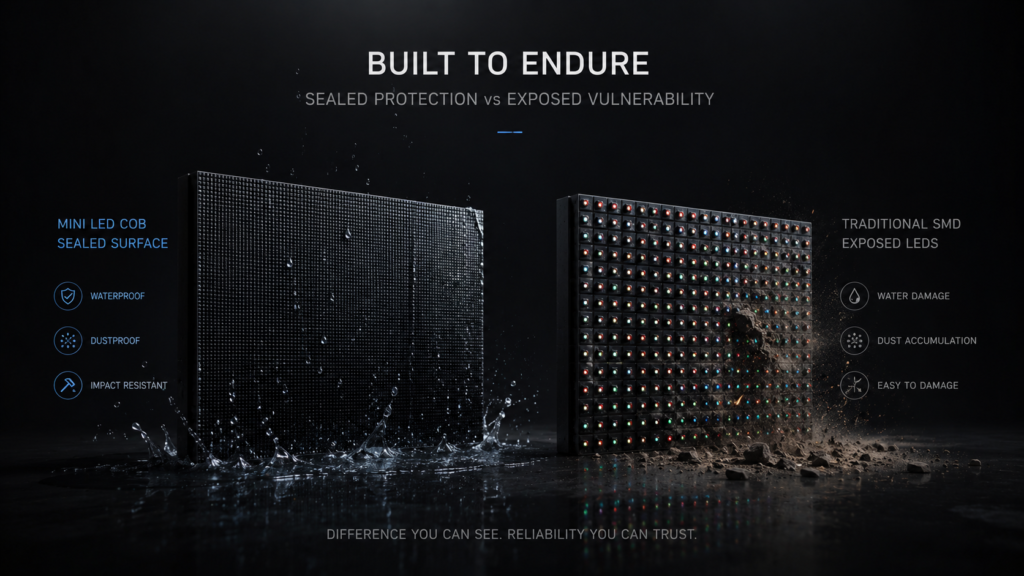
Full Array SMD is the traditional LED display technology where individual RGB chips are packaged together and mounted on a circuit board. Mini LED direct view uses significantly smaller LED chips (50–200μm) with COB (Chip on Board) or advanced SMD packaging.
Key characteristics:
- Full Array SMD: Pixel pitch P1.5–P10+, viewing distance 2–10+ meters, standard commercial quality
- Mini LED Direct View: Pixel pitch P0.4–P1.5, viewing distance 0.5–2 meters, premium image quality
Important distinction: This guide compares direct view LED technologies, not LCD backlights. Mini LED as a backlight for TV is a completely different product category.
For more on LED packaging technologies, see our COB vs CSP comparison guide.
Full Array SMD vs Mini LED: Key Differences
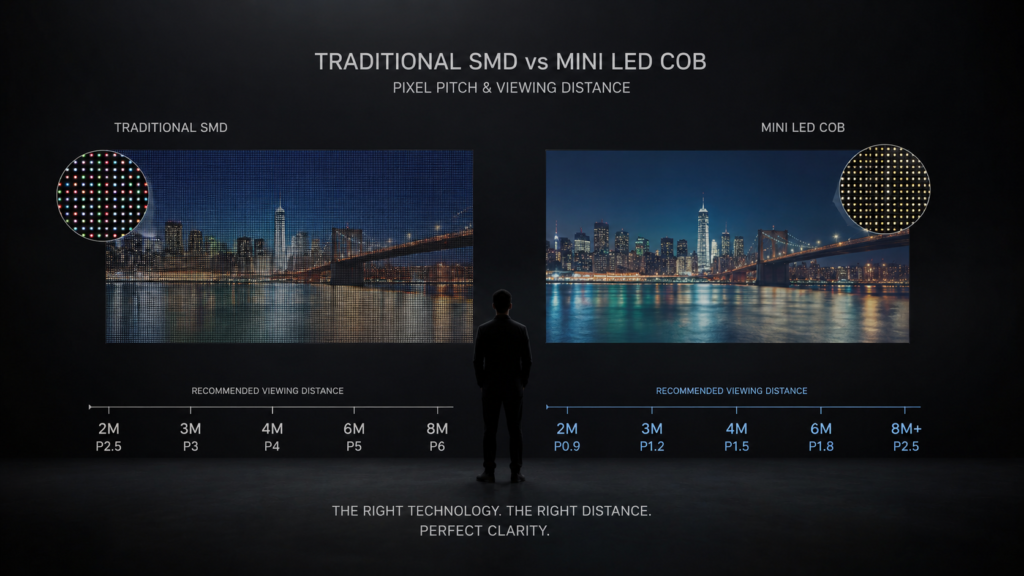
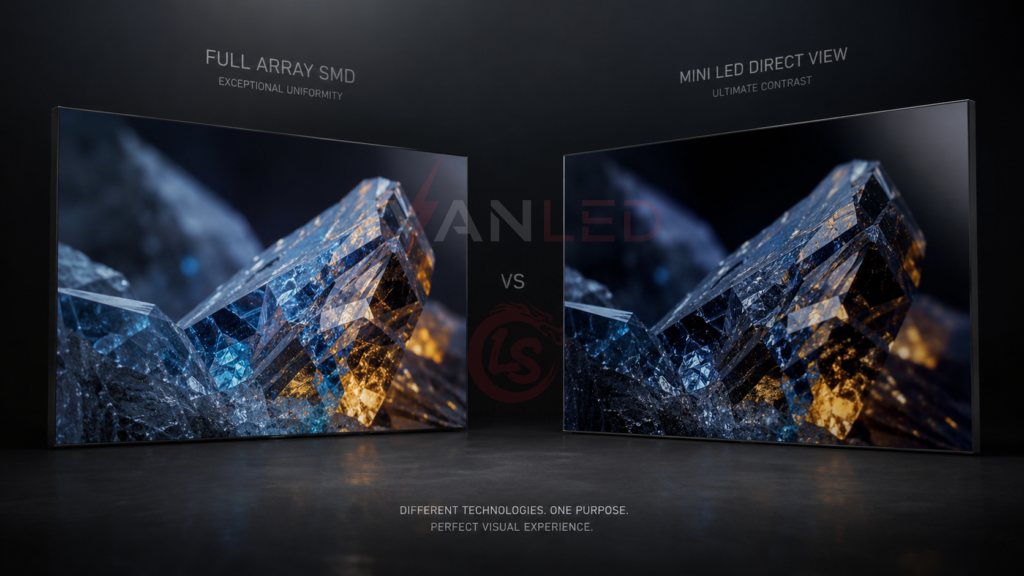
The key differences between Full Array SMD and Mini LED direct view are pixel pitch (resolution), brightness, durability, and cost. Mini LED offers finer pixels and better protection but at a significant price premium.
| Factor | Full Array SMD | Mini LED Direct View |
| Typical pixel pitch | P1.5 – P10+ | P0.4 – P1.5 |
| Minimum viewing distance | 2 – 10+ meters | 0.5 – 2 meters |
| Pixel density (P1.2 equivalent) | ~694,000/m² | ~1,230,000/m² |
| Typical brightness | 800 – 6,000+ nits | 1,000 – 3,000 nits |
| Contrast ratio | 3,000:1 – 10,000:1 | 10,000:1 – 1,000,000:1 |
| Durability (IP rating) | IP20 – IP43 | IP54 – IP65 |
| Impact resistance | Moderate (exposed LEDs) | High (epoxy-coated surface) |
| Relative cost (10m² P1.2) | $20,000 – $30,000 | $35,000 – $60,000+ |
| Best for | Digital signage, outdoor, events | Control rooms, luxury retail, broadcast |
For more on indoor vs outdoor considerations, see our indoor vs outdoor LED display guide.
When Does Mini LED Make Sense?
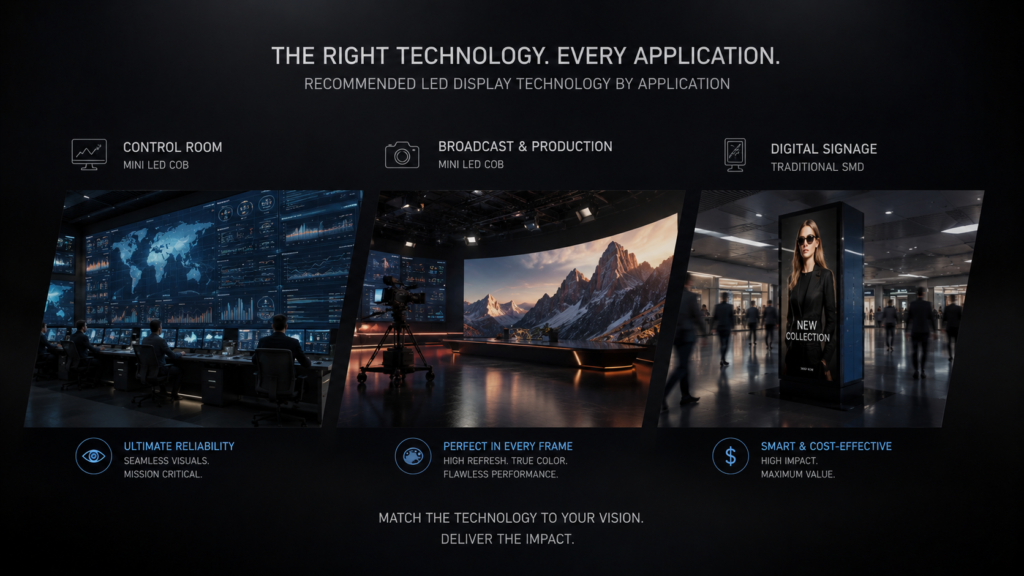
Mini LED direct view makes sense in three specific scenarios: close viewing (under 2 meters), controlled lighting environments, and applications where durability is critical.
Consider Mini LED for:
- Control rooms and command centers: Operators sit close to the screen, need sharp text and deep blacks
- Broadcast studios and virtual production: Camera recording demands no flicker, high contrast, and excellent color uniformity
- Luxury retail and showrooms: Close customer viewing, premium brand image required
- Medical imaging and simulation: Fine detail required with close viewing
When Does Full Array SMD Make Sense?
Full Array SMD is the practical choice for most commercial LED display projects, delivering excellent image quality at a fraction of the cost of Mini LED.
Choose SMD for:
- Digital signage (malls, airports, retail): Viewing distances typically over 2 meters
- Outdoor billboards: High brightness needed, long viewing distance
- Churches and worship centers: First row often 4-8 meters away
- Trade shows and event rental: Durability and weight matter more than pixel density
Cost Comparison: SMD vs Mini LED
Mini LED direct view typically costs 1.5-2.5x more than traditional SMD for comparable pixel pitch, with additional costs for controllers and processing.
Cost breakdown for a 10m² P1.2 screen:
- Full Array SMD: $20,000 – $30,000 for hardware; $5,000 – $10,000 for controllers; total $25,000 – $40,000
- Mini LED COB: $35,000 – $60,000+ for hardware; $8,000 – $15,000 for controllers; total $43,000 – $75,000+
For a complete LED display price guide 2026, see our detailed breakdown.
Common Mistakes When Choosing Between SMD and Mini LED
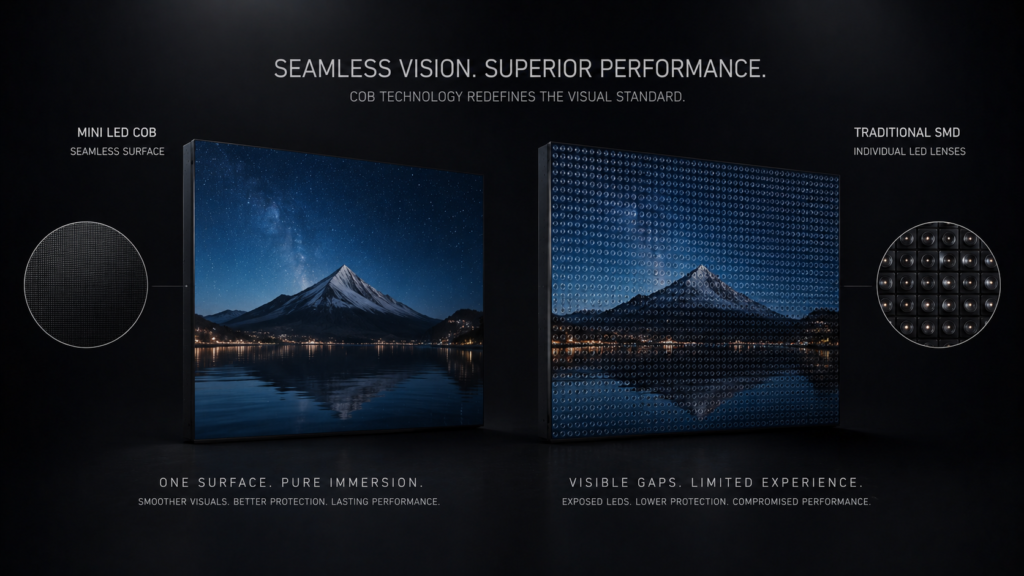
The most common mistake is choosing Mini LED for long viewing distances. At 5+ meters, the human eye cannot distinguish Mini LED from traditional SMD. You are paying 2x for zero visible benefit.
Other frequent errors:
- Buying SMD for close-up viewing (under 1.5m): Pixels will be visible, text will look jagged. Pay for Mini LED COB if viewers are very close.
- Confusing Mini LED backlight with Mini LED direct view: They are completely different products. Ensure your supplier is quoting the correct technology.
- Ignoring reliability needs for rental: For screens moved frequently, Mini LED COB’s impact resistance is worth the premium.
- Not testing with actual content: Always view both technologies at your intended viewing distance with your typical content before purchasing.
Expert Tips for Buyers
Tip 1: Calculate your actual viewing distance before deciding.
Measure the distance from the screen to the closest viewer. If it is over 2.5 meters, traditional SMD is almost always sufficient. Mini LED only makes sense for distances under 2 meters.
Tip 2: For outdoor applications, avoid Mini LED direct view.
Mini LED direct view typically has lower maximum brightness (2,000–3,000 nits) compared to traditional SMD (5,000–6,000+ nits). For direct sunlight, SMD is the right choice.
Tip 3: For control rooms, demand COB (Mini LED).
The superior contrast, deeper blacks, and 24/7 reliability of COB justify the premium. Avoid traditional SMD for mission-critical, close-viewing environments.
Tip 4: Ask for a side-by-side demo.
Reputable suppliers will show you both technologies with the same content at the intended viewing distance. If the difference is invisible, save your budget.
Tip 5: Consider GOB as a mid-ground option.
If you need durability (rental, high-traffic) but cannot afford Mini LED COB, GOB (Glue on Board) SMD offers 70% of the protection at 50% of the premium.
Frequently Asked Questions (FAQ)
What is the difference between Full Array SMD and Mini LED direct view?
Full Array SMD uses traditional-sized LED chips (P1.5–P10+) and is standard for most commercial LED displays. Mini LED direct view uses much smaller chips (P0.4–P1.5) with higher pixel density, enabling closer viewing distances and superior contrast, but at significantly higher cost.
Is Mini LED direct view better than traditional SMD?
For close viewing (<2 meters) in controlled lighting environments, yes — Mini LED offers superior image quality, contrast, and reliability. For most commercial applications with viewing distances over 3 meters, traditional SMD is cost-effective and visually indistinguishable.
How much more does Mini LED direct view cost than traditional SMD?
For comparable pixel pitch, Mini LED COB typically costs 1.5-2.5x more than traditional SMD. For a 10m² screen, traditional SMD might cost $20,000–$30,000 while Mini LED COB costs $35,000–$60,000+. Controllers and processing add another 20–40%.
Is Mini LED more durable than traditional SMD?
Yes. Mini LED COB displays have an epoxy-coated seamless surface that protects against dust, moisture, and physical impact. Traditional SMD has exposed LEDs that can be knocked off. For rental, interactive floors, or high-traffic areas, Mini LED COB is significantly more durable.
Can I use Mini LED direct view outdoors?
Generally no. Most Mini LED direct view products have lower maximum brightness (2,000–3,000 nits) compared to outdoor traditional SMD (5,000–6,000+ nits). For direct sunlight visibility, traditional SMD is the correct choice. Mini LED is designed for indoor, controlled-lighting environments.
Does IvanLED offer both Full Array SMD and Mini LED direct view displays?
Yes. We manufacture traditional SMD displays (P1.5–P10+) for commercial applications, and Mini LED COB displays (P0.4–P1.5) for premium, close-viewing environments.
Conclusion: Full Array or Mini LED?
Choosing between Full Array SMD and Mini LED direct view comes down to three factors: viewing distance, environment, and budget.
Our straightforward advice:
– For 80% of commercial LED applications (digital signage, outdoor, churches, events, trade shows): Traditional Full Array SMD is cost-effective and visually sufficient.
– For control rooms, broadcast studios, virtual production, and luxury retail with viewing distances under 2 meters: Mini LED direct view provides superior image quality and reliability.
– When in doubt, test both at the intended viewing distance. The difference may be invisible — or critical.
– Consider GOB SMD as a mid-ground option if you need durability but cannot afford Mini LED COB.
At IvanLED, we provide transparent technology recommendations based on your actual application, viewing distance, and budget — not just the latest buzzword. Browse our commercial LED display solutions or contact us to discuss your project requirements.
Ready to specify the right display technology for your project?
👉 Contact IvanLED with your application and viewing distance for a free recommendation.