









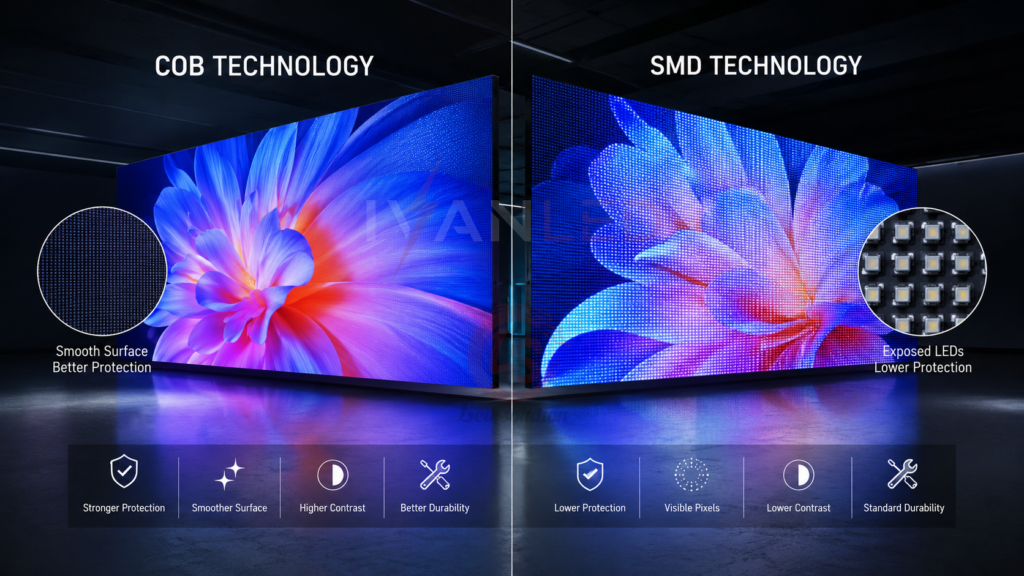
Buyer Pain Points: COB Technology Confusion
Distributors and buyers face specific challenges when evaluating COB technology:
Is COB really worth the premium price? COB displays typically cost 2-3x more than SMD at the same pixel pitch. The premium pays for better image quality, higher durability, wider viewing angles, and lower failure rates.
What applications actually need COB? COB is ideal for close-viewing indoor applications where image quality and durability matter — corporate lobbies, luxury retail, control rooms, museums, and interactive displays.
How reliable is COB compared to SMD? COB has dramatically lower failure rates — approximately 0.5-1 PPM compared to SMD’s 10-50 PPM. Fewer solder joints (90% fewer) means fewer points of failure.
Is COB difficult to repair? While COB modules cost more upfront, they fail less often. When repair is needed, the entire module is replaced — similar to SMD. The lower failure rate means fewer repairs over time.
Can COB be used outdoors? COB typically has lower brightness (1,000-1,500 nits) than outdoor SMD (4,000-6,000+ nits). For shaded outdoor areas, COB works. For direct sunlight, use high-brightness SMD.
What Is COB Technology?
COB (Chip on Board) is an advanced LED packaging technology where multiple LED chips are directly bonded onto a circuit board and covered with a single protective epoxy layer. This creates a seamless, durable display surface with no visible individual LEDs.
How it works:
- Traditional SMD mounts each LED chip in its own plastic housing
- COB places multiple LED chips directly on the board
- A uniform epoxy coating covers all chips at once
- If SMD is like many small light bulbs, COB is like a continuous sheet of light
Key characteristics:
- Seamless, smooth surface with no visible gaps
- Superior protection against moisture, dust, and impact
- Excellent color consistency and uniformity
- Pixel pitches from P0.9 to P2.5
- Typical brightness up to 1,500 nits
- 178° viewing angle
COB is widely used in control rooms, broadcast studios, luxury retail, corporate lobbies, museums, and interactive displays.
COB vs SMD: The Key Differences
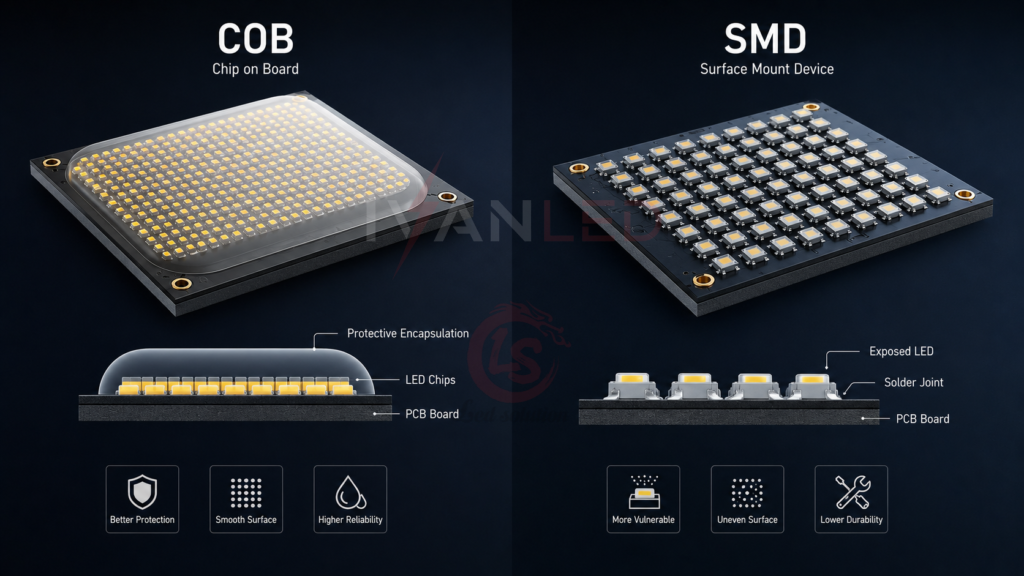
The key difference between COB and SMD is that COB encapsulates all LED chips in a single, seamless epoxy layer, while SMD mounts each LED chip in its own individual plastic housing.
| Feature | COB (Chip on Board) | SMD (Surface Mount Device) |
| Protection | Excellent (epoxy coating) | Moderate (plastic housing) |
| Viewing angle | 170-180° | 140-160° |
| Pixel pitch range | P0.9 – P2.5 | P1.5 – P10+ |
| Durability | High (impact resistant) | Moderate |
| Heat dissipation | Excellent | Moderate |
| Brightness | Up to 1,500 nits | 1,000 – 6,000+ nits |
| Lamp failure rate | 0.5-1 PPM | 10-50 PPM |
| Relative cost | 2-3x higher | Lower to moderate |
| Best for | Close viewing, indoor, high-end | Distance viewing, outdoor, budget |
5 Key Benefits of COB Technology
1. Superior Protection
COB displays are covered by a solid epoxy layer. This means water resistant (can withstand moisture), dust proof (no dust between LEDs), impact resistant (bumps and touches won’t damage individual chips), and easy to clean (smooth surface, no crevices).
Best for: Interactive floors, museum touch walls, rental screens, high-traffic areas.
2. Wider Viewing Angle
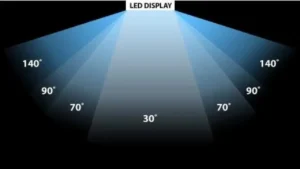
COB displays maintain color and brightness from almost any angle. At 80° from center, SMD drops to 50-60% while COB maintains 80-90%. At 170°, SMD shows poor color shift while COB remains visible.
Best for: Corporate lobbies, conference rooms, retail displays where people walk past from many directions.
3. Better Image Quality
Because COB creates a continuous light surface, it delivers higher contrast (deeper blacks, more vivid colors), uniform brightness (no “mosaic” or “grid” effect), and smoother visuals — ideal for close-up viewing.
Best for: Luxury retail, control rooms, broadcast studios, fine art displays.
4. Higher Reliability
A 2m x 1.5m SMD screen has about 10,000-50,000 solder joints. COB has 90% fewer failure points. The result: COB displays have dramatically lower failure rates and longer operational life.
Best for: 24/7 operation, critical installations, rental fleets.
5. Better Heat Dissipation
COB chips are mounted directly on the circuit board, allowing heat to dissipate more efficiently. COB displays run cooler than SMD at the same brightness, resulting in longer lifespan and reduced thermal stress on components.
Best for: Long-term installations, high-uptime environments, hot climates.
When to Choose COB vs SMD
Your choice between COB and SMD depends on five key factors: viewing distance, environment, image quality requirements, reliability needs, and budget.
Choose COB if:
- Viewing distance is under 2 meters (no visible individual pixels)
- People will touch the screen (impact resistant)
- You need 24/7 reliability (lower failure rate)
- Image quality is critical (better contrast and uniformity)
- You have a higher budget (premium technology)
Choose SMD if:
- Viewing distance is over 3 meters (pixels not visible anyway)
- Outdoor installation (higher brightness needed, 4,000-6,000+ nits)
- Budget is tight (lower upfront cost)
- Content is basic video/images (SMD is sufficient)
For a complete indoor vs outdoor LED display comparison, see our detailed guide.
Application Guide: Where COB Excels
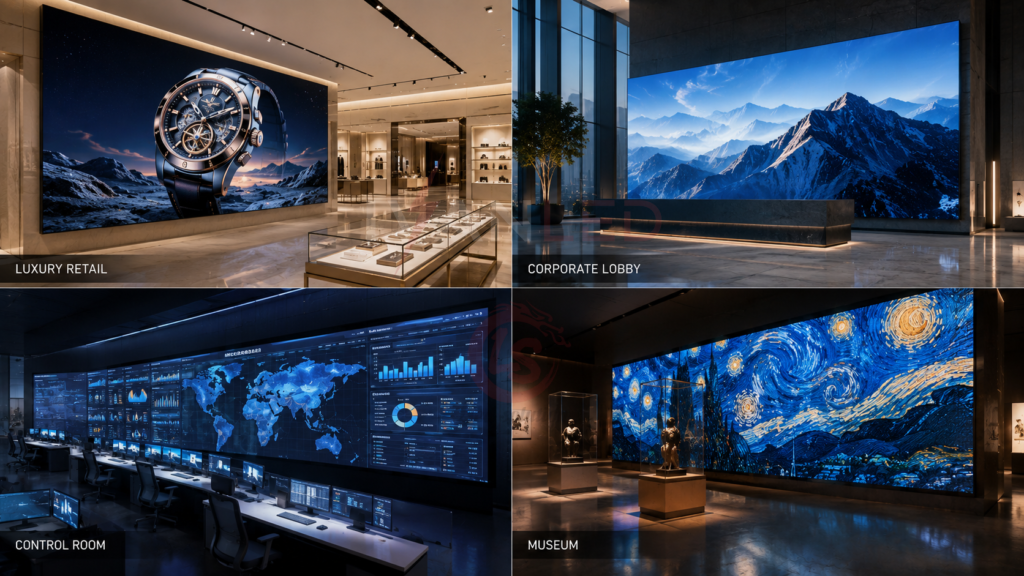
| Application | Why COB | Recommended Pitch |
| Luxury retail (close viewing) | Image quality, protection | P1.2 – P1.5 |
| Corporate lobby | Professional look, wide angle | P1.5 – P1.9 |
| Control room | 24/7 reliability, eye comfort | P0.9 – P1.5 |
| Museum interactive wall | Touch-safe, durable | P1.2 – P1.9 |
| Conference room | Text clarity, wide viewing | P1.5 – P1.9 |
| Broadcast studio | Color accuracy, camera-friendly | P0.9 – P1.2 |
Cost and Technical Specifications
COB displays typically cost 2-3x more than SMD at similar pixel pitch. The premium pays for better image quality, higher durability, wider viewing angles, and lower failure rates.
| Specification | COB P1.5 | COB P1.9 | SMD P2.5 |
| Pixel pitch | 1.5mm | 1.9mm | 2.5mm |
| Min viewing distance | 1.5m | 1.9m | 2.5m |
| Brightness | 1,000 nits | 1,200 nits | 1,500 nits |
| Viewing angle | 178° | 178° | 160° |
| Refresh rate | 3,840 Hz | 3,840 Hz | 1,920-3,840 Hz |
| IP rating (front) | IP65 | IP65 | IP20-IP40 |
| Price per m² (ref) | $2,000 – $3,500 | $1,500 – $2,500 | $800 – $1,200 |
For a complete LED display price guide 2026, see our detailed breakdown.
Expert Tips for Distributors
Tip 1: Position COB as a premium product.
COB’s higher price point means higher margins per unit. Position it for clients who value image quality, durability, and reliability — not for budget-conscious buyers.
Tip 2: Focus on close-viewing applications.
COB’s advantage is most visible in applications where viewers stand under 2 meters from the screen. Corporate lobbies, luxury retail, and control rooms are ideal targets.
Tip 3: Educate clients on total cost of ownership.
While COB costs more upfront, lower failure rates and reduced maintenance mean lower total cost over 5-10 years. Use the failure rate data (0.5-1 PPM vs 10-50 PPM) to make your case.
Tip 4: Test with actual content.
Before recommending COB to a client, view both COB and SMD displays with the client’s typical content at the intended viewing distance. The difference in image quality is most visible with text, fine graphics, and high-contrast content.
Tip 5: Offer pixel pitch options.
COB is available from P0.9 to P2.5. Match the pitch to the client’s viewing distance — P0.9–P1.2 for under 1.5m, P1.5–P1.9 for 1.5–2.5m, and P2.5 for over 2.5m.
Frequently Asked Questions (FAQ)
Is COB technology better than SMD?
For indoor applications with close viewing distances, COB is technically superior — better protection, wider viewing angles, higher reliability. For outdoor applications or distance viewing, SMD is sufficient and more cost-effective.
Can COB displays be used outdoors?
Yes, but COB typically has lower brightness (1,000-1,500 nits) than outdoor SMD (4,000-6,000+ nits). For shaded outdoor areas, COB works. For direct sunlight, use high-brightness SMD.
Are COB displays more expensive to repair?
No. While COB modules cost more upfront, they fail less often. When repair is needed, the entire module is replaced — similar to SMD. The lower failure rate means fewer repairs over time.
What pixel pitch COB do I need for a conference room?
For a conference room where people sit 2-3 meters away, P1.5 or P1.9 COB is ideal. The image will be perfectly smooth at normal viewing distance.
Does IvanLED manufacture COB displays?
Yes. IvanLED offers COB LED displays in pixel pitches from P0.9 to P2.5. Contact us for specifications and pricing.
What is the warranty on IvanLED COB displays?
IvanLED offers a 3-year warranty on all COB displays against manufacturing defects. Extended warranty options are available for larger projects.
Conclusion: Is COB Right for Your Portfolio?
COB technology offers superior durability, wider viewing angles, better image quality, and higher reliability than traditional SMD displays. The premium price is justified for close-viewing indoor applications where image quality, durability, and reliability are critical.
Our straightforward advice:
– For distributors serving luxury retail, corporate, and control room markets: COB is a must-have product.
– For budget-conscious clients or outdoor applications: SMD remains the better choice.
– Position COB as a premium product with higher margins and educate clients on total cost of ownership.
– Always test with actual content at the intended viewing distance before recommending.
At IvanLED, we manufacture high-quality COB LED displays in pixel pitches from P0.9 to P2.5. Our displays feature IP65 front protection, 3,840 Hz refresh rate, and 178° viewing angles. Browse our commercial LED display solutions or contact us to discuss your COB product requirements.
Ready to add COB displays to your portfolio?
👉 Contact IvanLED for product specifications and wholesale pricing.