








1. Buyer Pain Points: Indoor vs. Outdoor Confusion
B2B buyers sourcing LED displays face these specific challenges when deciding between indoor and outdoor models:
- Environmental misjudgment – Underestimating sunlight, humidity, or temperature extremes leads to choosing the wrong screen.
- Cost surprises – Outdoor screens cost significantly more, but buyers may not understand why.
- Performance mismatches – An indoor screen used outdoors will fail quickly; an outdoor screen used indoors will be painfully bright and waste energy.
- Specification overload – IP ratings, nits, pixel pitch, cooling — which specs actually matter?
At IvanLED, we help buyers choose the right display for their specific environment — no over-selling, no confusion.
2. Indoor vs. Outdoor LED Displays: Side-by-Side Comparison
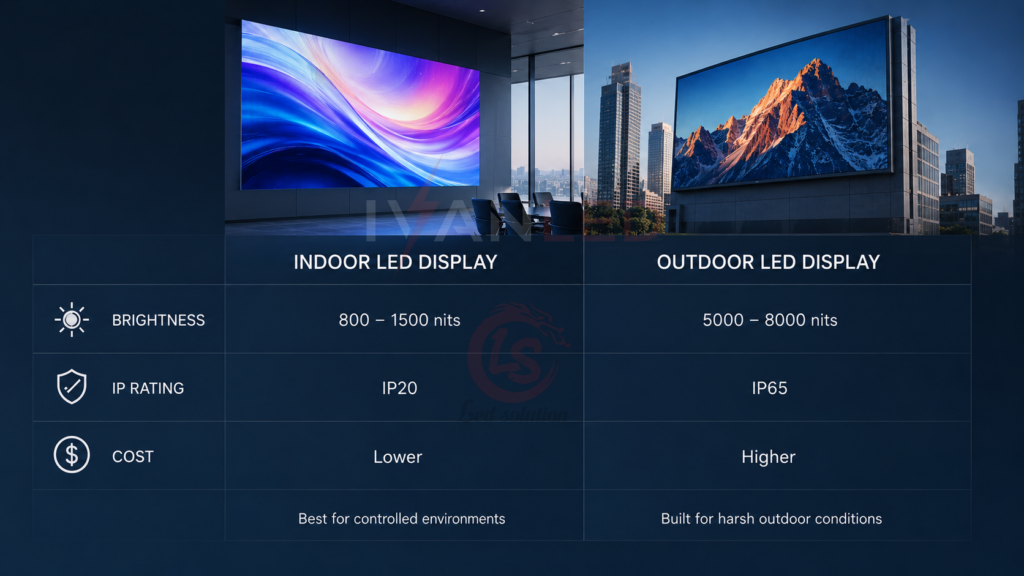
| Comparison Factor | Indoor LED Display | Outdoor LED Display |
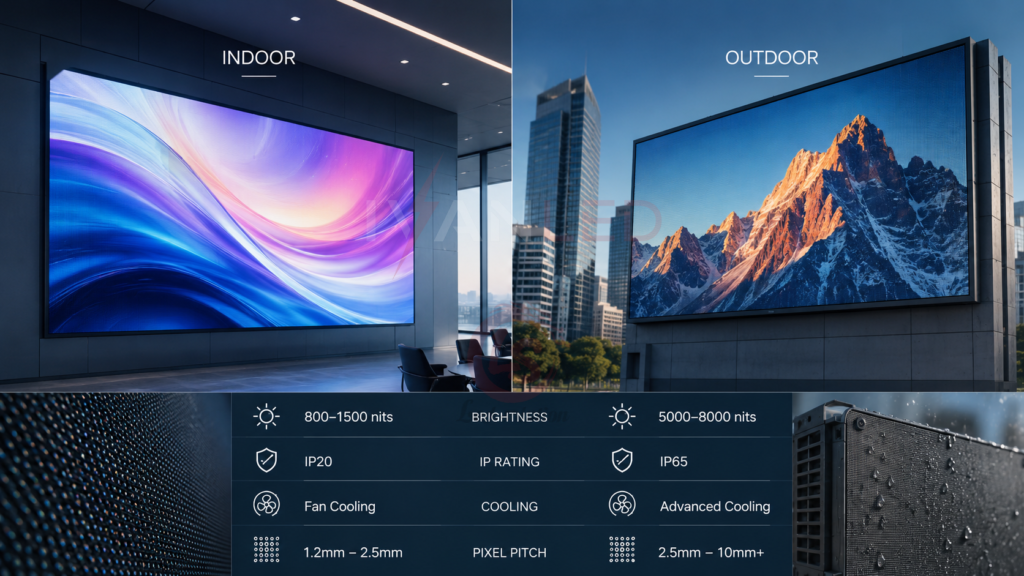
| Brightness (nits) | 800 – 1,500 | 4,500 – 6,500+ |
| Weather protection (IP rating) | IP20 – IP43 (dust protection only) | IP65 – IP67 (waterproof, dustproof) |
| Cabinet construction | Lightweight aluminum or steel | Heavy-duty, fully sealed |
| Cooling system | Passive (natural airflow) | Active (fans, heat sinks, or liquid cooling) |
| Pixel pitch range | P0.9 – P4 (fine to medium) | P3.9 – P16+ (medium to large) |
| Typical viewing distance | 1 – 10 meters | 5 – 50+ meters |
| Glue/encapsulation | Standard SMD (no additional coating) | Epoxy or silicone coating (GOB) for moisture protection |
| Installation | Wall-mounted, hanging, or freestanding | Structural steel frame, often with rear service access |
| Cost per m² (reference) | $700 – $2,500 | $900 – $3,500+ |
| Typical lifespan | 50,000 – 70,000 hours | 80,000 – 100,000 hours (with proper cooling) |
3. Detailed Comparison: Why Outdoor Screens Are Different
3.1. Brightness: Overcoming Sunlight
The most obvious difference is brightness. Outdoor displays must be visible in direct sunlight, which requires 4,500–6,500+ nits of brightness. Indoor displays, which operate in controlled lighting, only need 800–1,500 nits.
What happens if you use an indoor screen outdoors? It will look completely washed out and unreadable in daylight. What happens if you use an outdoor screen indoors? It will be painfully bright, cause eye strain, and waste significant energy.
3.2. Weather Protection: IP Rating
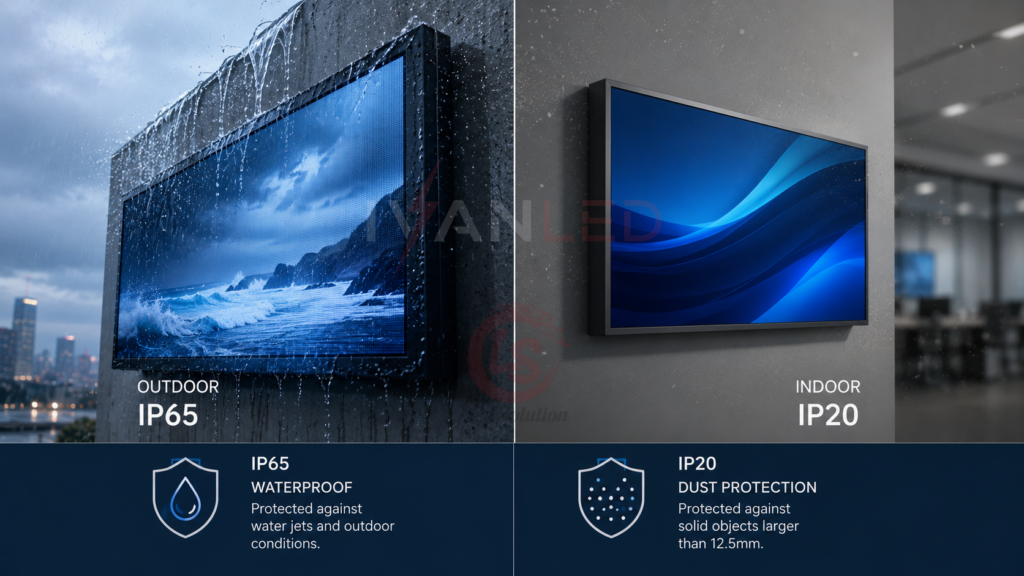
Outdoor displays must withstand rain, humidity, dust, and temperature extremes. This requires IP65 or higher ratings — fully sealed against water and dust. Indoor displays typically have IP20–IP43 ratings, offering only basic dust protection.
Critical distinction: An indoor screen exposed to outdoor conditions will suffer moisture ingress, corroding circuit boards and causing LED failure within weeks or months.
3.3. Cooling and Heat Management
Outdoor screens face direct sunlight (heating the cabinet) plus internal heat from the LEDs. They require active cooling — fans, heat sinks, or liquid cooling systems — to maintain safe operating temperatures. Indoor screens rely on passive cooling (natural airflow) because ambient temperatures are controlled.
Heat is the #1 cause of LED degradation. Outdoor screens are engineered to manage this; indoor screens are not.
3.4. Cabinet Construction and Durability
Outdoor cabinets are built from heavy-duty materials with fully sealed seams, waterproof gaskets, and corrosion-resistant coatings. Indoor cabinets are lighter, often using aluminum or thin steel, with simpler construction.
3.5. Pixel Pitch and Viewing Distance
Indoor displays are viewed from close range (1–10 meters), so they need finer pixel pitches (P0.9–P4) for sharp images. Outdoor displays are viewed from greater distances (5–50+ meters), so they can use larger pixel pitches (P3.9–P16) without visible pixelation.
3.6. Encapsulation and Glue
Outdoor LED modules often use GOB (Glue on Board) or silicone encapsulation to protect LEDs from moisture and physical impact. Indoor modules use standard SMD without additional coating.
3.7. Cost Differences
Outdoor screens are significantly more expensive due to:
- Higher-brightness LEDs
- Waterproofing and sealing
- Active cooling systems
- Heavier-duty cabinets
- More complex installation
Typical cost premium: Outdoor screens cost 30–60% more than equivalent indoor screens.
4. Application Guide: Which One Do You Need?
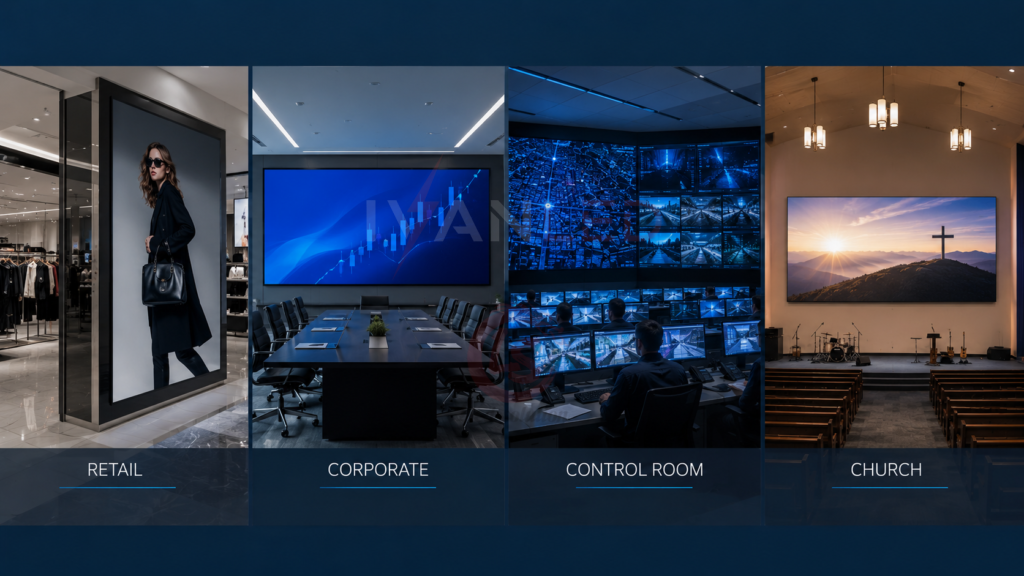
| Application | Recommended Type | Key Specs |
| Retail store / mall | Indoor | P2.5–P3.9, 800–1,200 nits |
| Corporate lobby / reception | Indoor | P1.5–P2.5, 800–1,000 nits |
| Control room / command center | Indoor | P0.9–P1.5, 600–800 nits |
| Conference room / classroom | Indoor | P1.5–P2.5, 800–1,000 nits |
| Church / worship center | Indoor | P2.5–P3.9, 800–1,200 nits |
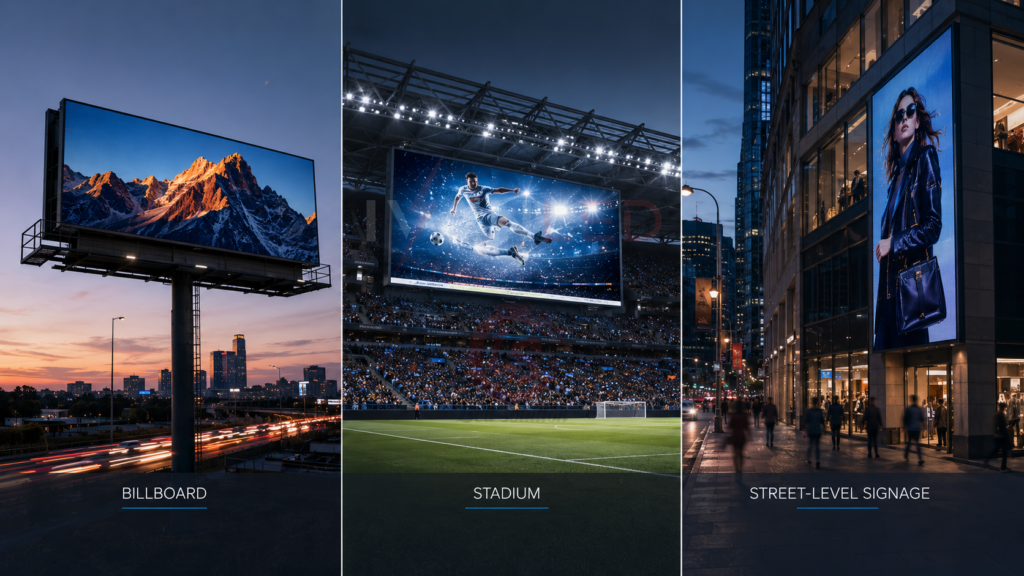
| Outdoor billboard (highway) | Outdoor | P6–P10, 5,500+ nits, IP65 |
| Street-level retail facade | Outdoor | P3.9–P5, 4,500+ nits, IP65 |
| Stadium / sports venue | Outdoor | P6–P10, 5,500+ nits, IP65 |
| Concert stage / event | Indoor or outdoor (rental) | P2.5–P3.9, 1,500+ nits (indoor) or 4,500+ (outdoor) |
| Airport / transit hub | Indoor | P2.5–P4, 800–1,200 nits |
5. Common Mistakes When Choosing Indoor vs. Outdoor LED Displays
- Using an indoor screen outdoors – It will fail from moisture and heat within months. This is the most common and costly mistake.
- Using an outdoor screen indoors – It will be excessively bright, cause visual discomfort, and waste energy.
- Assuming “all-weather” means truly outdoor – Some suppliers use this term loosely. Always verify IP rating (IP65 minimum for outdoor).
- Overlooking cooling requirements – Outdoor screens in hot climates need active cooling. Passive cooling is insufficient.
- Underestimating installation complexity – Outdoor screens require structural engineering, permits, and often crane installation.
- Forgetting about sunlight reflection – Outdoor screens need anti-glare coatings or louvers to reduce reflection.
6. Expert Tips from 10+ Years in LED Manufacturing
Tip 1: Always verify the IP rating in writing.
IP65 is the minimum for outdoor use. If a supplier claims “weatherproof” but cannot provide an IP65 rating, do not buy.
Tip 2: For outdoor screens, demand active cooling in hot climates.
Passive cooling is insufficient in direct sunlight. Ask about fans, heat sinks, or liquid cooling options.
Tip 3: Match pixel pitch to viewing distance.
Do not use fine-pitch (P1.5) outdoors — it is wasted money. Do not use large-pitch (P8) indoors — it will look pixelated.
Tip 4: For covered outdoor areas, choose semi-outdoor.
If the screen is under a canopy or roof, you may need only 2,500–3,500 nits and IP54–IP65 rating. Confirm with your supplier.
Tip 5: Buy spare modules.
Whether indoor or outdoor, order 5–10% spare modules at time of purchase. This ensures color and brightness match for future repairs.
7. Frequently Asked Questions (FAQ)
Q1: Can I use an indoor LED display outdoors?
No. Indoor displays lack waterproofing (IP20–IP43 vs. IP65 required) and sufficient brightness (1,500 nits vs. 4,500+ nits needed for sunlight). An indoor screen exposed to outdoor conditions will fail quickly from moisture, dust, and heat. This is the most common and costly mistake buyers make.
Q2: Can I use an outdoor LED display indoors?
Technically yes, but it is not recommended. Outdoor screens are very bright (4,500+ nits) and will cause eye strain in indoor environments. They are also heavier, more expensive, and consume more power. For indoor use, choose an indoor-specific display with appropriate brightness and pixel pitch.
Q3: What is the minimum IP rating for an outdoor LED display?
IP65 is the minimum for outdoor use. IP65 means fully protected against dust and low-pressure water jets from any direction. For areas with heavy rain or high-pressure cleaning, IP66 or IP67 is recommended.
Q4: How much more does an outdoor LED display cost?
Outdoor displays typically cost 30–60% more than equivalent indoor displays due to higher-brightness LEDs, waterproofing, active cooling, and more robust cabinets. For exact pricing, contact your supplier with your specific requirements.
Q5: What is a “semi-outdoor” LED display?
A semi-outdoor display is designed for covered outdoor areas, such as bus shelters, covered walkways, or canopies. It typically offers moderate brightness (2,500–3,500 nits) and IP54–IP65 protection. It is not suitable for direct sunlight or heavy rain.
Q6: Does IvanLED offer both indoor and outdoor LED displays?
Yes. IvanLED manufactures both indoor and outdoor LED displays across a wide range of pixel pitches, brightness levels, and IP ratings. We help buyers select the right type for their specific environment and application. Contact us for a recommendation.
8. Conclusion: Choosing the Right Display for Your Environment
The decision between indoor and outdoor LED displays is not just about where the screen is placed — it is about survival and performance. Indoor screens are optimized for controlled environments, while outdoor screens are engineered to withstand the elements.
IvanLED’s straightforward advice for 2026:
– For indoor applications: Choose 800–1,500 nits, P1.5–P4, IP20–IP43. Focus on resolution and color uniformity.
– For outdoor applications: Choose 4,500+ nits, P4–P10, IP65+. Focus on brightness, weatherproofing, and cooling.
– Never compromise on IP rating for outdoor use. IP65 is non-negotiable.
– When in doubt, ask for a site assessment to confirm environmental conditions.
At IvanLED, we manufacture both indoor and outdoor LED displays with the right specifications for every environment. We help buyers choose the right solution — not just the most expensive one.
Ready to specify the right LED display for your environment?
👉 Contact IvanLED with your installation details for a free recommendation and quote.