








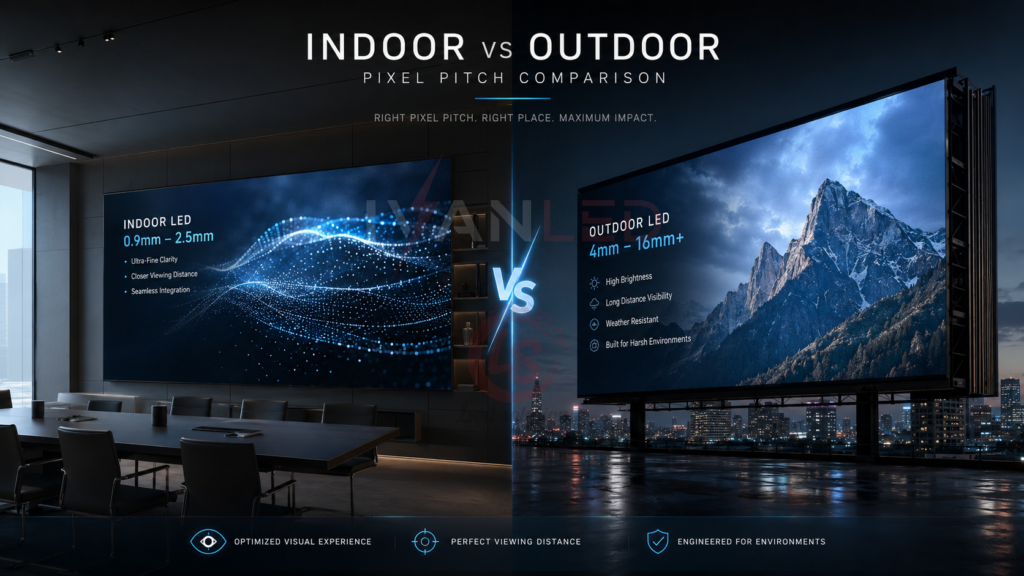
Buyer Pain Points: Indoor/Outdoor Pixel Pitch Confusion
B2B buyers often struggle with these specific questions:
- “Can I use the same pixel pitch indoors and outdoors?”
- “Why do outdoor screens need larger pixel pitch but higher brightness?”
- “My indoor P2.5 screen looks great. Why would it fail outdoors?”
- “How do I balance viewing distance AND sunlight?”
This guide answers these questions directly — no fluff, no generic advice.
Pixel Pitch Basics: Quick Refresher
Pixel pitch is the distance (in millimeters) between the centers of two adjacent LED pixels. Smaller number = pixels closer together = sharper image at close range. Larger number = pixels farther apart = lower resolution but higher brightness per pixel.
But here is the critical point for this guide: The “ideal” pixel pitch for indoor use is rarely ideal for outdoor use — and vice versa.
Indoor vs. Outdoor: The Fundamental Differences That Affect Pixel Pitch
| Factor | Indoor LED Display | Outdoor LED Display | Impact on Pixel Pitch |
| Typical viewing distance | 1–8 meters | 5–50+ meters | Indoor needs smaller pitch; outdoor can use larger pitch |
| Ambient light | Controlled (100–500 lux) | Direct sunlight (50,000+ lux) | Outdoor needs higher brightness per pixel, which favors larger pitch |
| Weather exposure | None (climate-controlled) | Rain, dust, humidity, heat | Outdoor requires IP65+ enclosure, which affects cabinet design |
| Typical content | Text, detailed graphics, presentations | High-contrast video, logos, simple messages | Indoor needs finer detail = smaller pitch |
| Brightness needed (nits) | 800–1,500 | 4,500–6,500+ | Outdoor larger pitch allows bigger, brighter LEDs |
| Heat generation | Low to moderate | High (sun + operation) | Outdoor larger pitch = less LED density = better heat dissipation |
Indoor Pixel Pitch Selection Guide
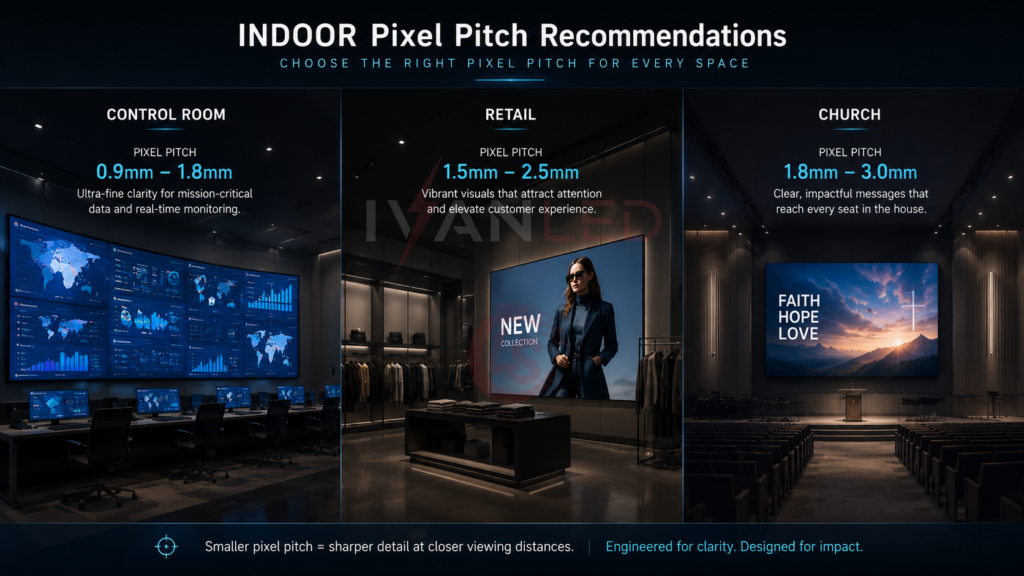
Indoor environments give you control over lighting and protect the screen from weather. Your main concern is image quality at close range.
Indoor Pixel Pitch by Application
| Application | Recommended Pixel Pitch | Viewing Distance | Why This Pitch |
| Control rooms / command centers | P0.9–P1.5 | 1–2 meters | Text-heavy, close viewing, needs sharp edges |
| Corporate lobbies / meeting rooms | P1.5–P2.5 | 2–4 meters | Mixed content (text + video), professional appearance |
| Retail stores / showrooms | P1.8–P2.5 | 2–5 meters | Product details must be clear, brand image matters |
| Trade show booths | P2.5–P3.9 | 2–6 meters | Balance of cost and quality; viewers stand back |
| Churches / auditoriums | P2.5–P3.9 | 4–15 meters | First row may be far; no need for ultra-fine pitch |
| Indoor events / rental | P3.9–P4.8 | 5–20 meters | Durability and weight matter more than resolution |
| Digital signage (malls, airports) | P2.5–P4 | 3–10 meters | Viewers walking; good balance of cost and clarity |
Indoor-Specific Considerations
- Brightness is not a constraint – Indoor screens need only 800–1,500 nits. This allows smaller pixel pitch without overheating.
- Text clarity is critical – For meeting rooms and control rooms, prioritize smaller pitch (P1.5–P2.5) for sharp text.
- No weather protection needed – IP20–IP43 is sufficient. Do not pay for IP65 on indoor screens.
- Uniformity matters – Indoor viewers are close. Demand ≥98% color/brightness uniformity from your supplier.
Outdoor Pixel Pitch Selection Guide
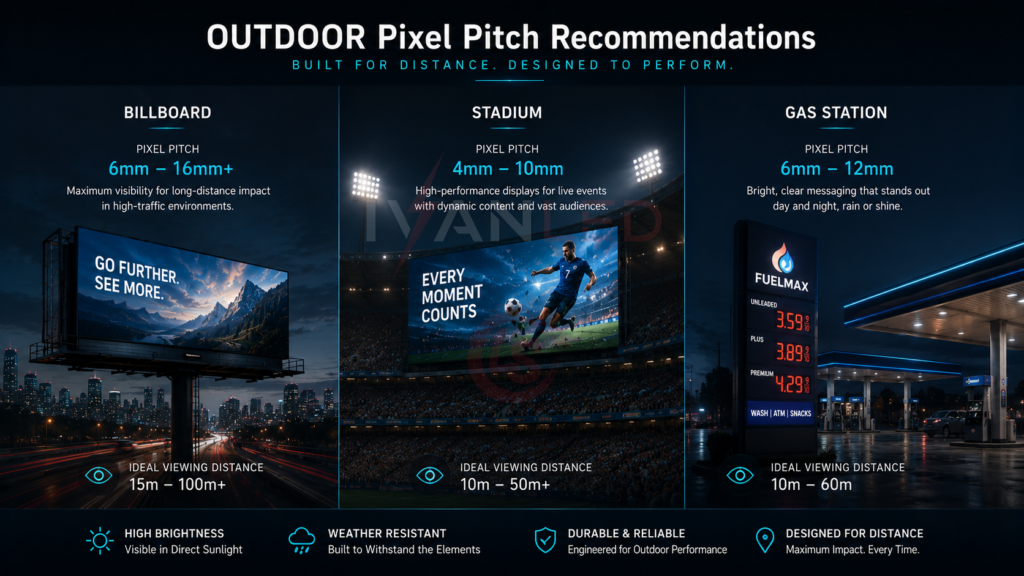
Outdoor environments are unforgiving. Sunlight, rain, dust, and temperature swings all affect performance. Your main concerns are brightness, durability, and viewing distance.
Outdoor Pixel Pitch by Application
| Application | Recommended Pixel Pitch | Viewing Distance | Why This Pitch |
| Street-level digital signage | P3.9–P5 | 3–10 meters | Closer than billboards, needs finer pitch but still weatherproof |
| Highway billboards | P6–P10 | 15–50+ meters | Long distance allows larger pitch; high brightness per LED is key |
| Stadium / arena scoreboards | P6–P10 | 10–50+ meters | Very long viewing distance; wide angle is more important than fine pitch |
| Building facades (close range) | P4–P6 | 5–15 meters | Pedestrians may walk by; balance pitch with IP65 requirement |
| Public squares / plazas | P5–P8 | 8–25 meters | Mixed viewing distances; durability against weather is critical |
| Gas station / drive-through | P3.9–P5 | 3–8 meters | Relatively close viewing; needs smaller pitch than highway billboards |
Outdoor-Specific Considerations
- Brightness is non-negotiable – Minimum 4,500 nits, preferably 5,000–6,500 nits. Larger pixel pitch allows larger, brighter LEDs.
- IP65 is mandatory – Waterproof and dustproof. No exceptions for outdoor use.
- Heat management is critical – Larger pitch means fewer LEDs per area = less heat. Fine-pitch outdoor screens need active cooling.
- UV protection – Outdoor LEDs and black mask materials must be UV-resistant to prevent yellowing and fading.
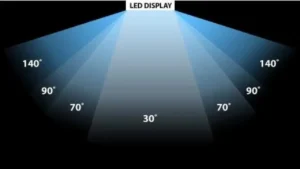
- Viewing angle matters more – Outdoor viewers come from all directions. Demand 140°+ viewing angle.
Indoor vs. Outdoor: Same Pixel Pitch? Almost Never
A common mistake: assuming a P3.9 indoor screen can be used outdoors. It cannot. Here is why:
| Issue | Why It Fails Outdoors |
| Brightness | Indoor P3.9 = 1,000–1,500 nits. Outdoor needs 4,500+. Screen will look black in sunlight. |
| Weather protection | Indoor cabinets have no gaskets or waterproof coatings. One rainstorm destroys them. |
| Heat dissipation | Indoor screens rely on ambient HVAC. Outdoor sun + operation heat causes failure. |
| UV resistance | Indoor black mask materials fade and crack under UV exposure within months. |
The reverse is also true: An outdoor P8 screen indoors looks terrible. The pixels are visible as dots, and the screen is painfully bright (5,000+ nits in a 200-lux room = eye strain).
Indoor vs. Outdoor Decision Matrix
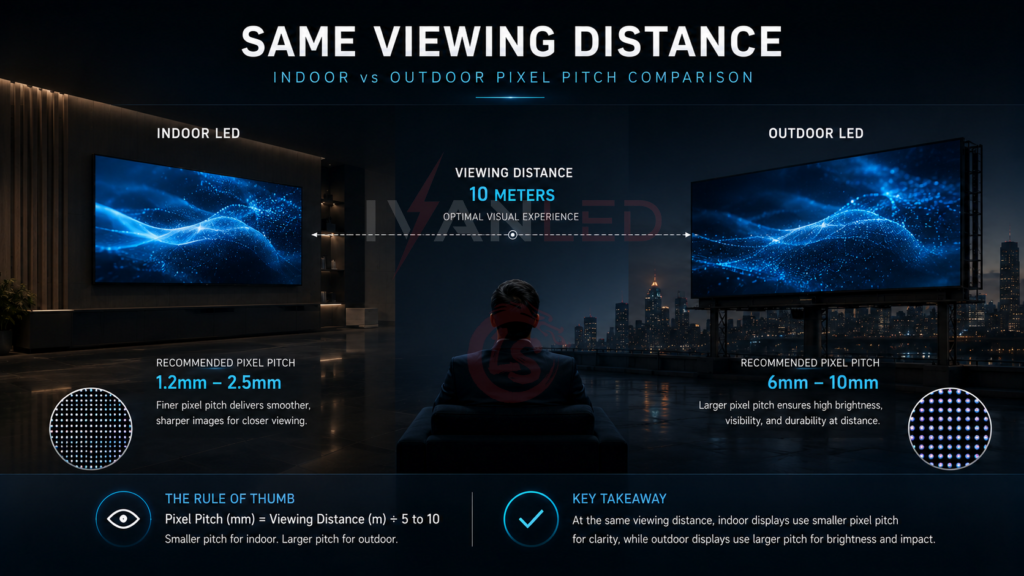
Use this quick reference to see how the SAME viewing distance changes pixel pitch recommendation based on indoor/outdoor environment.
| Viewing Distance | Indoor Recommended Pitch | Outdoor Recommended Pitch | Why the Difference? |
| 3 meters | P1.8–P2.5 | P3.9–P5 | Outdoor needs higher brightness per pixel, which requires larger pitch LEDs |
| 5 meters | P2.5–P3.9 | P4–P6 | Outdoor must overcome sunlight; larger pitch allows brighter individual LEDs |
| 10 meters | P3.9–P5 | P6–P8 | At this distance, outdoor can use larger pitch for better brightness and heat management |
| 20+ meters | P6–P8 | P8–P10+ | Both can use larger pitch; outdoor prioritizes brightness over resolution |
Common Indoor/Outdoor Pixel Pitch Mistakes
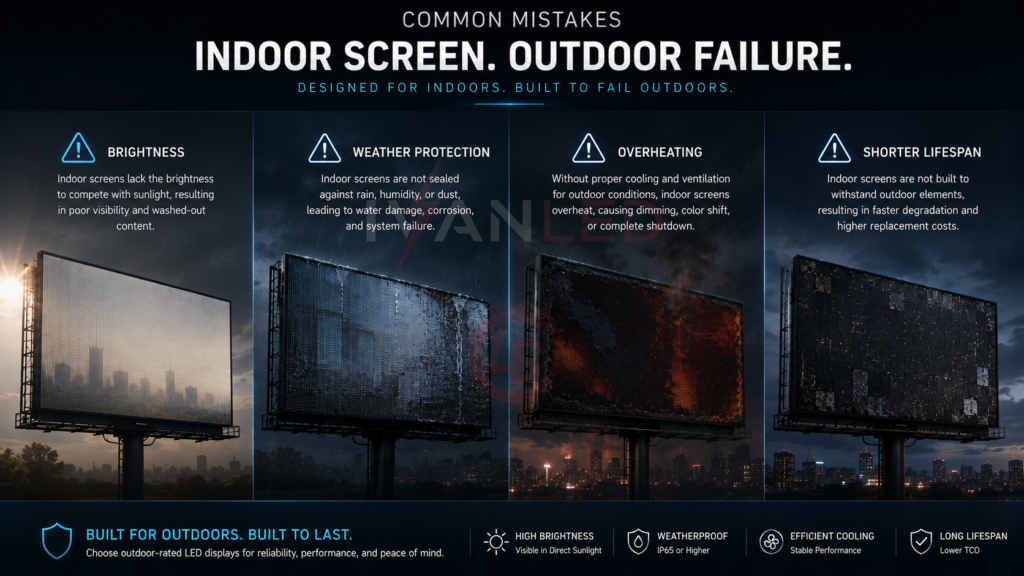
- Using indoor fine pitch outdoors – A P1.5 indoor screen outdoors will be invisible in sunlight and dead after first rain. Complete waste of money.
- Using outdoor large pitch indoors – A P10 outdoor screen indoors looks pixelated and painfully bright. Viewers will see individual dots.
- Assuming “indoor/outdoor hybrid” works for both – These compromises usually do neither well. They lack sufficient brightness for outdoor and sufficient resolution for indoor close viewing.
- Over-specifying outdoor pitch for long distance – A P3.9 outdoor screen at 30 meters offers no visible benefit over P8, but costs 3x more. Wasted budget.
- Under-specifying indoor pitch for close viewing – P3.9 at 2 meters looks terrible. Pay for P1.8–P2.5 when viewers are close.
Expert Tips for Indoor vs. Outdoor Pixel Pitch Selection
Tip 1: For outdoor, always ask for “actual brightness” not “maximum brightness.”
Some suppliers claim 6,000 nits but average only 4,000. Demand Field Test (actual test) data.
Tip 2: For indoor close viewing, test with your own text content.
Bring a PowerPoint slide or dashboard image. If the text edges look soft or jagged at intended viewing distance, pixel pitch is too large.
Tip 3: Outdoor P4–P6 is the “tweener” range.
Use P4 for closer outdoor (gas stations, street-level signage). Use P6+ for highway billboards. Do not use P4 for 30+ meter viewing.
Tip 4: For indoor rental, prioritize P3.9 GOB over P2.5 SMD.
Rental screens get bumped. GOB protects against dead pixels. The slightly larger pitch is not noticeable at 5+ meters.
Tip 5: When in doubt between two outdoor pitches, choose the larger one.
For outdoor, brightness and reliability matter more than resolution. A P8 screen that stays bright for 5 years beats a P4 screen that overheats or dims after 2 years.
Frequently Asked Questions
Q1: Can I use the same pixel pitch for indoor and outdoor if I add weatherproofing?
No. Weatherproofing does not solve the brightness problem. Indoor pixel pitches (P1.5–P2.5) use small LEDs that cannot achieve the 4,500+ nits needed for sunlight visibility. You need larger pitch (P4+) for outdoor brightness regardless of weatherproofing.
Q2: What is the smallest pixel pitch available for outdoor use?
P2.5–P3.9 outdoor screens exist, but they are expensive, require active cooling, and are only for close outdoor viewing (gas stations, street-level kiosks in shade). For most outdoor applications, P4–P8 is more practical and cost-effective.
Q3: How does direct sunlight affect pixel pitch choice?
Direct sunlight requires higher brightness per pixel. Larger pixel pitch allows larger LED chips that produce more light. Fine-pitch LEDs (P1.2–P2.5) physically cannot achieve the brightness needed for full sunlight without overheating and failing.
Q4: Is P3.9 indoor or outdoor?
P3.9 can be BOTH, but with different specifications. Indoor P3.9 = 800–1,500 nits, IP20, lightweight cabinet. Outdoor P3.9 = 4,500+ nits, IP65, heavier cabinet with cooling. Do not buy “P3.9” without specifying indoor or outdoor — they are different products.
Q5: What pixel pitch do I need for a covered outdoor area (no direct sun)?
You can use P2.5–P3.9 if viewing distance allows, with 2,500–3,500 nits brightness. However, you still need IP65 weather protection for rain/humidity. This is a “semi-outdoor” application — specify this clearly to your supplier.
Q6: Does IvanLED offer both indoor and outdoor pixel pitches?
Yes. We manufacture indoor pitches from P0.9 to P4, and outdoor pitches from P3.9 to P16. We help buyers select based on environment, viewing distance, and budget — not just pitch number.
Final Recommendation: Indoor vs. Outdoor Pixel Pitch Cheat Sheet
- Indoor, close viewing (1–3m): P0.9–P1.8 — fine pitch for text and detail
- Indoor, medium viewing (3–8m): P2.5–P3.9 — standard indoor signage
- Indoor, distant viewing (8m+): P4–P6 — large venues, events
- Outdoor, close (3–8m, shaded): P3.9–P5 — street-level, gas stations
- Outdoor, medium (8–20m): P5–P8 — building facades, stadiums
- Outdoor, distant (20m+): P8–P10+ — highway billboards, large arenas
Remember: Outdoor always requires IP65 + 4,500+ nits + UV protection. Indoor does not. Never use an indoor screen outdoors, even if the pixel pitch number seems right.
At IvanLED, we provide environment-specific recommendations and transparent specifications — no “one pitch fits all” shortcuts.
Ready to choose the right pixel pitch for your indoor or outdoor project?
👉 Contact IvanLED with your environment and viewing distance for a free recommendation.