








What Is Micro LED Technology?
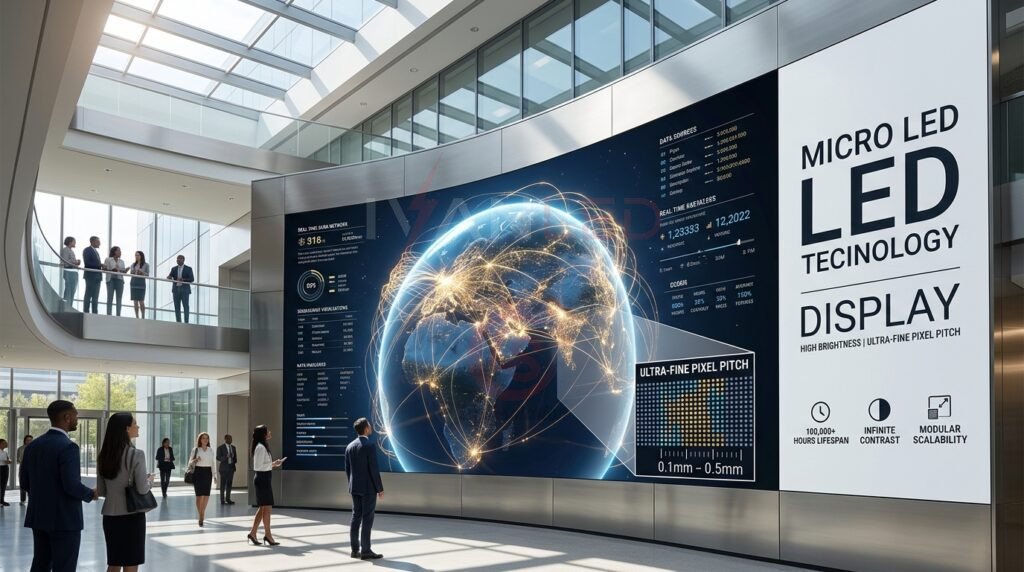
Micro LED technology uses tiny LED chips — typically 1 to 100 microns in size — as individual self-emissive pixels on a display. Unlike traditional LED displays that use packaged LEDs, Micro LED chips are directly bonded to the substrate, enabling ultra-fine pixel pitches (0.1-0.5mm), extremely high brightness (3,000-10,000+ nits), and exceptional image quality.
Key characteristics:
- Chip size: 1-100 microns (compared to 100-300 microns for traditional SMD)
- Pixel pitch: 0.1-0.5mm for ultra-high resolution
- Brightness: 3,000-10,000+ nits
- Lifespan: 100,000+ hours
- Self-emissive: Each pixel produces its own light
The tiny chip size allows for pixel pitches that were previously impossible with traditional LED technology. A 100-inch screen can achieve 4K resolution, and larger screens can reach 8K. This makes Micro LED suitable for applications where viewers sit close to the screen and demand pristine image quality.
For more on display technologies, see our LED display functions guide.
Advantages of Micro LED
Micro LED offers six key advantages: high brightness, wide color gamut, ultra-fine pixel pitch, long lifespan, low power consumption, and high durability.
High brightness: Micro LED achieves 3,000-10,000+ nits — significantly brighter than OLED (under 1,000 nits) and competitive with outdoor SMD. This makes it ideal for high-ambient-light environments.
Wide color gamut: Using high-purity RGB chips, Micro LED delivers 10-12 bit grayscale and wide color gamut, ensuring vibrant, accurate colors.
Ultra-fine pixel pitch: 0.1-0.5mm pixel pitch enables 4K and 8K resolution even on smaller screens — ideal for close-viewing applications.
Long lifespan: 100,000+ hours (10+ years of use) with slow brightness decay and no burn-in risk.
Low power consumption: Self-emissive design eliminates backlight power loss, making Micro LED more energy-efficient than OLED at the same brightness.
Limitations and Challenges of Micro LED
Micro LED faces three major challenges: high production costs, complex manufacturing processes, and limited production capacity. These factors keep prices 5-10x higher than traditional LED displays.
High production cost: Micro LED chip fabrication requires extreme precision for 1-100 micron chips. Mass transfer (placing millions of chips onto the substrate) adds significant cost. A 115-inch Micro LED TV currently costs approximately $30,000.
Complex manufacturing: Every step — chip fabrication, brightness testing, mass transfer, packaging, and integration — is significantly more complex than traditional LED production. Testing millions of individual pixels adds time and cost.
Yield rate challenges: The tiny size of Micro LED chips makes them prone to damage during transfer. A single defective pixel affects the entire screen. Yield rates are lower than traditional LED, increasing costs.
Micro LED vs. Mini LED vs. OLED
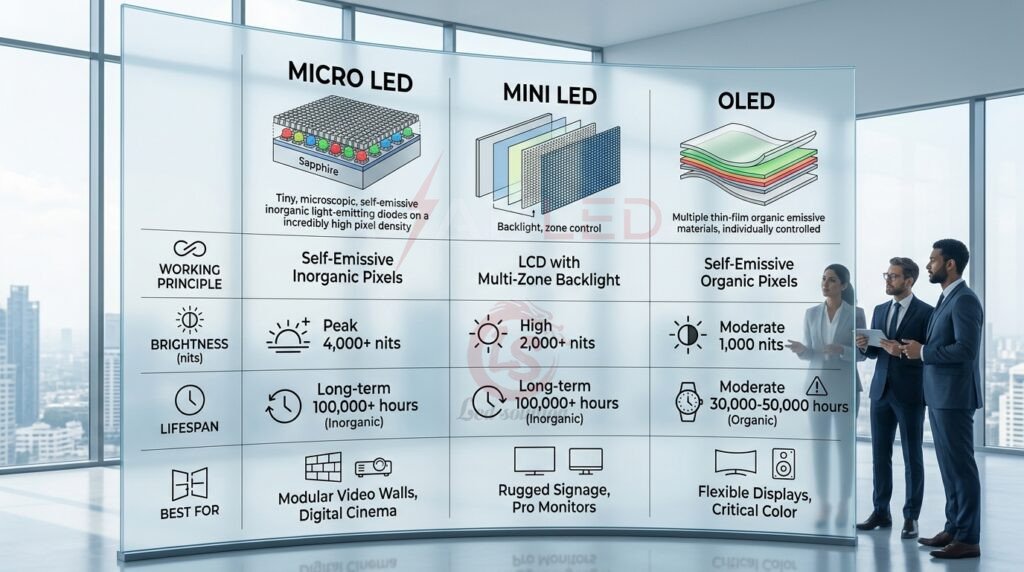
Micro LED and OLED are both self-emissive (each pixel produces its own light), while Mini LED uses an LCD panel with LED backlighting. Micro LED offers superior brightness and lifespan but at significantly higher cost than both Mini LED and OLED.
| Technology | Working Principle | Brightness (nits) | Lifespan | Best For |
| Micro LED | Self-emissive (each pixel is a micro LED) | 4,000+ | 100,000+ hours | Premium display, ultra-high brightness |
| Mini LED | LCD panel + LED backlight | 2,000+ | 100,000+ hours | High-brightness displays, automotive |
| OLED | Self-emissive (organic materials) | Under 1,000 | 30,000-50,000 hours | Consumer TVs, smartphones, high contrast |
For more on packaging technologies, see our COB vs CSP comparison guide.
Applications of Micro LED
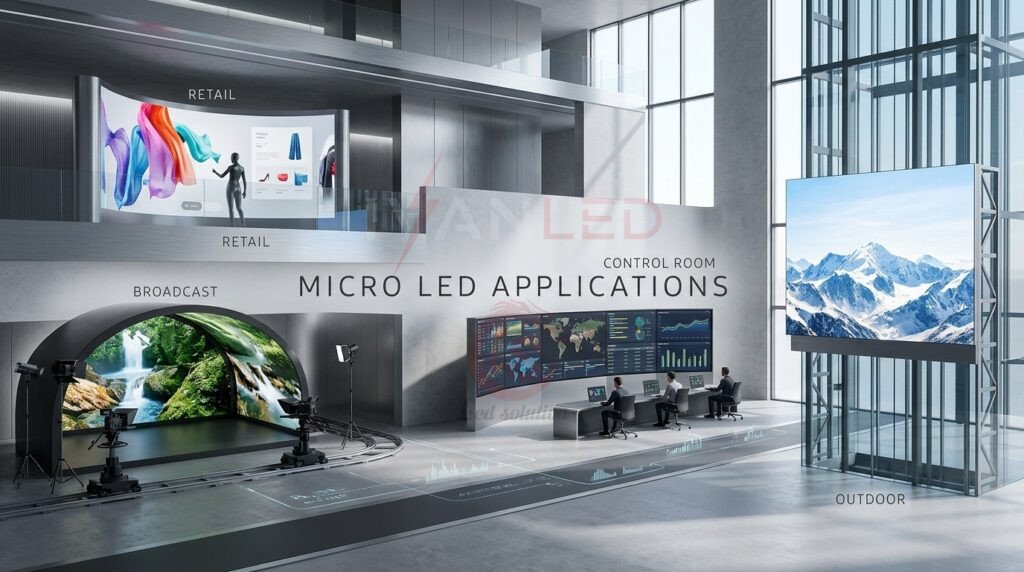
Micro LED is currently best suited for premium applications requiring extreme brightness, ultra-high resolution, or long lifespan: retail displays, broadcast studios, control rooms, and outdoor advertising.
| Application | Why Micro LED | Typical Size |
| Retail / showrooms | Premium image quality, high brightness for window displays | 2-5m wide |
| Broadcast studios / virtual production | High brightness, wide color gamut, camera-friendly | 3-8m wide |
| Control rooms / command centers | Ultra-fine pitch for data detail, 24/7 reliability | 2-6m wide |
| Outdoor advertising (premium) | Extreme brightness for direct sunlight visibility | 5-20m² |
| Corporate lobbies / headquarters | Brand image, premium visual impact | 3-6m wide |
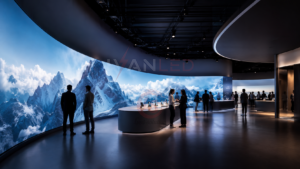
| Museums / exhibition halls | Image quality for close viewing, long lifespan | 2-5m wide |
For more on display solutions, see our LED display solutions.
Common Mistakes When Choosing Micro LED
The most common mistake is choosing Micro LED for applications where the extra brightness and resolution are invisible to viewers. If your viewing distance is over 3 meters or your ambient light is controlled, the premium for Micro LED may be wasted.
Other frequent errors:
- Underestimating total system cost: The screen is only 40-60% of the total investment. Controllers, cables, and infrastructure add significant cost.
- Not verifying manufacturing capability: Not all LED manufacturers have Micro LED production capability. Ask about yield rates and production capacity.
- Forgetting about lead times: Micro LED production is still limited. Lead times may be longer than traditional LED displays.
- No spare parts planning: Micro LED batches are even more critical than traditional LED due to complex manufacturing. Order spare modules upfront.
Expert Tips for Micro LED Buyers
Tip 1: Evaluate whether your application actually needs Micro LED.
For most projects, COB or fine-pitch SMD deliver excellent performance at 20-40% of the cost of Micro LED. Only consider Micro LED if you truly need extreme brightness, ultra-fine pitch, or 100,000+ hour lifespan.
Tip 2: Consider total cost of ownership.
Micro LED’s higher upfront cost may be offset by longer lifespan and lower maintenance. For 24/7 installations, the extended lifespan could justify the premium.
Tip 3: Verify manufacturing capability.
Ask about yield rates, production capacity, and case studies. Not all manufacturers have the expertise to produce Micro LED reliably.
Tip 4: Plan for longer lead times.
Production is still limited. Plan your project timeline accordingly.
Tip 5: Order spare modules.
Order 5-10% spare modules with your initial purchase to ensure color match for future repairs.
For more on pricing, see our LED display price guide 2026.
Frequently Asked Questions (FAQ)
Is Micro LED technology ready for mainstream installations?
Yes, but with caveats. Major manufacturers have launched Micro LED products, but production capacity is limited, prices remain high, and lead times may be longer than traditional LED displays. Micro LED is best suited for premium applications with adequate budgets.
How much does a Micro LED display cost?
Micro LED displays cost 5-10x more than traditional SMD or COB displays of similar size. A 115-inch Micro LED TV costs approximately $30,000. Pricing varies by size, resolution, and customization. Contact suppliers for current quotes.
What is the difference between Micro LED and Mini LED?
Micro LED uses self-emissive micro pixels with chips 1-100 microns in size. Mini LED uses an LCD panel with LED backlighting (chips 100-200 microns). Micro LED offers superior brightness, contrast, and lifespan but at much higher cost.
How long does Micro LED last?
Micro LED offers 100,000+ hours of lifespan (approximately 10+ years of use). This is significantly longer than OLED (10,000-30,000 hours) and comparable to traditional LED displays. Micro LED also has no burn-in risk and slower brightness decay.
Does IvanLED offer Micro LED displays?
As a professional LED display manufacturer, IvanLED stays at the forefront of display technology. Browse our LED display products or contact us to discuss your project requirements and learn about our current product offerings.
Conclusion: Is Micro LED Right for Your Project?
Micro LED technology represents the cutting edge of display technology, offering exceptional brightness, lifespan, and image quality for premium applications. However, the high cost and complex manufacturing mean it is only suitable for projects with adequate budgets and specific requirements.
Our straightforward advice:
– For most LED display projects: COB or fine-pitch SMD offer better ROI — excellent performance at 20-40% of Micro LED cost.
– For luxury retail, high-end broadcast, or premium control rooms: Micro LED delivers unmatched brightness and lifespan.
– Always calculate total cost of ownership — not just upfront price — when evaluating Micro LED.
– Verify manufacturing capability and lead times before committing to a Micro LED project.
At IvanLED, we help buyers evaluate display technologies to find the right solution for their application and budget.