









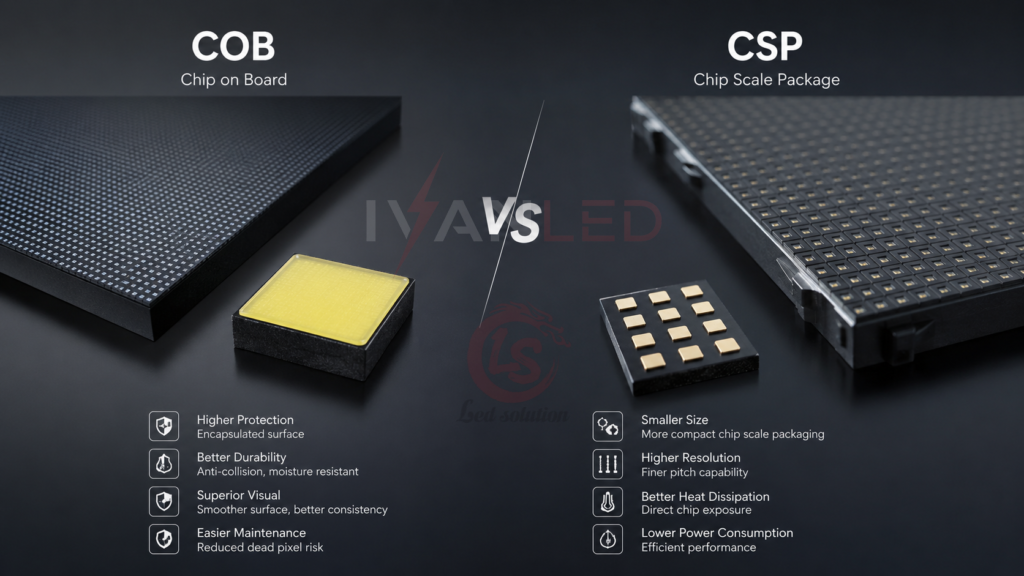
Buyer Pain Points: COB vs CSP Confusion
Distributors and buyers face specific challenges when choosing between COB and CSP:
Which technology is more durable? COB’s seamless epoxy surface provides superior protection against moisture, dust, and impact. CSP’s individual LEDs are more exposed to environmental damage.
Which offers better image quality? COB delivers superior color consistency and uniformity because all chips are encapsulated in a single process. CSP’s individual packaging can lead to visible color variations between pixels.
Which is easier to repair? CSP allows individual LED replacement, making field repairs easier. COB requires module-level replacement, which can be more costly but is less frequent due to higher durability.
Which is brighter? CSP can achieve higher brightness (2,000–4,000+ nits) without overheating. COB typically maxes out around 1,500 nits due to heat concentration.
Which is more affordable? CSP is generally more cost-effective for high-brightness applications. COB has a higher upfront cost but lower maintenance costs over time.
What Is COB Packaging?
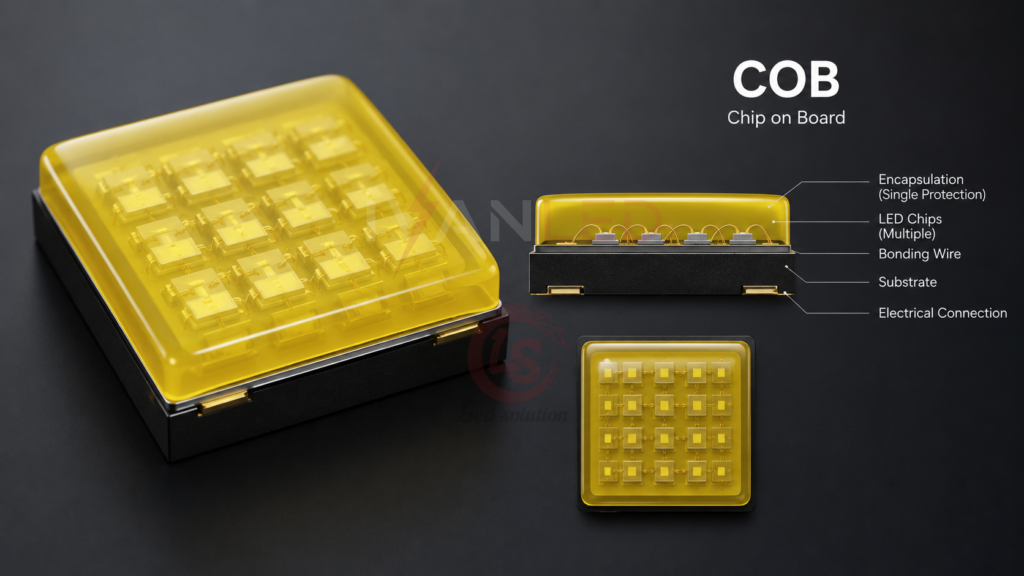
COB (Chip on Board) is a packaging technology where multiple LED chips are mounted directly onto a PCB and then encapsulated in a single, seamless epoxy or silicone layer. This creates a unified, protected surface with no individual LED housings.
Key characteristics:
- LED chips are directly bonded to the PCB
- Single-step encapsulation covers all chips
- Seamless, smooth surface with no visible gaps
- Superior protection against moisture, dust, and impact
- Excellent color consistency across the entire module
- Pixel pitches as small as 0.4mm
COB is widely used in control rooms, broadcast studios, luxury retail, and any application requiring close viewing and high reliability.
What Is CSP Packaging?
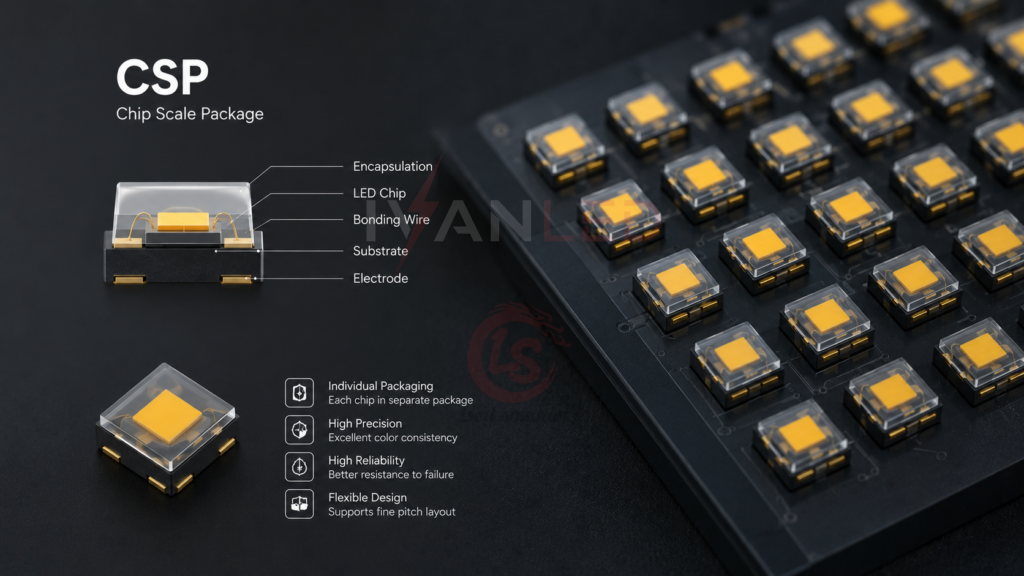
CSP (Chip Scale Package) is a packaging technology where each LED chip receives its own individual package that is nearly the same size as the chip itself. Each LED is independent, allowing for higher brightness and easier individual replacement.
Key characteristics:
- Each LED chip has an individual package
- No encapsulation layer covers the entire module
- Individual LEDs can be replaced separately
- Better heat dissipation per LED
- Achieves higher brightness (2,000–4,000+ nits)
- Pixel pitches typically 0.9–2mm
CSP is commonly used in outdoor displays, high-brightness applications, and environments where maintenance access is a priority.
COB vs CSP: Side-by-Side Comparison
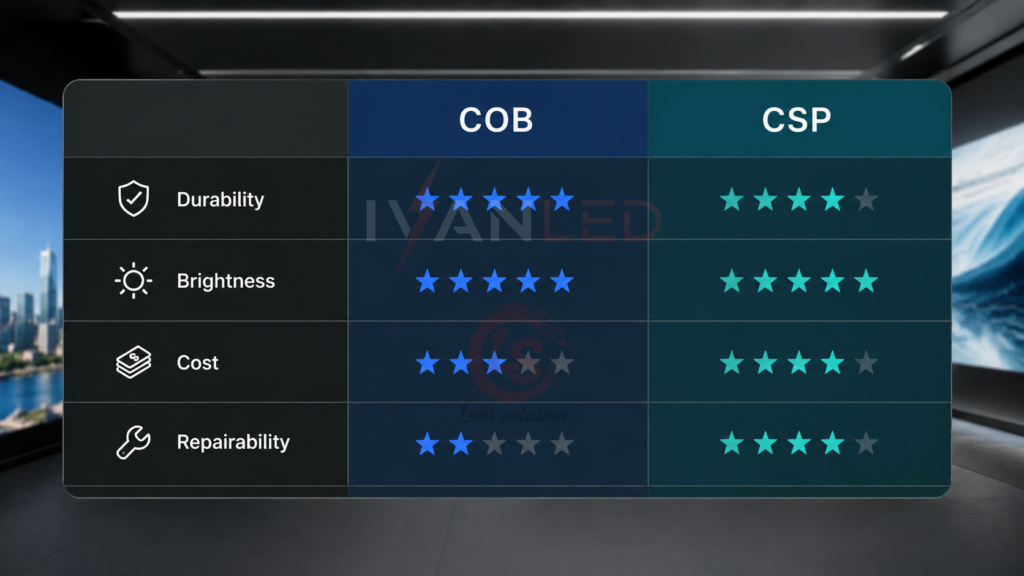
The key difference between COB and CSP is that COB encapsulates all LED chips in a single, seamless layer, while CSP individually packages each LED chip separately.
| Feature | COB (Chip on Board) | CSP (Chip Scale Package) |
| Packaging method | Multiple chips, single encapsulation | Individual package per chip |
| Pixel pitch range | 0.4 – 1.5mm | 0.9 – 2.0mm |
| Typical brightness | Up to 1,500 nits | 2,000 – 4,000+ nits |
| Surface finish | Seamless, smooth | Individual LED housings visible |
| Durability (impact, moisture) | High (sealed surface) | Moderate (exposed LEDs) |
| Color consistency | Excellent (single encapsulation) | Moderate (batch variations) |
| Heat dissipation | Direct to PCB (good) | Requires airflow channels |
| Repairability | Module-level replacement | Individual LED replacement |
| Thickness | Thinner | Slightly thicker |
| Relative cost | Higher upfront, lower maintenance | Lower upfront, higher maintenance |
| Best for | Indoor, close viewing, reliability | High brightness, outdoor, repairability |
Which Technology Should You Choose?
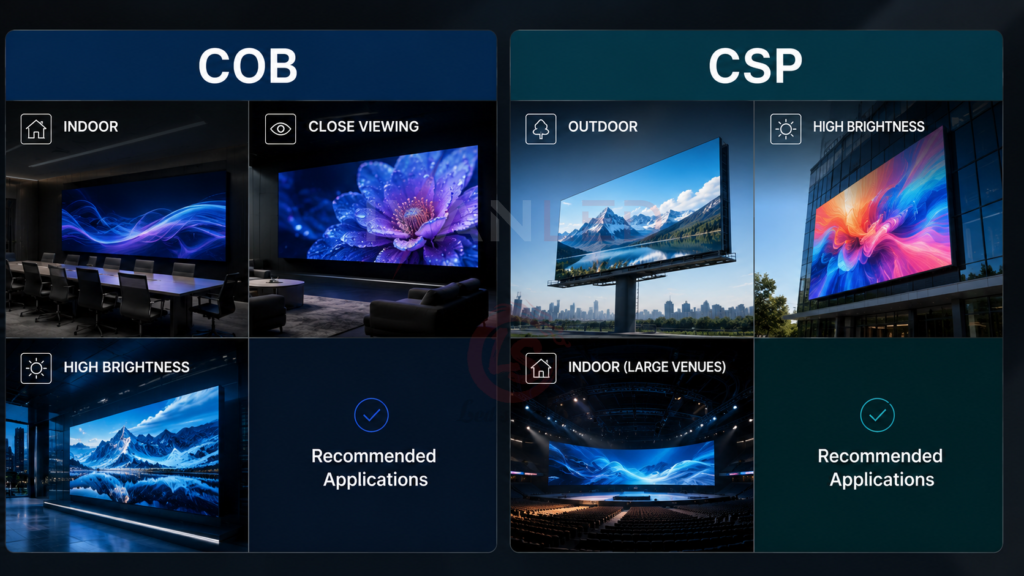
Your choice between COB and CSP depends on four key factors: viewing distance, environment, brightness needs, and maintenance strategy.
Choose COB if:
- Viewing distance is under 2 meters (close viewing)
- Color consistency and uniformity are critical
- The environment has dust, humidity, or physical contact risk
- You prefer a seamless, premium surface finish
- Module-level replacement is acceptable for maintenance
Choose CSP if:
- You need brightness above 2,000 nits (outdoor or bright environments)
- Individual LED replacement is preferred for maintenance
- Lower upfront cost is a priority
- Viewing distance is over 1.5 meters
- Color consistency is less critical than brightness
Expert Tips for Distributors
Tip 1: Match pixel pitch to viewing distance.
COB achieves pixel pitches as small as 0.4mm, making it ideal for control rooms and broadcast studios. CSP typically starts at 0.9mm. For most indoor applications with viewing distances over 1.5 meters, both technologies work well.
Tip 2: Consider the environment.
COB’s sealed surface is significantly more durable in dusty, humid, or high-traffic environments. For outdoor or rental applications, COB is often worth the premium. For indoor, controlled environments, CSP can be a cost-effective alternative.
Tip 3: Plan for brightness requirements.
If your application requires high brightness for sunlight visibility or vibrant HDR content, CSP is the better choice. COB is ideal for controlled lighting environments where brightness needs are modest.
Tip 4: Evaluate total cost of ownership.
COB has a higher upfront cost but lower maintenance costs over time due to superior durability. CSP is cheaper initially but may require more frequent repairs. For long-term installations, COB often provides better ROI.
Tip 5: Test with your actual content.
Before finalizing, view both COB and CSP displays with your typical content at the intended viewing distance. The difference in color consistency and surface finish may be visible or negligible depending on your application.
Frequently Asked Questions (FAQ)
What is the difference between COB and CSP packaging?
COB (Chip on Board) mounts multiple LED chips directly onto a PCB and encapsulates them in a single seamless layer. CSP (Chip Scale Package) individually packages each LED chip separately. COB offers better durability and color consistency; CSP offers higher brightness and easier repairability.
Which is more durable, COB or CSP?
COB is significantly more durable. The seamless encapsulation protects all LED chips from moisture, dust, and physical impact. CSP’s individually packaged LEDs are more exposed and vulnerable to environmental damage, making COB the better choice for high-traffic or outdoor applications.
Which offers better brightness, COB or CSP?
CSP achieves higher brightness — typically 2,000–4,000+ nits — compared to COB’s typical maximum of 1,500 nits. CSP’s individual packaging allows better heat dissipation per LED, enabling higher brightness without reducing lifespan. Choose CSP for outdoor or high-ambient-light environments.
Is COB more expensive than CSP?
Yes, COB typically has a higher upfront cost than CSP due to the more complex manufacturing process and premium materials. However, COB often provides lower total cost of ownership due to superior durability and reduced maintenance requirements. CSP is more cost-effective for high-brightness applications.
Which is better for indoor fine-pitch displays?
COB is generally better for indoor fine-pitch displays, especially for close viewing (under 2 meters). It offers superior color consistency, a seamless surface, and higher durability. CSP can also work for indoor applications but is more commonly used where higher brightness or easier repairability is prioritized.
Does IvanLED offer both COB and CSP LED displays?
Yes. IvanLED manufactures both COB and CSP LED displays. We help buyers select the right technology based on viewing distance, environment, brightness requirements, and budget. Contact us for a recommendation and quote for your specific project.
Conclusion: Choosing the Right Packaging Technology
COB and CSP are both advanced LED packaging technologies that deliver superior image quality compared to traditional SMD. The right choice depends on your specific application:
Our straightforward advice:
– For close-viewing, high-reliability indoor applications: COB is the superior choice.
– For high-brightness outdoor or maintenance-friendly applications: CSP is the better option.
– Consider total cost of ownership — not just upfront price — when evaluating COB vs CSP.
– Always test with your actual content at the intended viewing distance before finalizing.
At IvanLED, we manufacture both COB and CSP LED displays with high-quality components and rigorous quality control. Our team can help you evaluate which technology fits your project requirements. Browse our commercial LED display solutions or contact us for a free consultation.
Ready to choose the right LED packaging technology for your project?
👉 Contact IvanLED for a free consultation and customized quote.