








You are sourcing an indoor LED display for a conference room, a retail store, or a corporate lobby. The options seem endless — different pixel pitches, brightness levels, installation types, and price points. Choosing the wrong screen means wasted budget and poor results. This guide breaks down the key factors for selecting a high-quality indoor LED display that delivers reliable performance and excellent image quality.
The key takeaway: Choosing the right indoor LED display requires evaluating five factors: pixel pitch (based on viewing distance), brightness (800-1,500 nits for indoor environments), reliability (quality components and thermal management), maintenance (front vs rear access), and total cost of ownership (including energy and maintenance).
Table of Contents
What Is an Indoor LED Display?
An indoor LED display is a large-format screen used in indoor environments, composed of LED modules that display text, images, and videos. It is designed for close viewing, with higher resolution and lower brightness than outdoor displays.
Indoor LED displays are used in retail stores, conference rooms, corporate lobbies, churches, and event spaces. They offer superior image quality, slim profiles, and flexible installation options compared to traditional projection systems.
For more on display types, see our LED display types guide.
What Defines a High-Quality Indoor LED Display?
A high-quality indoor LED display is defined by five characteristics: excellent display quality (high resolution, vivid colors, high contrast), stable performance (consistent operation over time), quality materials and workmanship (durable components), comprehensive after-sales support, and a strong manufacturer reputation.
Display quality: Clear, vivid, high-contrast images that maintain visual impact in both bright and dim indoor lighting.
Stable performance: Reliable operation under varying temperature and humidity conditions without degradation.
Quality materials: High-grade LED chips, electronic components, and housing materials with advanced manufacturing processes.
After-sales support: Installation, maintenance, and technical support from the manufacturer.
Reputation: A manufacturer with proven experience and positive customer feedback.
For more on display quality, see our LED screen quality guide.
Key Factors for Choosing an Indoor LED Display
When selecting an indoor LED display, evaluate seven factors: display effect (resolution, color, contrast), reliability and stability (components, thermal management), energy efficiency, maintenance and management, brand reputation, adaptability and flexibility, and price versus cost-effectiveness.
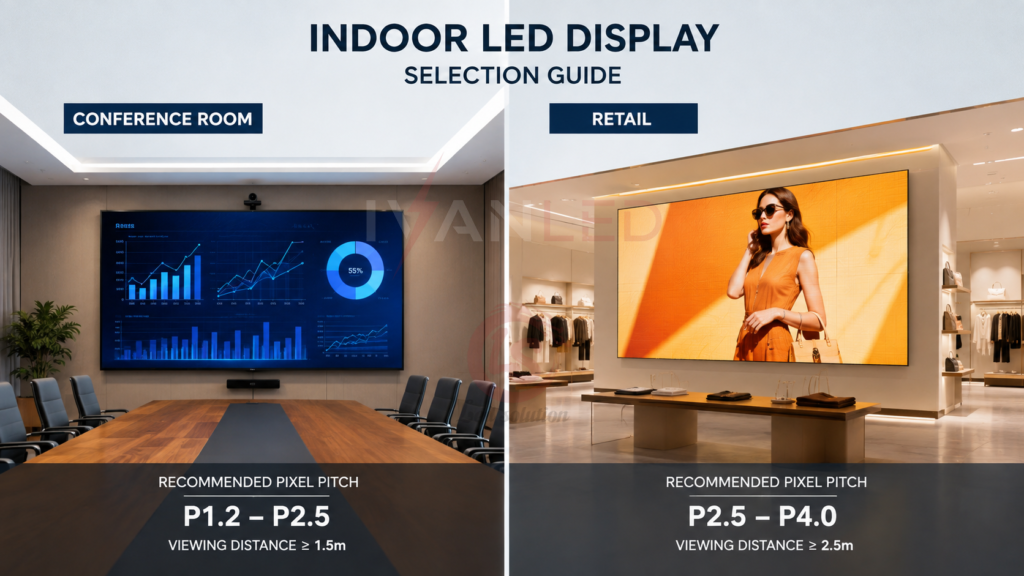
Display effect: Resolution determines image clarity. For close viewing (under 3 meters), choose P1.2-P2.5. For medium viewing (3-5 meters), P2.5-P4 is sufficient. Color reproduction and contrast affect visual impact — look for high uniformity and deep blacks.
Reliability and stability: Quality LED chips and electronic components ensure consistent performance. A reliable heat dissipation system prevents premature failure. Ask about the manufacturer’s quality control processes and 72-hour aging tests.
Energy efficiency: High-quality displays consume less power, reducing operating costs. Look for energy-efficient LED light sources and power supplies.
Maintenance and management: Easy module replacement, remote monitoring, and front maintenance options reduce downtime and maintenance costs.
Brand reputation: Well-known manufacturers typically have experience, professional teams, and reliable after-sales service.
Adaptability and flexibility: Multiple installation methods and signal source inputs accommodate different applications.
Price and cost-effectiveness: Consider quality, performance, service, and price together — the cheapest option is rarely the best value.
Benefits of High-Quality Indoor LED Displays
High-quality indoor LED displays offer five key benefits: superior display quality, long-term stability and reliability, lower operating costs, better after-sales support, and improved brand image.
Superior display quality: Higher resolution, wider color range, and clearer images provide more impactful visual experiences for commercial applications and presentations.
Long-term stability and reliability: Longer lifespan and greater stability reduce device failure and performance degradation. This is critical for commercial displays that require continuous operation.
Lower operating costs: Lower power consumption and better heat dissipation save energy costs. Fewer failures and longer lifespan reduce maintenance costs.
Better after-sales support: Well-known brands have complete after-sales systems and technical teams for timely repair and maintenance.
Improved brand image: High-quality displays create a professional impression, enhancing brand perception and attracting more customers.
Pixel Pitch Selection for Indoor Displays
Pixel pitch determines the resolution and optimal viewing distance of your indoor LED display. Match pixel pitch to the closest viewer distance using the rule: pixel pitch (mm) = closest viewing distance (meters).
Common indoor pixel pitch applications:
- P0.9-P1.5: Control rooms, broadcast studios, luxury retail (viewing distance 1-2 meters)
- P1.5-P2.5: Conference rooms, corporate lobbies, high-end retail (viewing distance 2-3 meters)
- P2.5-P4: Retail stores, churches, exhibition halls (viewing distance 3-5 meters)
- P4-P6: Indoor events, large lobbies, trade show booths (viewing distance 4-8 meters)
For more on pixel pitch, see our pixel pitch guide.
IvanLED Indoor LED Displays: Quality You Can Rely On
With over a decade of experience in LED display manufacturing, IvanLED offers a comprehensive range of indoor LED displays designed for superior image quality, durability, and easy maintenance. Our displays are engineered with several key features that deliver consistent performance across diverse applications.
Wide pixel pitch range: From P0.9 to P6, covering control rooms, conference rooms, retail, and event applications. This ensures you can find the right resolution for your specific viewing distance and application.
High refresh rate (1,920-7,680Hz): Our indoor displays support high refresh rates, ensuring flicker-free video playback and smooth motion rendering for presentations and video content.
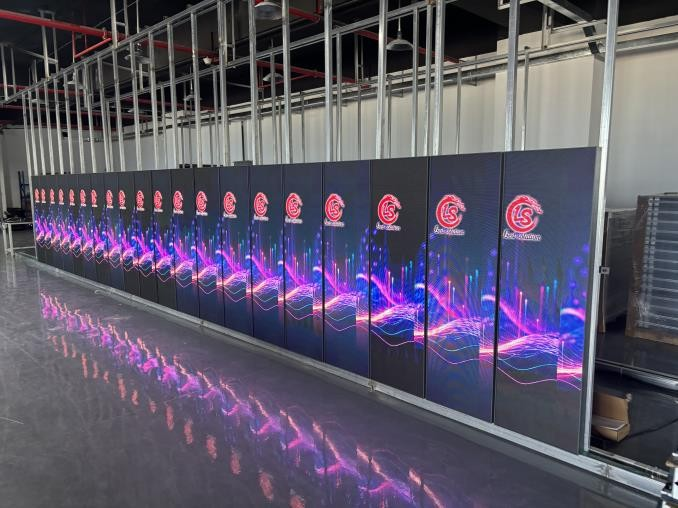
Ultra-thin cabinet design: Slim profiles as thin as 32.3mm (BYH V1 Series) enable seamless integration into any indoor space. Lightweight construction simplifies installation and reduces structural requirements.
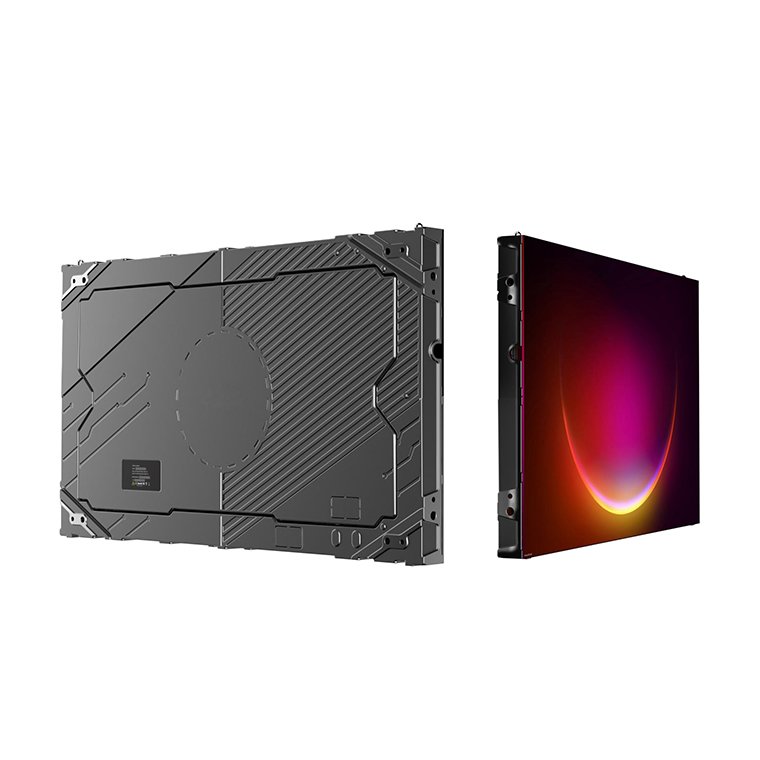
BYH V1 Series
- High contrast & wide color gamut – Vivid, realistic image quality.
- Excellent black uniformity – Consistent pure-black appearance.
- Wide-angle consistency – No visible seams or color shift at 160° view.
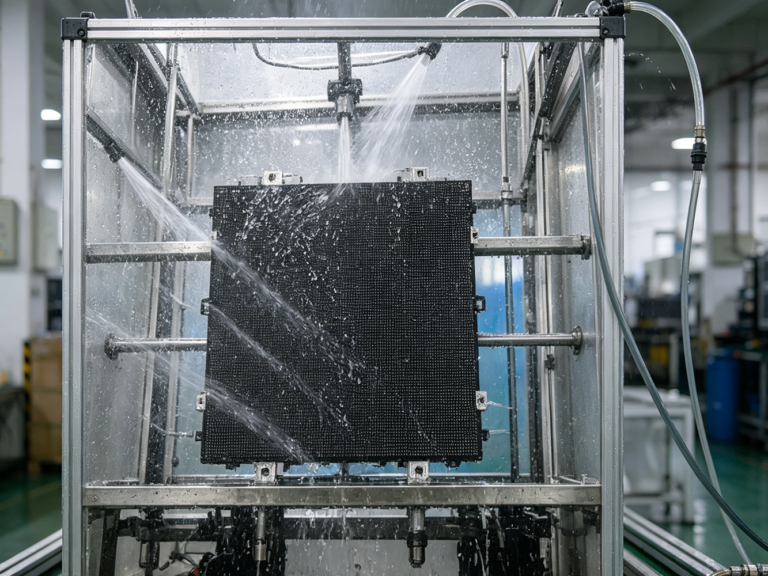
- Durable & easy to clean – IP65-rated, dirt-resistant surface.
- Ultra-slim design – <60mm thickness for space-saving installation.
- Fast & cost-efficient – 40% faster installation, saves $150+/sqm.
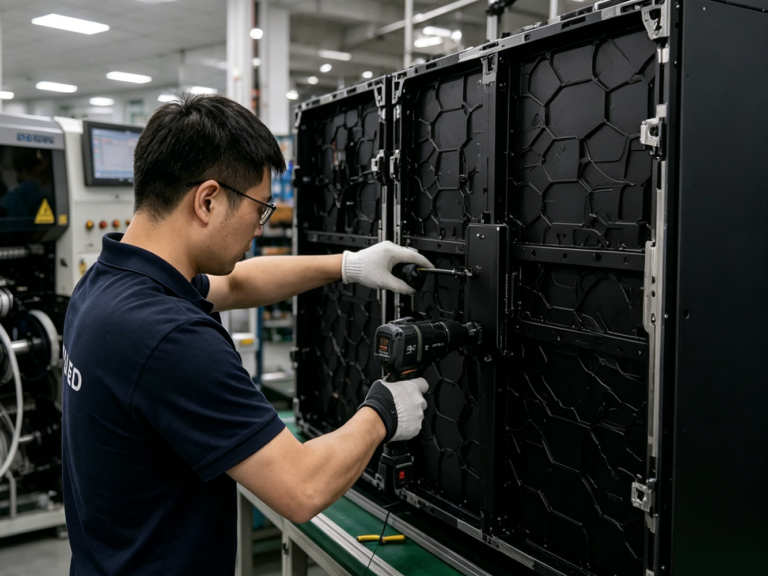
Front maintenance options: Our displays support front maintenance, ideal for wall-mounted installations where rear access is limited. Modules can be replaced quickly without removing the entire screen.
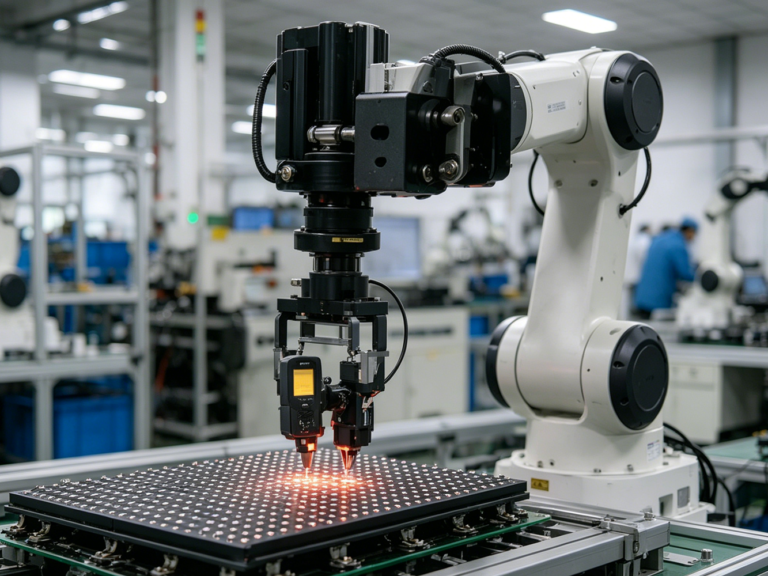
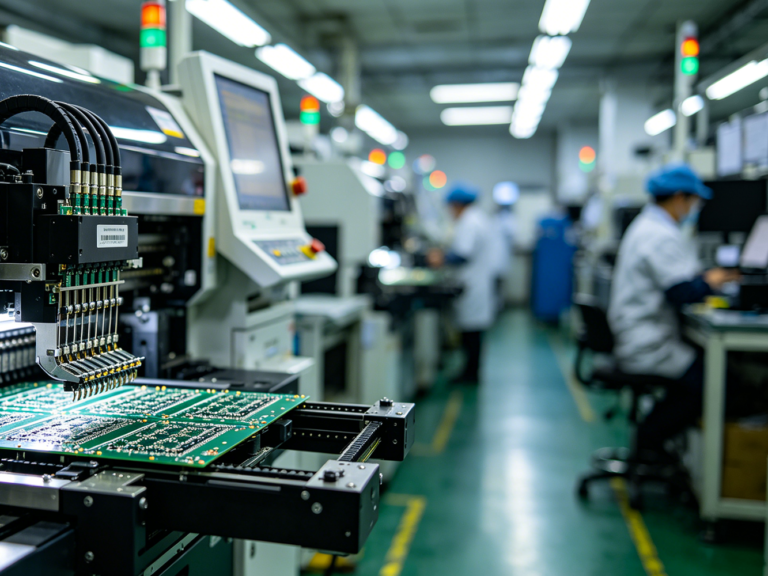
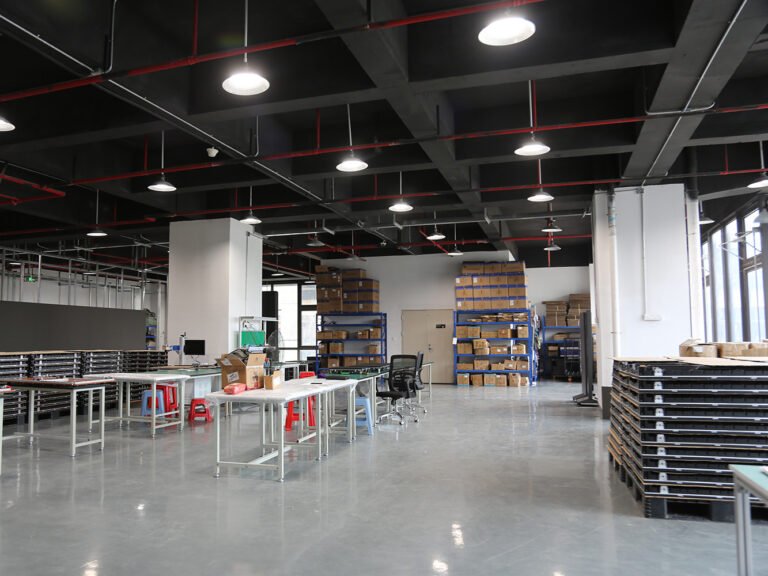
Quality assurance: Every IvanLED display undergoes a 72-hour aging test before shipment. We use components from internationally recognized brands such as Nationstar, Kinglight, and Meanwell. With a 3-year warranty and free spare modules (5% of order quantity) included, we stand behind the quality of our products.


Indoor vs Outdoor LED Displays: Key Differences
Indoor LED displays differ from outdoor displays in brightness (800-1,500 nits vs 4,500-6,000+ nits), IP rating (IP20-IP40 vs IP65+), pixel pitch (finer for indoor close viewing), and cooling (passive vs active).
| Factor | Indoor LED Display | Outdoor LED Display |
| Brightness | 800-1,500 nits | 4,500-6,000+ nits |
| IP rating | IP20-IP40 | IP65+ |
| Typical pixel pitch | P0.9-P6 | P4-P16 |
| Cooling | Passive (natural airflow) | Active (fans or AC) |
| Typical applications | Retail, corporate, events, churches | Billboards, building facades, stadiums |
For more on indoor vs outdoor, see our indoor vs outdoor LED display guide.
Common Mistakes When Buying Indoor LED Displays
The most common mistake is choosing a pixel pitch that is too small for the viewing distance — paying for resolution you cannot see. For a conference room viewed from 3 meters, P2.5 is sufficient; P1.2 would be wasted budget.
Other frequent errors:
- Ignoring maintenance access: Wall-mounted installations without rear access require front-maintenance displays
- Overlooking brightness needs: Areas with large windows or skylights need higher brightness (1,200-1,500 nits)
- No spare modules: Without spares purchased with the initial order, future repairs will have color mismatch
- Forgetting about controllers: The display is useless without compatible controllers and software
- Skipping the aging test: Without burn-in testing, defective modules may fail shortly after installation
Expert Tips for Indoor LED Display Buyers
Tip 1: Match pixel pitch to viewing distance.
Use the rule: pixel pitch (mm) = closest viewing distance (meters). For a conference room with viewers 2.5 meters away, P2.5 is ideal.
Tip 2: Choose front maintenance for wall-mounted installations.
If rear access is limited, front-maintenance displays allow module replacement without removing the screen.
Tip 3: Consider ambient light conditions.
Spaces with large windows need higher brightness (1,200-1,500 nits). Controlled lighting environments can use 800-1,000 nits.
Tip 4: Order spare modules.
Order 5-10% spare modules with your initial purchase to ensure color match for future repairs.
Tip 5: Verify the supplier’s quality assurance.
Ask about 72-hour aging tests, component brands, and warranty coverage. Quality manufacturers provide this information transparently.
Frequently Asked Questions (FAQ)
What pixel pitch is best for an indoor LED display?
The best pixel pitch depends on viewing distance. For viewing distances under 2 meters, choose P0.9-P1.5. For 2-3 meters, P1.5-P2.5. For 3-5 meters, P2.5-P4. For 4-8 meters, P4-P6. Match pixel pitch to your closest viewing distance.
What brightness do I need for an indoor LED display?
Indoor LED displays typically need 800-1,500 nits. Spaces with large windows or skylights need 1,200-1,500 nits. Controlled lighting environments can use 800-1,000 nits.
How much does an indoor LED display cost?
Indoor LED displays range from $700-$1,500/m² for standard P2.5-P4 displays to $1,500-$3,000+/m² for fine-pitch P1.2-P1.9 displays. Controllers and installation add 20-40% to the total project cost.
How long do indoor LED displays last?
Quality indoor LED displays last 50,000-100,000 hours — approximately 5-10 years of normal use. With proper operation (70-80% brightness) and adequate cooling, they can last even longer.
Does IvanLED offer indoor LED displays for different applications?
Yes. IvanLED manufactures indoor LED displays for retail, corporate, conference rooms, churches, and events.
Conclusion: Choose the Right Indoor LED Display
Choosing the right indoor LED display requires understanding pixel pitch, brightness, maintenance access, and total cost of ownership. The right choice ensures your display delivers excellent image quality, reliable performance, and long-term value.
Our straightforward advice:
– Match pixel pitch to viewing distance — do not over-specify.
– Choose brightness for your environment — 800-1,500 nits for indoor use.
– Select front maintenance for wall-mounted installations.
– Order spare modules (5-10%) with your initial purchase.
– Verify the supplier’s quality assurance — aging tests, component brands, and warranty.
At IvanLED, we manufacture indoor LED displays for all applications with high refresh rates, ultra-thin cabinets, and comprehensive quality assurance. Browse our LED display products or contact us to discuss your project requirements.