





Classification by Technology
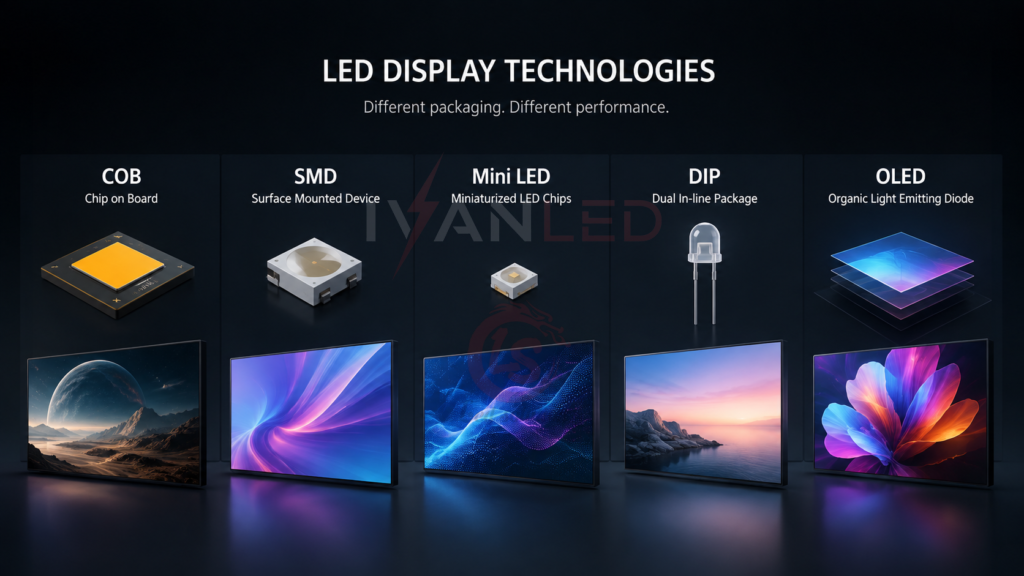
LED display technologies vary by how the LED chips are packaged and mounted. The main types are COB, SMD, Mini LED, DIP, and OLED. Each offers different advantages in brightness, resolution, and durability.
COB (Chip on Board): LED chips are directly mounted on a circuit board and encapsulated in a single layer. Offers vivid colors, excellent protection, and high durability. Suitable for indoor and outdoor applications.
SMD (Surface Mount Device): LED chips are mounted on a printed circuit board. Compact design with high resolution and color uniformity. Common in sports stadiums, retail stores, and conference rooms.
Mini LED: Uses chips measuring 100-200 microns. Features thousands of LEDs per display. Offers better contrast, higher peak brightness, and lower power consumption.
DIP (Dual In-line Package): Traditional LED packaging with two pin rows. High brightness for outdoor signage but lower resolution and heavier than newer technologies.
OLED: Each pixel emits light individually. Superior contrast ratio, vibrant colors, and fast response times. Dominates televisions and wearable devices.
For more on display technologies, see our LED Technologies Compared: SMD, COB, Mini & Micro LED.
Classification by Application
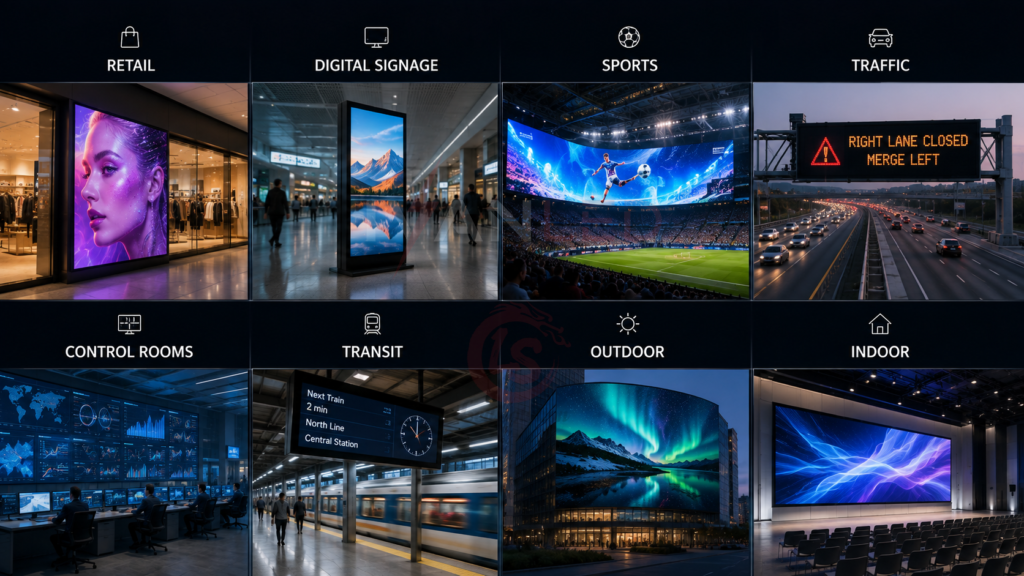
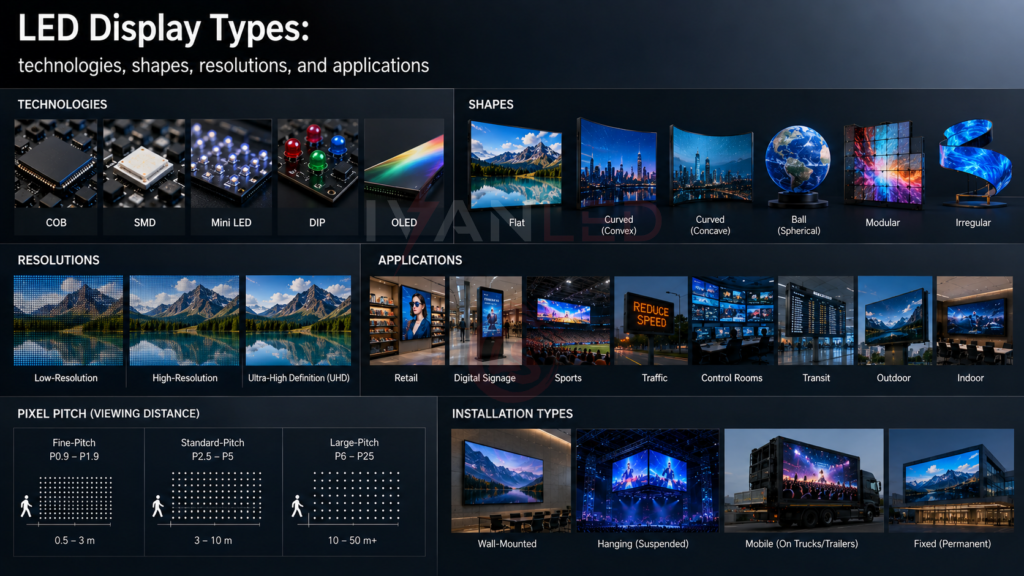
LED displays are designed for specific applications: retail, digital signage, sports, traffic, control rooms, transit, outdoor, and indoor. Each type has tailored specifications for brightness, durability, and content needs.
| Application | Key Features | Typical Use |
| Retail LED displays | Lightweight, fast-locking, affordable | Events, concerts, temporary installations |
| Digital signage | High brightness, 100,000+ hours lifespan | Advertising, corporate communications |
| Sports LED displays | High clarity, vibrant colors, energy efficient | Stadiums, replays, game statistics |
| Traffic LED displays | Durable, weatherproof, high visibility | Highways, road closures, lane information |
| Control room displays | High resolution, customizable, 24/7 reliability | Security monitoring, data visualization |
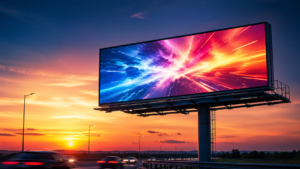
| Outdoor displays | 5,000-10,000 nits, IP65 weatherproof | Billboards, roadside signs, stadiums |
| Indoor displays | High image clarity, lower brightness | Stages, exhibitions, retail interiors |
For more on applications, see our LED display solutions.
Classification by Shape
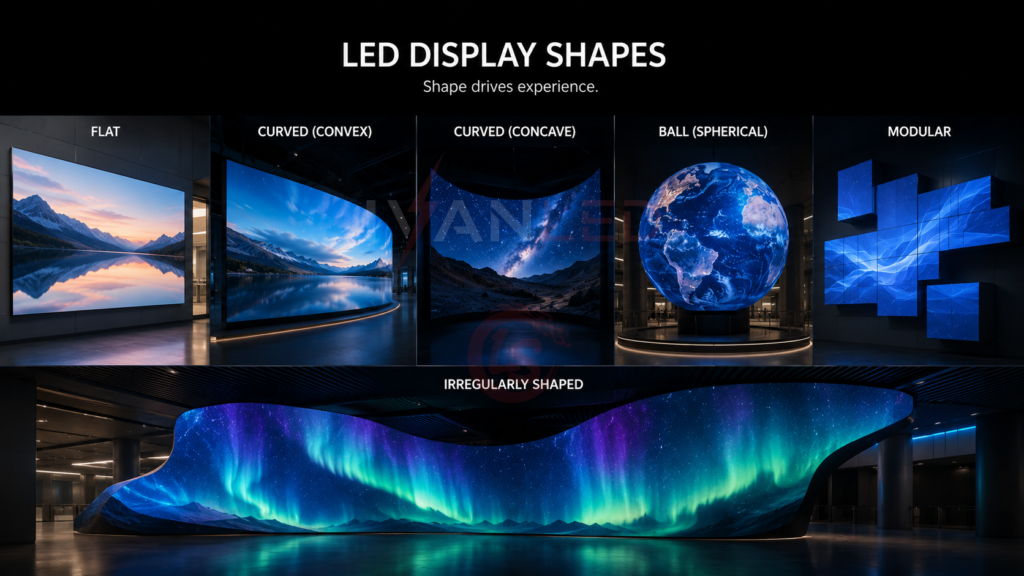
LED displays come in various shapes: flat, curved (convex and concave), ball (spherical), modular, and irregularly shaped. Shape affects both aesthetic value and functionality.
Flat LED displays: Ultra-thin, simple, sleek appearance. Suitable for most standard applications including entertainment and advertising.
Curved LED displays: Convex (outward curve) for wider viewing angles and advertising. Concave (inward curve) for immersive experiences in cinemas and theaters.
LED ball displays: 360-degree viewing area. Common in stadiums, museums, and retail spaces. Available in sizes from 0.5m to 5m diameter.
Modular LED displays: Interchangeable modules allow scaling up or down. Can be configured into irregular or cylindrical shapes.
Irregularly shaped displays: Custom shapes for attention-grabbing installations in shopping malls and event staging.
For more on curved displays, see our curved LED display guide.
Classification by Color
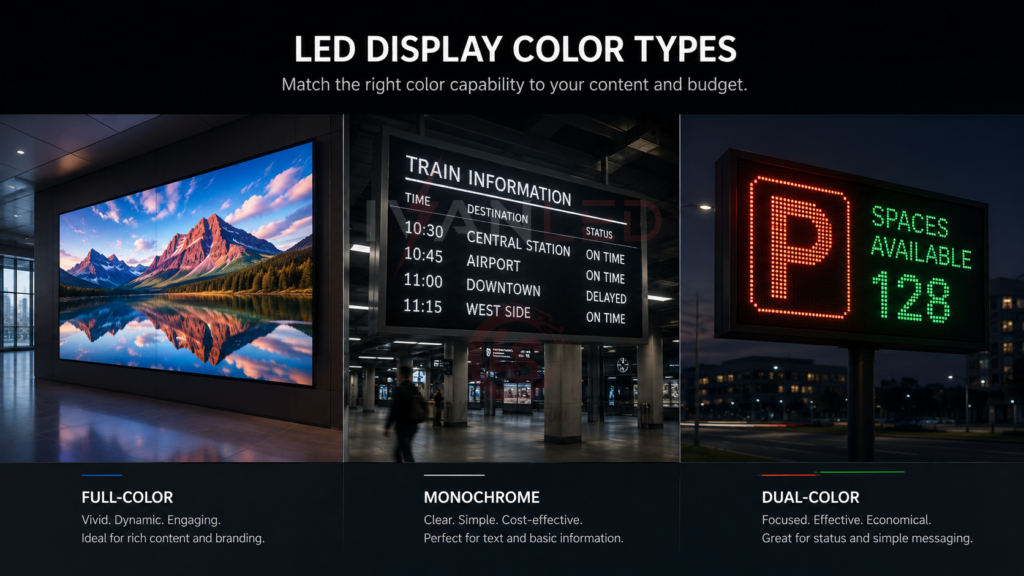
LED displays are classified by color capability: full-color, monochrome, and dual-color. The choice depends on content complexity and budget.
Full-color LED displays: Generate millions of colors using RGB combinations. Suitable for advertising, entertainment, and any application requiring dynamic visuals.
Monochrome LED displays: Produce only one color. Used for simple text messages in transit stations and traffic signage. Lower cost and easier maintenance.
Dual-color LED displays: Produce two colors. More visually appealing than monochrome. Common in banks and transportation systems.
Classification by Resolution
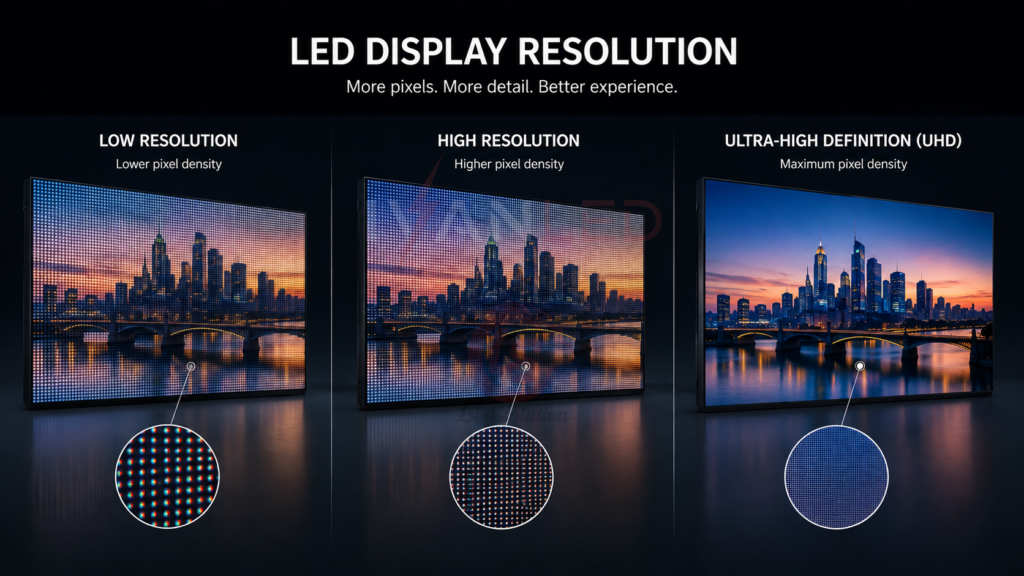
Resolution determines image clarity. LED displays are categorized as low-resolution, high-resolution, and ultra-high definition (UHD). Higher resolution means more pixels per square meter and sharper images.
Low-resolution LED displays: Lower pixel density. Suitable for simple visuals viewed from a distance. Common in stadiums and large public spaces.
High-resolution LED displays: Higher pixel density for sharper images. Suitable for corporate lobbies, retail stores, and outdoor public spaces.
Ultra-high definition (UHD) LED displays: 3840 x 2160 resolution. Near life-like images. Suitable for home entertainment and professional displays.
For more on resolution, see our LED screen resolution guide.
Classification by Installation Method
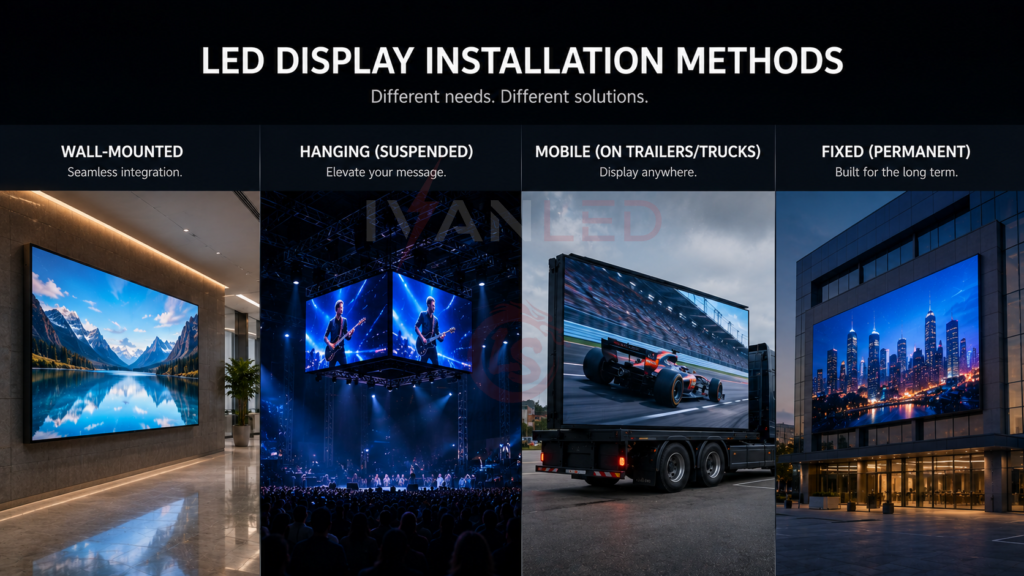
LED displays are installed in four main ways: wall-mounted, hanging (suspended), mobile (on trailers or trucks), and fixed (permanent). The method depends on venue, mobility needs, and application.
Mobile LED displays: Mounted on trailers or trucks. Lightweight and easy to transport. Content can be updated remotely. Ideal for events and changing locations.
Wall-mounted LED displays: Sleek design, saves floor space. Customizable with SMD or DIP technology. Common in offices, retail, and lobbies.
Fixed LED displays: Permanent installation. Robust materials, weather-resistant enclosures. Common in outdoor billboards and stadiums.
Hanging (suspended) LED displays: Suspended from ceilings or structures. Creates floating visual effects. Requires load-bearing support and skilled installation.
Classification by Pixel Pitch
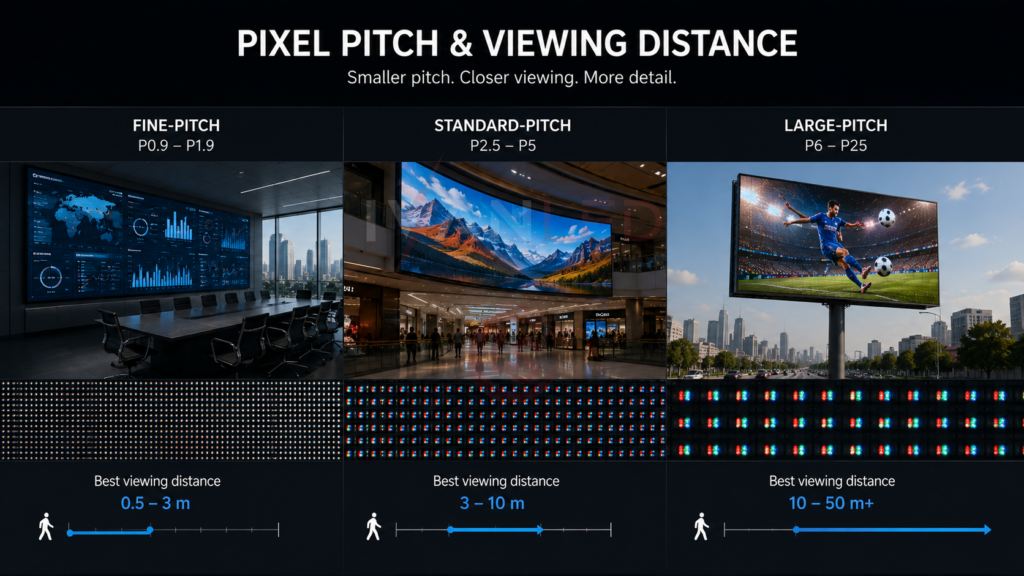
Pixel pitch determines image clarity and optimal viewing distance. LED displays are classified as fine-pitch (P0.9-P1.9), standard-pitch (P2.5-P5), and large-pitch (P6-P25).
Fine-pitch LED displays (P0.9-P1.9): Extremely small pixel pitch for close-up viewing. Suitable for control rooms, broadcast studios, and premium indoor applications.
Standard-pitch LED displays (P2.5-P5): Medium pixel pitch for moderate viewing distances. Common in conference halls, retail stores, and indoor events.
Large-pitch LED displays (P6-P25): Large pixel pitch for long-distance viewing. P6 for indoor moderate distances; P25 for outdoor long distances. Common in large LED screens and billboards.
For more on pixel pitch, see our pixel pitch guide.
Other LED Display Types
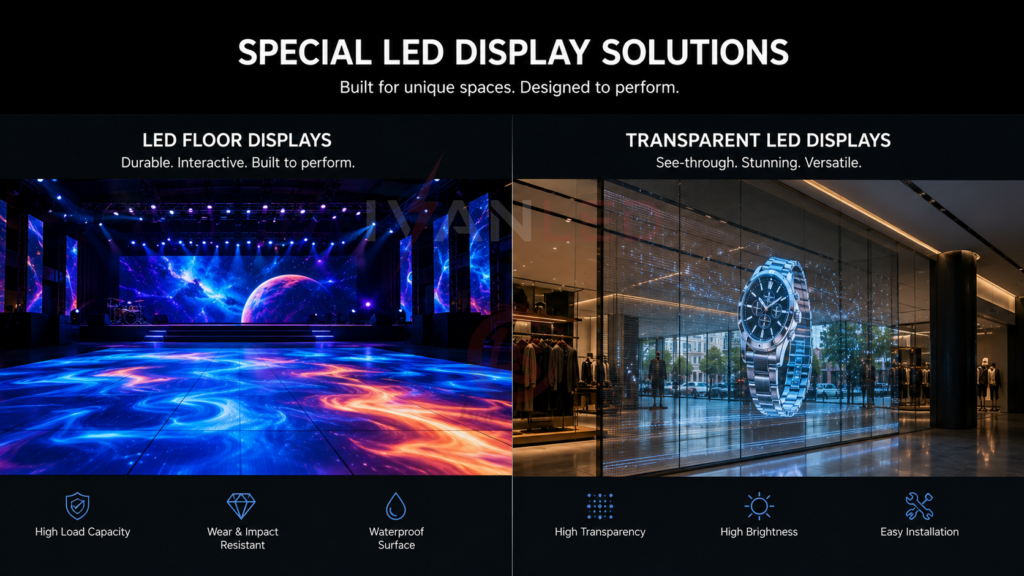
Two additional LED display types are worth noting: LED floor displays (for stage floors with high durability) and transparent LED displays (see-through glass-like screens for retail and architectural applications).
LED floor displays: Installed on stage floors. Made from materials that withstand heavy foot traffic. Some models include sensor technology for movement tracking.
Transparent LED displays: Glass-like transparency with light bar technology. Transmission rates up to 70%. Lightweight and customizable. Ideal for retail windows and architectural integration.
For more on transparent displays, see our transparent LED wall guide.
Common Mistakes When Choosing LED Display Types
The most common mistake is choosing a display type based solely on price without considering application requirements. A low-cost indoor display will fail outdoors; a high-brightness outdoor display will be painfully bright indoors.
Other frequent errors:
- Mismatching pixel pitch to viewing distance: Fine pitch for long distances wastes budget; large pitch for close viewing looks pixelated
- Ignoring environmental factors: Indoor displays lack weatherproofing for outdoor use
- Overlooking maintenance access: Some installations require front access; others allow rear access
- Not considering installation method: Hanging displays require load-bearing structures; wall-mounted need appropriate wall strength
Expert Tips for Selecting LED Display Types
Tip 1: Match technology to environment.
SMD for most applications; COB for durability and protection; OLED for premium contrast; DIP for simple outdoor signage.
Tip 2: Choose pixel pitch based on viewing distance.
Fine pitch (P0.9-P1.9) for under 2 meters; standard pitch (P2.5-P5) for 2-5 meters; large pitch (P6+) for over 5 meters.
Tip 3: Consider installation method early.
Wall-mounted, hanging, and mobile installations have different structural and electrical requirements. Plan during the design phase.
Tip 4: Order spare modules.
Order 5-10% spare modules with your initial purchase to ensure color match for future repairs.
Tip 5: Request a demo.
View the display type with your actual content at the intended viewing distance before finalizing.
Frequently Asked Questions (FAQ)
What is the difference between SMD and COB LED displays?
SMD (Surface Mount Device) mounts individual LEDs on a PCB. COB (Chip on Board) mounts multiple LED chips directly on a circuit board with a single encapsulation layer. COB offers better durability and protection; SMD is more common and cost-effective for most applications.
What pixel pitch do I need for my application?
Pixel pitch determines optimal viewing distance. Fine pitch (P0.9-P1.9) for under 2 meters. Standard pitch (P2.5-P5) for 2-5 meters. Large pitch (P6+) for over 5 meters. Match pitch to your closest viewer distance.
Can outdoor LED displays be used indoors?
Technically yes, but not recommended. Outdoor displays are extremely bright (4,500-10,000 nits) and will cause eye strain indoors. They are also heavier, more expensive, and consume more power than indoor-specific displays.
Which LED display type is best for retail advertising?
For retail advertising, SMD displays with standard pixel pitch (P2.5-P4) are typically best. They offer good image quality at reasonable cost. For window displays, transparent LED displays are ideal. For high-traffic retail, COB displays offer better durability.
Does IvanLED offer different types of LED displays?
Yes. IvanLED manufactures a wide range of LED display types including SMD, COB, indoor, outdoor, rental, fixed, curved, flexible, and transparent displays. Browse our LED display products or contact us to discuss your project requirements.
Conclusion: Choosing the Right LED Display Type
LED displays come in many types — each designed for specific applications, environments, and budgets. Understanding the classifications by technology, application, shape, color, resolution, installation method, and pixel pitch helps you choose the right display for your project.
Our straightforward advice:
– Match technology to environment: SMD for most; COB for durability; OLED for premium contrast.
– Choose pixel pitch by viewing distance: Fine for close; standard for moderate; large for long distances.
– Consider installation method early: Wall-mounted, hanging, or mobile — each has different requirements.
– Always consider environmental factors: Indoor vs outdoor, temperature, humidity, and UV exposure.
– Order spare modules (5-10%) with your initial purchase.
At IvanLED, we manufacture a wide range of LED display types for indoor, outdoor, retail, rental, and architectural applications.