









Buyer Pain Points: Transparent LED Wall Confusion
Buyers face specific challenges when evaluating transparent LED walls:
Can transparent LED walls really be that transparent? Yes. Quality transparent LED walls achieve 60-90% transparency, meaning you can see through the screen when it is off or displaying dark content.
Are they bright enough for outdoor use? It depends. Front-emitting designs reach 5,000+ nits for outdoor visibility. Side-emitting designs are better for indoor use where transparency is prioritized.
How do they compare to traditional LED screens? Traditional LED screens are opaque and block visibility. Transparent LED walls preserve the view while adding dynamic content — a fundamental difference in application.
Are they difficult to install? Transparent LED walls are lightweight (as low as 14kg/m²) and require minimal structural support compared to traditional LED walls.
What about maintenance? Most transparent LED walls offer front maintenance, allowing quick access without dismantling the screen.
What Is a Transparent LED Wall?
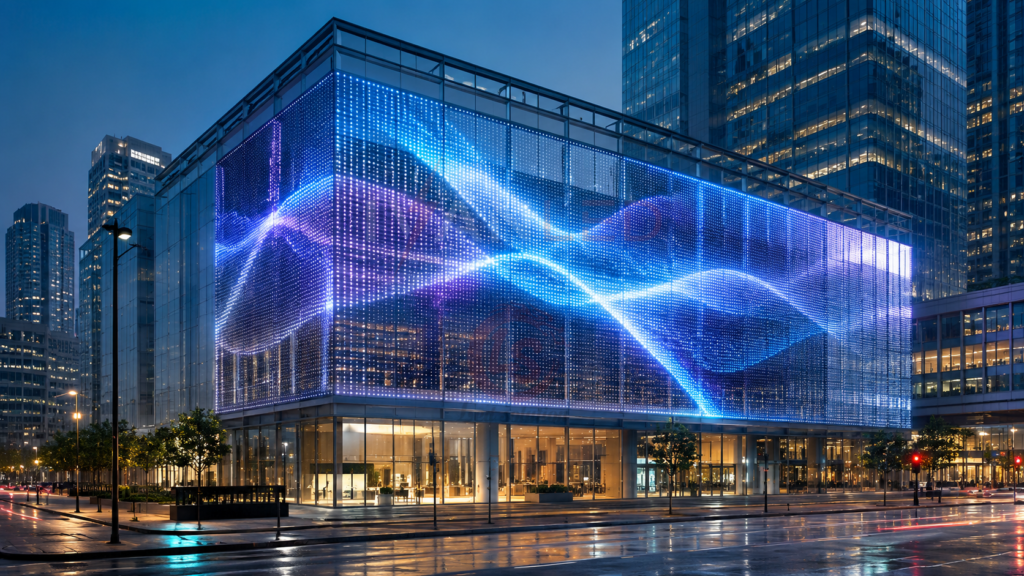
A transparent LED wall is a display that uses specially designed LED strips and transparent substrates to achieve 60-90% light transmittance while displaying full-color video content. It allows viewers to see through the screen while watching dynamic visuals.
Key characteristics:
- High transparency: 60-90% light transmittance
- Ultra-thin design: As thin as 10mm
- Lightweight: As light as 14kg/m²
- Modular construction: Customizable sizes and shapes
- Energy efficient: Average power consumption under 280W/m²
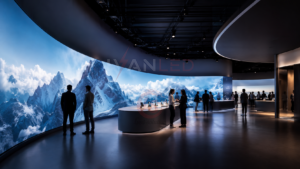
Transparent LED walls are widely used in retail storefronts, building facades, exhibition halls, museums, and corporate lobbies where both transparency and digital content are desired.
How Does a Transparent LED Wall Work?
A transparent LED wall works by mounting LED chips on transparent substrates (glass or acrylic) with gaps between the LEDs that allow light to pass through. When the screen is on, the LEDs create images; when it is off, the screen becomes nearly invisible.
The technical process:
- LED arrangement: LED chips are mounted on a transparent substrate in a grid pattern with strategic gaps
- Light emission: Each LED emits light in a specific direction (side-emitting or front-emitting)
- Transparency maintenance: Background areas remain transparent as LEDs only light up for content
- Content mapping: The control system maps content to the LED array
- Dynamic display: Content appears to float in space while the screen remains see-through
The key takeaway: Transparent LED walls are not magic — they are clever engineering that balances pixel density with transparency to create a stunning visual effect.
Types of Transparent LED Walls
Transparent LED walls come in two main types: side-emitting (prioritizes transparency) and front-emitting (prioritizes brightness). Your choice depends on the installation environment and visual requirements.
| Feature | Side-Emitting LED | Front-Emitting LED |
| Light transmittance | 70-90% | 50-70% |
| Brightness (nits) | Lower (indoor use) | Higher (5,000+ for outdoor) |
| Color performance | Good | Excellent (vivid, high contrast) |
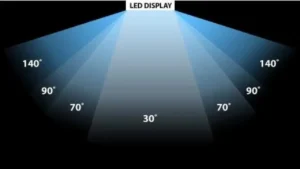
| Viewing angle | Limited (brightness drops off-angle) | Wide (clear from most angles) |
| Module thickness | Thinner | Slightly thicker |
| Best for | Retail windows, indoor glass facades | Outdoor advertising, stage performances |
Are Transparent LED Walls Worth the Investment?
Transparent LED walls are worth the investment for high-visibility commercial spaces where brand image, customer engagement, and spatial aesthetics are priorities. The ROI comes from increased foot traffic, extended dwell time, and enhanced brand perception.
Consider the value proposition:
- Brand impact: A transparent LED wall creates a “wow” factor that static signage cannot match
- Advertising revenue: Dynamic content can be sold to multiple advertisers or rotated for different campaigns
- Space efficiency: Displays content without blocking views or taking floor space
- Energy savings: Transparent LED walls consume less power than traditional signage and lighting combined
- Long lifespan: 50,000+ hours (8-10 years of normal use)
For a complete LED display price guide 2026, see our detailed breakdown.
Transparent LED Wall Applications
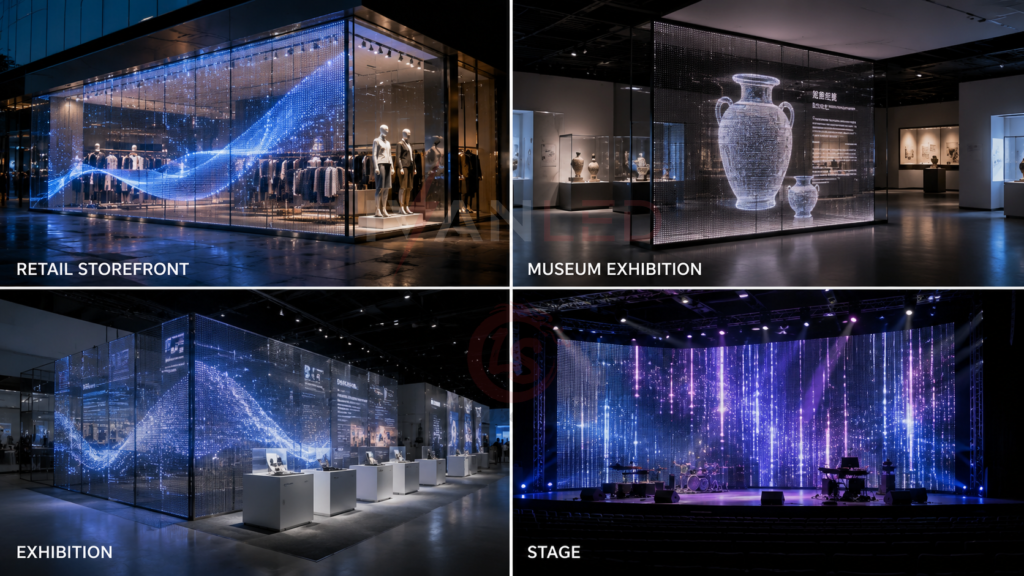
Transparent LED walls are transforming how brands communicate in retail, architecture, events, and public spaces. Their versatility makes them suitable for a wide range of applications.
| Application | Why Transparent LED Works | Best Use Case |
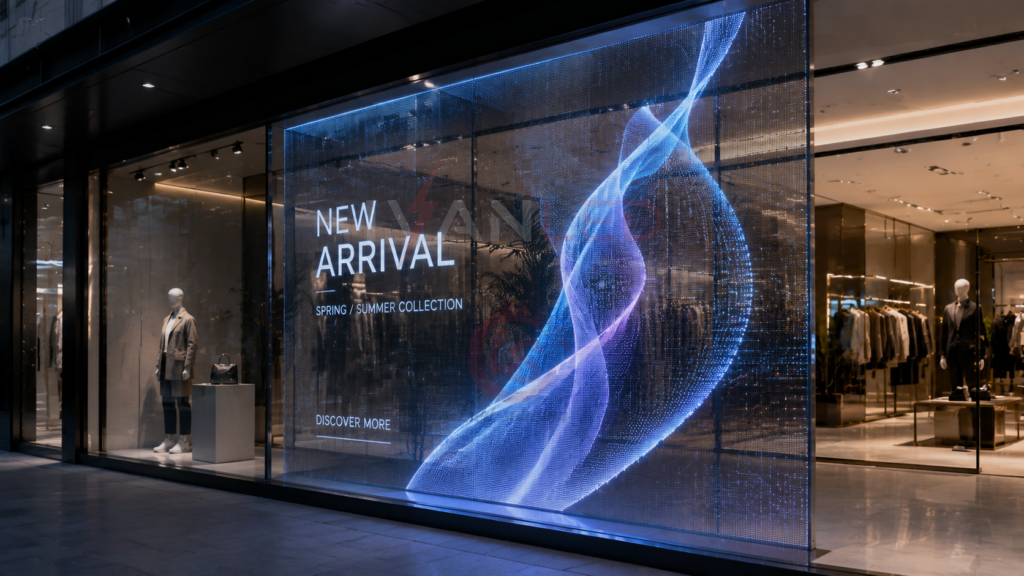
| Retail storefronts | Maintains window visibility while displaying promotions | Fashion, luxury, automotive showrooms |
| Building facades | Integrates with glass curtain walls without blocking light | Commercial buildings, hotels, airports |
| Museums & exhibitions | Adds interactive content without cluttering exhibit spaces | Cultural institutions, trade shows, galleries |
| Stage performances | Creates floating visual effects for dramatic impact | Concerts, theater, product launches — see our stage rental LED screen guide |
| Corporate lobbies | Displays brand content without obstructing office views | Headquarters, innovation centers, reception areas |
| Transportation hubs | Shows wayfinding and advertising in glass-heavy spaces | Airports, train stations, bus terminals |
How to Choose the Right Transparent LED Wall
Choosing the right transparent LED wall requires balancing transparency, brightness, pixel pitch, and installation environment. Start with your viewing distance and ambient light conditions.
Key selection criteria:
Transparency: For retail windows and building facades where background visibility is critical, choose 80-90% transparency (side-emitting). For high-brightness outdoor applications, choose 50-70% transparency (front-emitting).
Brightness: Indoor environments require 500-1,500 nits. Outdoor installations require 5,000+ nits for sunlight visibility.
Pixel pitch: Smaller pixel pitch = higher resolution = clearer images. For viewing distances under 3 meters, choose P3–P4. For distances over 5 meters, P5–P8 is sufficient.
Installation method: Fixed installation for permanent walls; mobile installation for events and temporary displays.
Maintenance access: Front maintenance is recommended for wall-mounted installations where rear access is limited.
For more on choosing the right display, see our pixel pitch selection guide.
Common Mistakes When Buying Transparent LED Walls
The most common mistake is choosing a side-emitting screen for outdoor use. Side-emitting designs have lower brightness (1,500–2,500 nits) and will be invisible in direct sunlight.
Other frequent errors:
- Overlooking viewing angle limitations: Side-emitting screens have narrower optimal viewing angles
- Underestimating installation complexity: Glass curtain wall integration requires careful engineering
- Forgetting about content requirements: Dark backgrounds and high contrast content work best on transparent screens
- Not checking IP rating for outdoor use: Outdoor screens need IP65+ weatherproofing
- Ignoring structural requirements: Even lightweight screens need proper mounting support
Expert Tips for Transparent LED Wall Buyers
Tip 1: Match the type to your environment.
Side-emitting for indoor, high-transparency applications (retail windows, lobbies). Front-emitting for outdoor or high-ambient-light environments.
Tip 2: Test your content.
Transparent LED walls perform best with dark backgrounds, high contrast, and simple compositions. Test your actual content before finalizing the screen purchase.
Tip 3: Plan for maintenance access.
Ensure your installation allows for front access to modules. Transparent LED walls are designed for front maintenance — rear access is not always possible on glass curtain walls.
Tip 4: Consider the viewing position.
Transparent LED walls have an optimal viewing position. Design your installation to maximize visibility from the most trafficked areas.
Tip 5: Order spare modules.
Order 5-10% spare modules with your initial purchase. LED batches change over time, and spare parts purchased later may not match.
Frequently Asked Questions (FAQ)
What is the difference between side-emitting and front-emitting transparent LED walls?
Side-emitting LED walls have LED chips mounted on the side of the PCB, achieving 70-90% transparency but lower brightness. Front-emitting LED walls have LEDs facing the viewer, offering higher brightness (5,000+ nits) with 50-70% transparency. Choose side-emitting for indoor transparency; front-emitting for outdoor visibility.
Can transparent LED walls be used outdoors?
Yes, but only front-emitting transparent LED walls with high brightness (5,000+ nits) and IP65+ weatherproofing are suitable for outdoor use. Side-emitting screens have lower brightness and are designed for indoor applications.
How much does a transparent LED wall cost?
Transparent LED walls typically cost 2-4x more than traditional LED screens of the same size, ranging from $1,500 to $4,000+ per m² depending on pixel pitch, transparency, and brightness. Contact your supplier for a custom quote based on your specific requirements.
What transparency do I need for a retail window display?
For retail window displays, 80-90% transparency (side-emitting) is recommended to maintain window visibility while displaying dynamic content. Lower transparency screens will block the view and defeat the purpose of a glass storefront.
How do I maintain a transparent LED wall?
Transparent LED walls require minimal maintenance. Regular cleaning of the glass surface (when the screen is off), periodic inspection of power and signal connections, and prompt replacement of any faulty modules. Most transparent LED walls support front maintenance for quick access.
Does IvanLED offer transparent LED wall solutions?
Yes. IvanLED manufactures transparent LED walls in both side-emitting and front-emitting configurations, with custom sizes, resolutions, and transparency levels. Contact us to discuss your project requirements.
Conclusion: Is a Transparent LED Wall Right for Your Project?
Transparent LED walls are a powerful tool for retail, architecture, and events. They combine the visual impact of digital content with the spatial openness of glass, creating stunning visual experiences that traditional screens cannot match.
Our straightforward advice:
– For retail windows and indoor glass facades: Choose side-emitting transparent LED walls with 80-90% transparency.
– For outdoor building facades and high-brightness environments: Choose front-emitting transparent LED walls with 5,000+ nits brightness and IP65+ weatherproofing.
– Always consider viewing position, content requirements, and maintenance access when planning your installation.
– Test your content on the actual screen before finalizing to ensure the best visual results.
At IvanLED, we manufacture high-quality transparent LED walls for retail, architectural, and event applications. Browse our commercial LED display solutions or contact us to discuss your project requirements.
Ready to elevate your space with a transparent LED wall?
👉 Contact IvanLED for a free consultation and customized quote.