









What Materials Are Used in LED Screens?
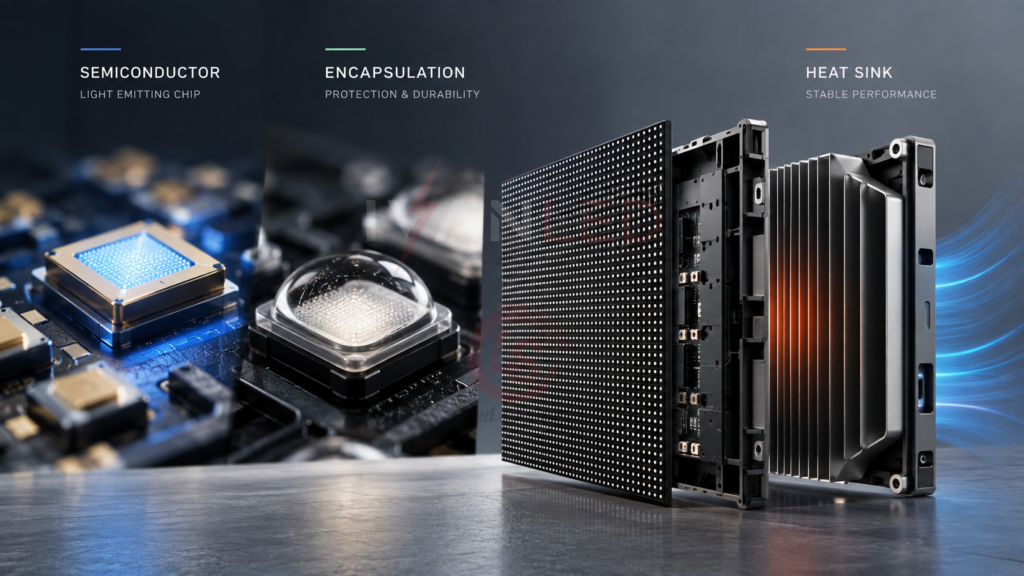
LED screens are built from five core material categories: semiconductor materials that emit light, substrate materials that support the chips, encapsulation materials that protect them, conductive materials that carry electricity, and heat dissipation materials that keep everything cool.
Each category plays a critical role in the display’s performance and longevity. The quality of these materials varies significantly between manufacturers, which explains why similar-looking displays can have vastly different price tags and lifespans.
For more on display quality, see our LED screen quality guide.
Core Components of LED Screens
Every LED display consists of three core components: the individual LEDs that emit light, the modules that group them together, and the display panels that provide the structural framework.
Light-emitting diodes (LEDs): The fundamental light sources. When an electric current passes through them, they emit light. The quality and efficiency of the LEDs determine brightness, color accuracy, and energy consumption.
LED modules: Multiple LEDs arranged on a single board. These are the building blocks of the screen, allowing for scaling and customization based on display size.
Display panels: The assembled units that house LED modules. They provide the structural framework and protective casing for the LEDs and electronics.
For more on LED components, see our LED lamp bead selection guide.
Semiconductor Materials in LEDs
Gallium nitride (GaN) is the most important semiconductor material for modern LEDs, enabling blue and white light emission. Gallium arsenide (GaAs) is used for infrared LEDs. These materials have direct bandgap properties that enable efficient light emission.
Gallium-based compounds: GaN is used for blue and white LEDs. GaAs is used for infrared LEDs. Both offer efficient light emission.
Indium gallium zinc oxide (IGZO): A transparent semiconducting material used in thin-film transistors. It improves display resolution and reduces power consumption.
The semiconductor material determines the color and efficiency of the LED. Higher-quality materials produce brighter, more accurate colors with less energy consumption.
Substrate Materials
Sapphire is the most common substrate material for LED manufacturing due to its hardness and chemical stability. Silicon carbide (SiC) offers better thermal conductivity but at higher cost. Silicon is the most cost-effective option but can reduce LED performance due to lattice mismatch.
Sapphire: Hard, chemically stable, and provides stable support for the epitaxial layer. However, its thermal conductivity is poor.
Silicon carbide (SiC): Excellent thermal conductivity improves heat dissipation. The lattice constant is suitable for gallium nitride, resulting in higher layer quality.
Silicon: Cost-effective and widely used in the semiconductor industry. However, lattice mismatch with GaN can degrade LED performance.
Encapsulation and Lens Materials
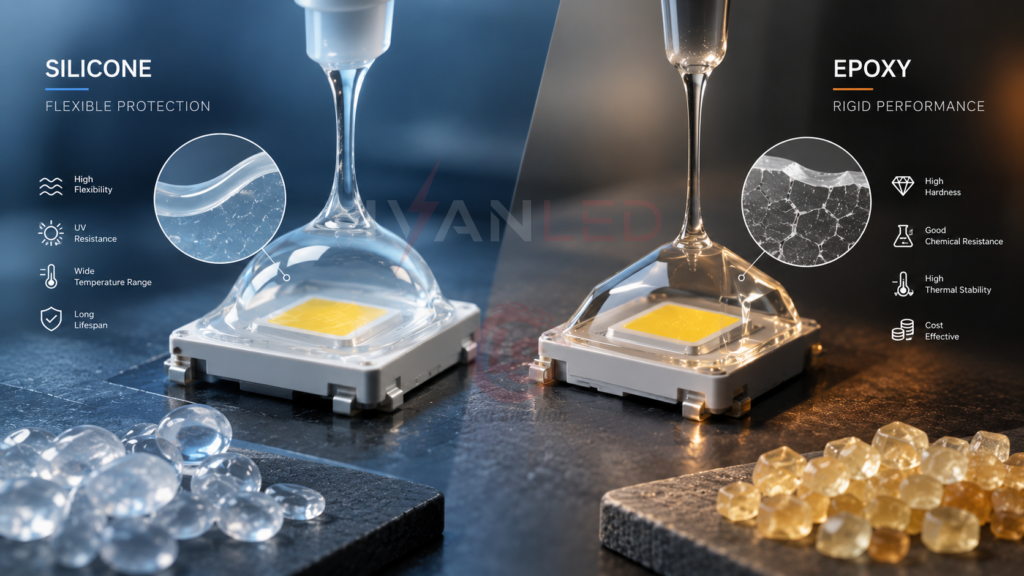
Silicone and epoxy resins are the primary encapsulation materials for LED chips. Silicone offers superior UV resistance and thermal stability for high-power LEDs. Epoxy resins provide good adhesion and are more cost-effective for standard applications.
Epoxy resins: Used for encapsulation due to excellent adhesion and transparency. They provide good protection at lower cost.
Silicone materials: Offer high UV resistance and aging resistance. Silicone has light transmittance proportional to luminous intensity and efficiency.
Optical lenses: Made from optical-grade plastics or glass. They focus or spread light to achieve the desired visual effect.
The encapsulation material protects the LED chip from moisture, dust, and physical damage while maintaining light transmission.
Conductive Materials
Gold and copper are the primary conductive materials for LED electrodes. Gold offers excellent conductivity and reliability in unstable environments. Copper is more cost-effective but has higher oxidation, reducing lifespan in certain conditions.
Metals for electrodes: Gold is used for high-reliability applications. Copper is cost-effective but requires protection from oxidation.
Transparent conductive oxides (TCOs): Indium tin oxide (ITO) and fluorine-doped tin oxide (FTO) are widely used. They allow light emission and electrical conductivity simultaneously.
The choice of conductive materials affects electrical efficiency and long-term reliability.
Phosphor Materials for Color Conversion
YAG (yttrium aluminum garnet) phosphors are used to create white LEDs by converting blue light to yellow. Quantum dots are semiconductor nanocrystals that improve color accuracy and brightness by emitting pure red and green light when excited by blue light.
YAG phosphors: Absorb blue light and emit yellow light. The remaining blue light mixes with yellow to create white light. The amount of phosphor varies the color temperature.
Quantum dots: Semiconductor nanocrystals that emit light when excited. They produce pure red and green light, expanding the color gamut and creating more vivid colors.
Phosphor materials determine the color quality and accuracy of the display.
Heat Dissipation Materials
Heat sinks made from aluminum or copper absorb and dissipate heat from LED components. Thermal interface materials (TIMs) bridge microscopic gaps between components and heat sinks to improve thermal conductivity.
Thermal interface materials (TIMs): Bridge gaps between LED components and heat sinks. Available as pastes, pads, or tapes. Proper selection ensures effective heat transfer.
Heat sinks: Designed to absorb and dissipate heat. Aluminum and copper offer excellent thermal conductivity. Heat sinks increase surface area to transfer heat away from the LED.
Protective and Structural Materials
Aluminum alloys are the primary material for housings and frames due to their lightweight and unique properties. Encapsulation materials like silicone and epoxy protect the LED chips from environmental damage.
Encapsulation materials: Silicone offers thermal stability and moisture resistance for high-power LEDs. Epoxy resins provide good adhesion and economy for outdoor LED lighting.
Housing and frames: Aluminum alloys provide a secure and aesthetically pleasing framework. Material selection is critical for performance and lifespan.
Emerging Materials: Perovskite and 2D Materials
Perovskite materials and two-dimensional materials like graphene are emerging as next-generation LED materials. Perovskites offer high color purity and efficiency at lower production costs. 2D materials enable ultra-thin, flexible, and efficient displays.
Perovskite materials: Offer excellent light-emitting properties with high color purity and efficiency. Their tunable bandgap allows for vivid colors and high brightness. Research is ongoing to improve stability for commercial applications.
Two-dimensional materials: Graphene and transition metal dichalcogenides (TMDs) enable ultra-thin, flexible displays. Micro LEDs based on 2D materials can achieve high pixel density and small sizes.
These emerging materials promise lighter, more flexible, and more efficient displays in the future.
Common Mistakes When Evaluating LED Screen Materials
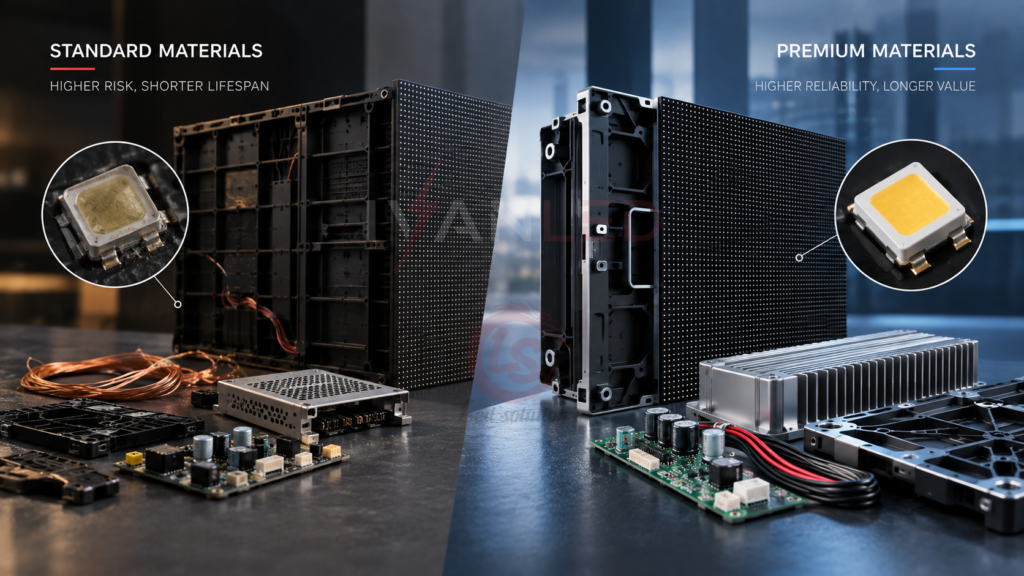
The most common mistake is comparing LED screens based only on pixel pitch and brightness while ignoring material quality. Cheap displays often use inferior semiconductor materials, poor encapsulation, and inadequate heat dissipation — leading to premature failure and color degradation.
Other frequent errors:
- Ignoring heat dissipation: Poor thermal management is the #1 cause of premature LED failure. Aluminum heat sinks and proper TIMs are essential.
- Overlooking encapsulation quality: Low-quality silicone or epoxy cracks and yellows over time, reducing brightness and color accuracy.
- Not asking about conductive materials: Copper electrodes without proper oxidation protection will fail over time. Gold is more reliable.
- Forgetting about phosphor quality: Cheap phosphors degrade faster, causing color shift and reduced brightness.
Expert Tips for Evaluating Material Quality
Tip 1: Ask about the semiconductor material.
Quality LEDs use gallium nitride (GaN) for blue and white LEDs. Ask your supplier what materials they use — the answer reveals their quality level.
Tip 2: Verify heat dissipation design.
Check for aluminum heat sinks and proper thermal interface materials. Poor heat dissipation leads to rapid brightness decay and premature failure.
Tip 3: Ask about encapsulation material.
Silicone is superior to epoxy for high-power and outdoor applications. It offers better UV resistance and thermal stability.
Tip 4: Consider the conductive materials.
Gold electrodes offer better reliability than copper, especially in outdoor or humid environments. Ask what is used in your display.
Tip 5: Request L70/L80 lifespan data.
Material quality directly affects lifespan. L70 data (hours until brightness drops to 70%) is the best indicator of overall material quality.
For more on lifespan, see our LED display light attenuation guide.
Frequently Asked Questions (FAQ)
What is the most important material in an LED display?
The semiconductor material (gallium nitride for blue/white LEDs) is most important as it determines light emission efficiency and color quality. However, all material categories — substrate, encapsulation, conductive, and heat dissipation — must be quality to achieve long lifespan.
Why do similar-looking LED displays have such different prices?
Price differences come from material quality. Cheap displays use lower-grade semiconductor materials, epoxy instead of silicone encapsulation, copper electrodes without oxidation protection, and inadequate heat sinks. These compromises reduce lifespan and image quality.
Does heat dissipation material really matter for LED lifespan?
Yes. Heat is the #1 cause of LED failure. Proper heat sinks (aluminum) and thermal interface materials can extend LED lifespan by 2-3x. Poor heat dissipation accelerates brightness decay and can cause permanent damage.
What is the difference between silicone and epoxy encapsulation?
Silicone offers superior UV resistance, thermal stability, and aging resistance — ideal for high-power and outdoor LEDs. Epoxy is more cost-effective and provides good adhesion but can yellow and crack over time, especially in outdoor applications.
Does IvanLED use quality materials in its displays?
Yes. IvanLED uses premium semiconductor materials, silicone encapsulation, and aluminum heat sinks in our displays. Browse our LED display products or contact us to learn more about our material specifications.
Conclusion: Material Quality Determines Display Lifespan
The materials used in an LED display directly determine its brightness, color accuracy, and lifespan. Semiconductor materials affect light emission efficiency. Encapsulation materials protect against environmental damage. Heat dissipation materials prevent premature failure. Conductive materials ensure reliable electrical performance.
Our straightforward advice:
– Ask about the semiconductor material. Gallium nitride (GaN) is the standard for quality LEDs.
– Verify heat dissipation design. Aluminum heat sinks and proper TIMs are essential.
– Request silicone encapsulation for outdoor or high-power applications.
– Ask about conductive materials. Gold electrodes offer better reliability.
– Request L70/L80 lifespan data — the best indicator of overall material quality.
At IvanLED, we use premium materials in all our displays — from semiconductor chips to heat sinks.