









Buyer Pain Points: LED Bead Selection Challenges
B2B buyers sourcing LED displays face these specific LED bead challenges:
- Specification overload – Many technical terms (SMD, DIP, COB, Micro LED). Which one is right for your project?
- Quality uncertainty – Suppliers may claim high brightness and long life, but how do you verify?
- Consistency concerns – Even beads from the same batch can have color and brightness variations.
- Long-term reliability – How will the beads perform after 3, 5, or 10 years of use?
- Cost vs. performance trade-offs – Is the premium for high-end beads justified for your application?
At IvanLED, we use high-quality LED beads from leading brands and provide full transparency on specifications, batch matching, and lifespan data.
LED Bead Fundamentals: What You Need to Know
LED beads are the individual light-emitting components on an LED display. Each bead typically contains red, green, and blue (RGB) chips that combine to create full-color images. The quality and characteristics of these beads directly affect the display’s performance.
Key functions of LED beads:
- Emitting light at specific wavelengths (colors)
- Converting electrical energy into light (luminous efficiency)
- Determining maximum brightness and contrast
- Influencing the display’s lifespan and color stability over time
Types of LED Beads for Displays
By Packaging Technology
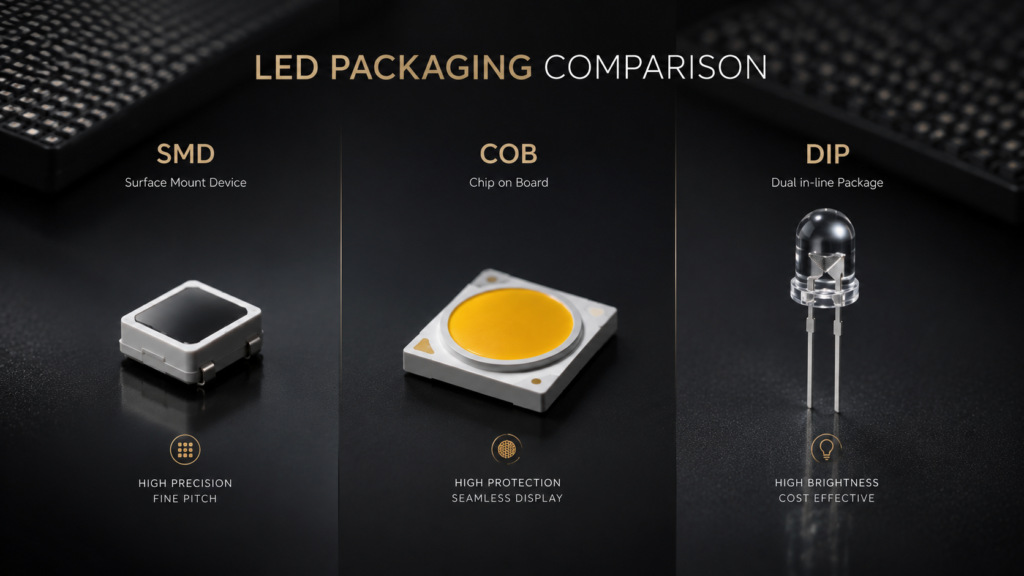
| Packaging Type | Description | Typical Applications | Advantages |
| DIP (Dual In-line Package) | Traditional through-hole mounting with two pins. Larger bead size. | Outdoor billboards, large-pitch displays (P10+) | High brightness, good heat dissipation |
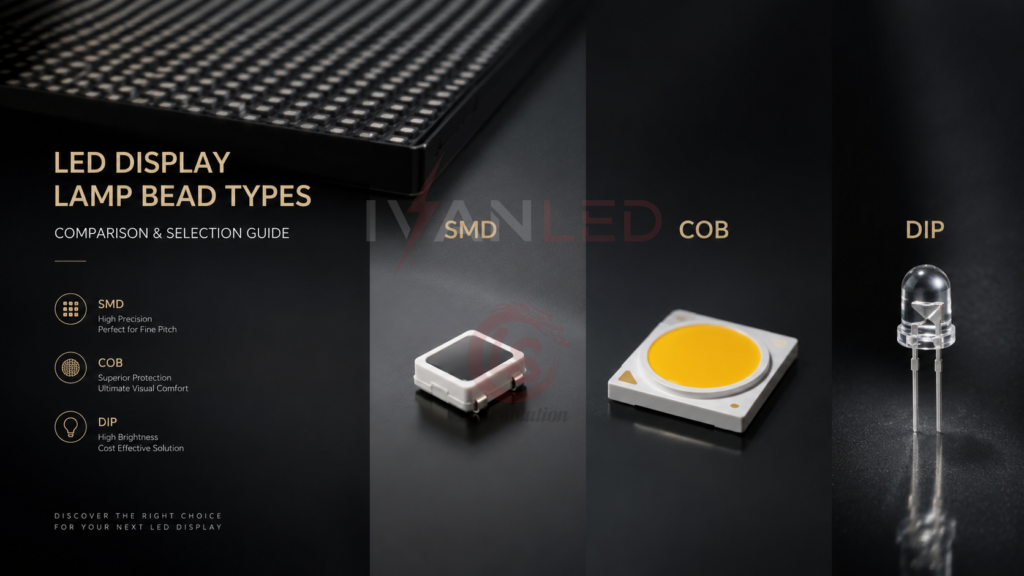
| SMD (Surface Mount Device) | Directly mounted on PCB surface. Small size, high integration. | Indoor displays, rental screens, fine-pitch (P1.5–P10) | Wide color gamut, high resolution, compact |
| COB (Chip on Board) | Multiple LED chips directly bonded to the substrate without individual packaging. | Close viewing (P0.4–P1.5), control rooms, luxury retail | Superior contrast, durability, seamless surface |
| Micro LED | Extremely small chips (0.1–0.2mm), directly on substrate. Very high cost. | High-end virtual production, broadcast, premium installations | Highest resolution, excellent color uniformity |
By Viewing Angle
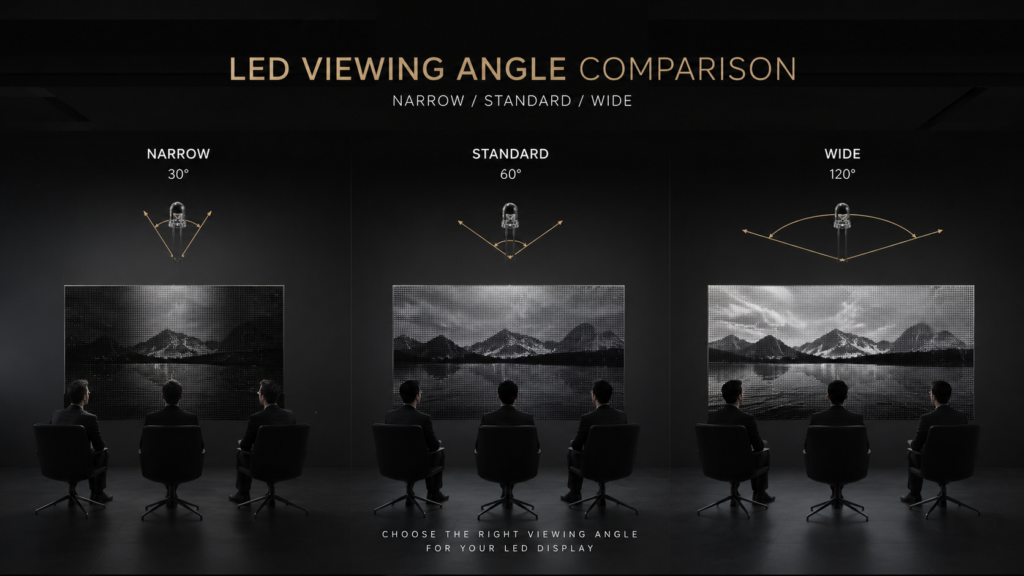
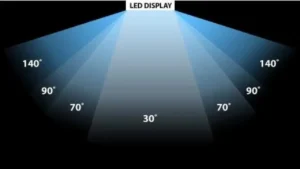
Viewing angle determines from which side of the screen the image remains clear and visible.
| Angle Type | Beam Angle Range | Best For |
| Narrow angle | < 60° | Outdoor billboards, stage displays (focused, high-intensity) |
| Standard angle | 60° – 120° | General indoor displays, retail signage |
| Wide angle | > 120° | Public viewing areas, stadiums, large lobbies (multiple viewing points) |
By Luminous Color
| Color Type | Description | Use Case |
| Single-color | Emits one color (e.g., red, white, blue) | Simple text displays, traffic signs |
| Dual-color | Contains two color chips (e.g., red and green) | Basic signage, yellow/amber displays |
| Full-color (RGB) | Contains red, green, and blue chips for millions of colors | Video walls, advertising, all standard displays |
Key Specifications to Evaluate When Choosing LED Beads
1. Brightness (Nits / Luminous Intensity)
Brightness is measured in nits (cd/m²) for the finished screen, and in millicandelas (mcd) for individual beads. Match brightness to the environment:
- Indoor applications: 800–1,500 nits (sufficient for controlled lighting)
- Semi-outdoor / covered: 2,000–3,500 nits
- Outdoor direct sunlight: 4,500–6,000+ nits
Important: Higher brightness often requires higher current, which can shorten lifespan. Balance brightness with longevity.
2. Pixel Pitch and Bead Size
Pixel pitch (distance between pixels) determines resolution. The LED bead size must be compatible with the pixel pitch:
- Ultra-fine pitch (P0.4–P1.5): Requires COB or Micro LED (very small chips)
- Fine pitch (P1.5–P2.5): Requires small SMD or COB
- Standard pitch (P2.5–P6): Standard SMD beads
- Large pitch (P6+): Larger SMD or DIP beads
3. Lifespan Rating (L70 / L80 / L90)
The lifespan of an LED bead is typically expressed as L70 — the number of hours until brightness drops to 70% of its original output.
What to look for:
- For most commercial applications: L70 ≥ 50,000 hours
- For 24/7 operation: L70 ≥ 80,000–100,000 hours
- Always ask for lumen maintenance data, not just estimated lifespan
4. Color Consistency & BIN Matching
LED beads are manufactured in batches, and each batch has slight variations in color and brightness. These are classified into “BINs.”
Best practice:
- Specify that your order must come from the same BIN and production batch
- Demand a color uniformity specification (e.g., ΔE ≤ 3 for professional displays)
- Request a color calibration after installation
5. Protection Rating (IP Code)
The IP rating indicates resistance to dust and moisture:
- IP20–IP40: Indoor only (no weather protection)
- IP54–IP65: Dust-protected and water-resistant (outdoor use)
- IP67+: Submersible (rare, specialized applications)
Application-Specific LED Bead Recommendations
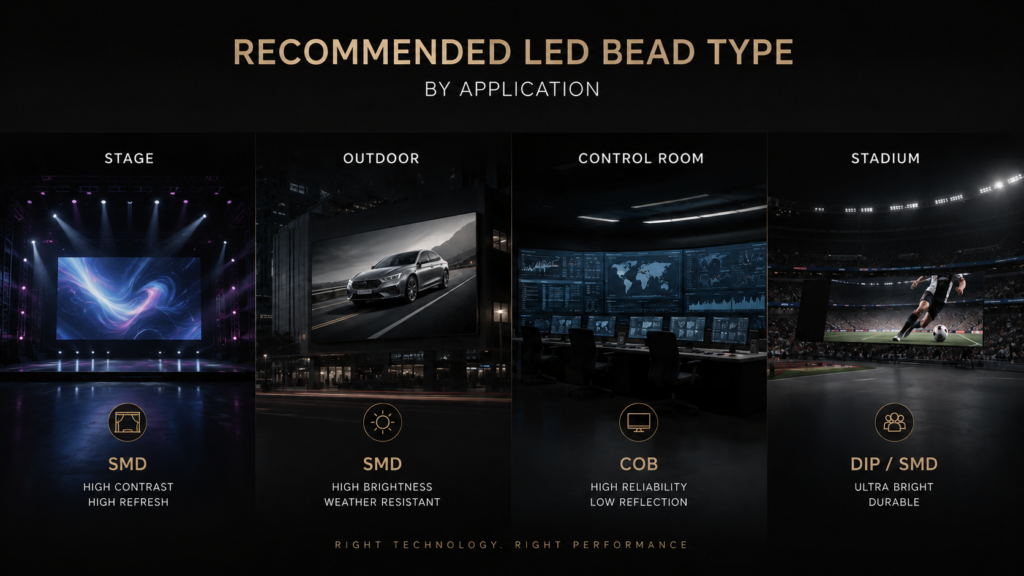
| Application | Recommended Bead Type | Key Specs | Why |
| Indoor digital signage (retail, malls) | SMD (P2.5–P4) | 800–1,500 nits, standard angle | Cost-effective, good image quality, sufficient brightness |
| Outdoor billboard (highway) | SMD or DIP (P6–P16) | 5,000+ nits, narrow angle, IP65 | High brightness for sunlight, weatherproof, long viewing distance |
| Control room / command center | COB or fine-pitch SMD (P0.9–P1.5) | High contrast, wide angle, 24/7 reliability | Close viewing, need for sharp text, consistent color |
| Church / worship center | SMD (P2.5–P3.9) | 1,000–1,500 nits, standard angle | Balanced quality and cost; good for mixed video and text |
| Event stage / concert | SMD (P2.5–P6) or GOB | High brightness, wide angle, durable | Needs impact resistance (GOB) and visibility from many angles |
| Stadium / sports venue | SMD or DIP (P6–P10) | 5,000+ nits, wide angle, IP65 | Long viewing distance, sunlight visibility, high durability |
| High-end retail / luxury brand | COB (P1.2–P1.5) | Excellent color uniformity, high contrast | Close customer viewing, premium brand image |
How to Verify LED Bead Quality Before Purchase
1. Request and Review Technical Documentation
A reputable supplier will provide:
- Datasheets with detailed specifications (brightness, wavelength, viewing angle, recommended current)
- Lumen maintenance data (L70/L80 curves, test conditions)
- BIN classification information (how color and brightness are grouped)
- IP rating certificates (for outdoor applications)
- Test reports from independent labs
Red flags: Supplier provides only estimates, cannot provide batch data, or refuses to share test reports.
2. Evaluate Samples
Before placing a large order, request a sample of LED beads (or a sample panel).
Test the samples for:
- Visual inspection (uniformity, color consistency)
- Brightness measurement
- Color temperature and chromaticity (using a spectrometer)
- Viewing angle test
3. Verify Batch Consistency
When receiving a large order, test a random sample from each batch.
Check for:
- Color temperature variation (should match the sample)
- Brightness variation (should be within the specified tolerance)
- Any obvious manufacturing defects (bent pins, discoloration, broken domes)
4. Check the Reputation of the LED Chip Manufacturer
Not all LED beads are equal. The quality of the underlying LED chip matters greatly.
Reputable LED chip brands include:
- Nationstar (China)
- Kinglight (China)
- San’an (China)
- Epistar (Taiwan)
- Osram (Germany)
- Cree (USA)
Ask your display supplier: “What brand of LED chips do you use?” Avoid suppliers who cannot disclose this, or who use generic, unbranded chips.
Common LED Bead Selection Mistakes
- Choosing beads only based on brightness – High brightness often means shorter lifespan if the beads are overdriven.
- Ignoring batch consistency – Mixing beads from different BINs creates visible color and brightness patches.
- Not considering viewing angle – A narrow-angle outdoor bead may look dark when viewed from the side in a stadium.
- Forgetting about heat dissipation – High-quality beads can still fail prematurely if the module lacks proper heat sinking.
- Skipping sample verification – Suppliers may provide a good sample but deliver lower-quality beads for the bulk order.
Expert Tips from 10+ Years in LED Manufacturing
Tip 1: Ask for the specific brand and model of LED bead in your quote.
Do not accept generic descriptions like “high-quality SMD.” Insist on the exact make and model (e.g., Nationstar SMD 2727) so you can independently verify specs.
Tip 2: Request a sample panel, not just individual beads.
Individual beads can be tested, but a full panel shows how they work together — color uniformity, thermal performance, and consistency.
Tip 3: For outdoor displays, demand IP65-certified modules, not just “waterproof” claims.
IP65 is a specific tested standard. “Waterproof” is marketing language. Ask for the certificate.
Tip 4: Order spare modules, not spare beads.
Replacing individual LED beads requires specialized equipment. It is more practical to replace entire modules. Order 5–10% spare modules at time of purchase.
Tip 5: Consider the total cost of ownership, not just the bead price.
Cheaper beads may require more frequent replacement, higher energy costs (less efficient), or cause color shift that requires expensive recalibration. Quality beads pay for themselves over the display’s lifetime.
Frequently Asked Questions (FAQ)
Q1: What is the difference between SMD and COB LED beads?
SMD (Surface Mount Device) beads are individual packaged RGB components mounted on a PCB. They are the industry standard for most LED displays. COB (Chip on Board) directly mounts many LED chips onto the substrate without individual packaging, creating a seamless, high-contrast surface. COB offers better durability, deeper blacks, and wider viewing angles, but at a higher cost.
Q2: How long do LED beads typically last?
Quality LED beads have a rated lifespan of 50,000–100,000 hours (L70). In real-world use, operating at 70–80% current and with good thermal management, they can last 8–12+ years. Lower-quality beads or those run at maximum current may fade noticeably within 3–5 years.
Q3: What is BIN matching, and why does it matter?
LED beads are manufactured in batches with slight variations in color and brightness. Manufacturers group these into “BINs.” BIN matching means all beads in your order come from the same BIN, ensuring consistent color and brightness across the entire display. Without BIN matching, you may see visible “patches” of different color temperatures.
Q4: Which is better for outdoor use: SMD or DIP?
For modern outdoor displays, SMD with proper IP65 protection is more common. DIP is older technology but can still be used for very large-pitch (>P10) billboards due to its high brightness. SMD offers better color mixing, higher resolution, and is generally more cost-effective for most outdoor applications today.
Q5: Can LED beads be replaced individually?
Technically yes, but in practice it is not recommended. Replacing individual SMD or COB LEDs requires specialized equipment (hot air rework station, stencils) and skilled technicians. The risk of damaging the PCB or adjacent beads is high. For field maintenance, replacing the entire module is faster, safer, and more cost-effective.
Q6: Does IvanLED provide batch-matched LED beads with clear BIN information?
Yes. IvanLED sources LED beads from reputable brands (Nationstar, Kinglight, San’an, etc.) and ensures batch matching for every order. We provide BIN information and color uniformity data upon request. Our quality control includes calibration and testing before shipment.
Conclusion: How to Choose the Right LED Beads
Your decision checklist:
- Define your application – Indoor or outdoor? Viewing distance? Ambient light? Hours of operation?
- Select packaging type – SMD (most applications), COB (close viewing, premium), DIP (large outdoor), or Micro LED (ultra-premium).
- Choose brightness and viewing angle – Match to environment and viewer positioning.
- Verify quality – Request batch-matched LEDs, L70/L80 data, and independent test reports.
- Ask for samples – Test and verify before placing a large order.
- Plan for spares – Order 5–10% spare modules to ensure long-term color matching.
IvanLED’s straightforward advice for 2026:
– The LED bead is not the place to cut corners. Quality beads cost more upfront but save money in energy, maintenance, and replacement over the display’s life.
– For most indoor applications, high-quality SMD beads from a reputable brand with batch matching are the best balance of performance and cost.
– For close viewing, premium retail, or control rooms, COB technology is worth the premium for its durability and superior contrast.
At IvanLED, we use only high-quality, batch-matched LED beads from leading manufacturers. We provide full transparency on specifications and test data, so you know exactly what you are buying.
Ready to source a display with the right LED beads for your project?
👉 Contact IvanLED with your application and brightness requirements. We will recommend the optimal LED bead configuration and provide detailed specifications.