










Part 1: Why Screen Size Matters
The size of your LED screen affects:
| Factor | How size impacts it |
| Viewing experience | Too small = audience can’t see. Too large = overwhelming, pixelated |
| Resolution | Same resolution on larger screen = lower pixel density |
| Pixel pitch requirement | Larger screens can use larger pixel pitch |
| Cost | Larger screens cost significantly more |
| Installation | Structural requirements increase with size |
| Power consumption | Larger screens use more power |
Part 2: How to Calculate the Right Size
Step 1: Measure Your Viewing Distance
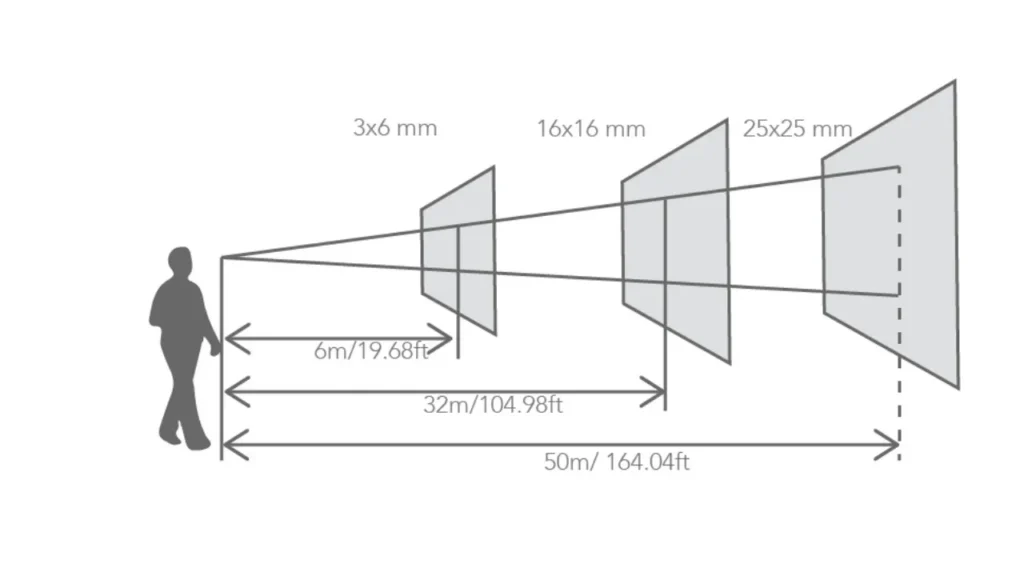
The most important factor is where your audience will sit or stand.
| Seating arrangement | Viewing distance |
| Front row (closest seat) | Minimum viewing distance |
| Back row (farthest seat) | Maximum viewing distance |
| Standing/walking audience | Average distance |
Step 2: Calculate Minimum Screen Height
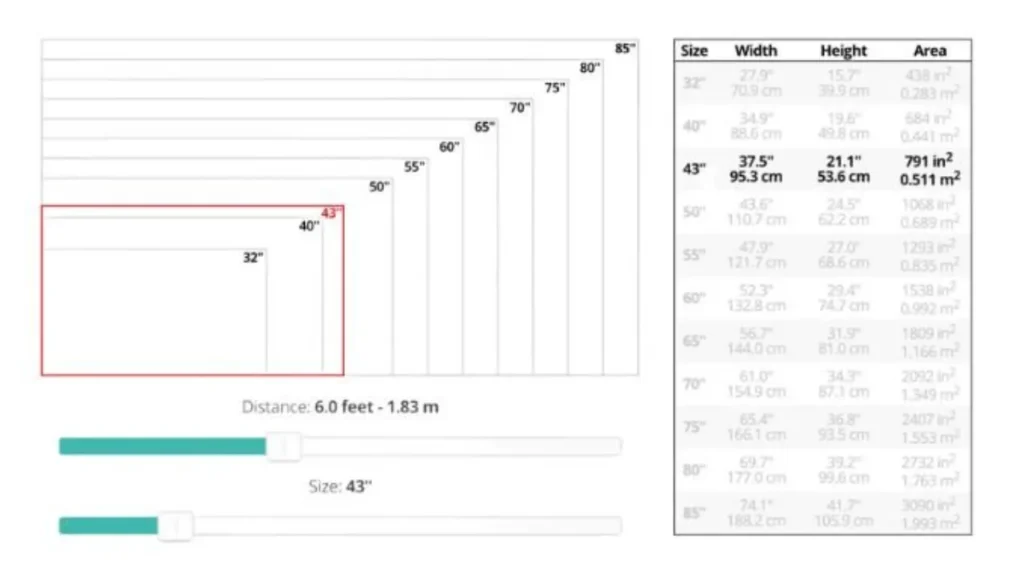
The industry standard formula:
Minimum screen height = Viewing distance ÷ 6
| Viewing distance | Minimum screen height | Example dimensions (16:9) |
| 3 meters | 0.5 m | 0.9m x 0.5m |
| 6 meters | 1 m | 1.8m x 1m |
| 9 meters | 1.5 m | 2.7m x 1.5m |
| 12 meters | 2 m | 3.6m x 2m |
| 15 meters | 2.5 m | 4.5m x 2.5m |
| 18 meters | 3 m | 5.3m x 3m |
| 30 meters | 5 m | 8.9m x 5m |
| 60 meters | 10 m | 17.8m x 10m |
Step 3: Calculate Screen Width

Most LED screens use 16:9 aspect ratio (widescreen).
Screen width = Screen height × 16/9 (≈ 1.78)
| Height | Width (16:9) | Total area |
| 0.5 m | 0.9 m | 0.45 m² |
| 1 m | 1.8 m | 1.8 m² |
| 1.5 m | 2.7 m | 4 m² |
| 2 m | 3.6 m | 7.2 m² |
| 2.5 m | 4.5 m | 11.3 m² |
| 3 m | 5.3 m | 16 m² |
| 4 m | 7.1 m | 28.4 m² |
| 5 m | 8.9 m | 44.5 m² |
| 6 m | 10.7 m | 64 m² |
Step 4: Calculate Total Screen Size in Inches
TVs and monitors are measured diagonally. For LED video walls, we typically use width x height in meters.
Diagonal calculation (for reference):
Diagonal (inches) = √(Width² + Height²) ÷ 0.0254
| Width x Height (m) | Diagonal (inches) |
| 1.8m x 1m | ~80″ |
| 2.7m x 1.5m | ~120″ |
| 3.6m x 2m | ~165″ |
| 4.5m x 2.5m | ~200″ |
| 5.3m x 3m | ~240″ |
Part 3: Size by Application
Indoor Applications
| Application | Typical size range | Recommended pixel pitch |
| Conference room | 80″-120″ (2m x 1.1m – 2.7m x 1.5m) | P1.5-P2.5 |
| Classroom / training | 85″-150″ (1.9m x 1.1m – 3.3m x 1.9m) | P2.5-P3.9 |
| Retail store | 55″-100″ (1.2m x 0.7m – 2.2m x 1.2m) | P2.5-P4 |
| Lobby / atrium | 100″-200″+ (2.2m x 1.2m – 4.4m x 2.5m) | P3.9-P6 |
| Church sanctuary | 120″-200″ (2.7m x 1.5m – 4.4m x 2.5m) | P2.5-P3.9 |
| Control room | 150″-300″ (3.3m x 1.9m – 6.7m x 3.8m) | P1.2-P2.5 |
Outdoor Applications
| Application | Typical size range | Recommended pixel pitch |
| Storefront sign | 2m x 1m – 4m x 2m | P4-P6 |
| Gas station price sign | 3m x 2m – 6m x 3m | P6-P10 |
| Roadside billboard | 6m x 3m – 14m x 5m | P8-P16 |
| Highway billboard | 10m x 5m – 20m x 8m | P10-P20 |
| Stadium scoreboard | 5m x 3m – 15m x 8m | P6-P10 |
| Building facade | Custom (any size) | P8-P16 |
Part 4: Standard LED Module and Cabinet Sizes
Common Module Sizes
| Module size (mm) | Common pixel pitches |
| 320 x 160 | P1.2, P1.5, P1.8, P2, P2.5, P3, P4, P5, P6.6, P8, P10 |
| 320 x 320 | P4, P5, P6.6, P8, P10 |
| 256 x 128 | P2.5, P2.6, P2.9, P3.9, P4.8 |
| 192 x 192 | P3, P6 |
| 160 x 160 | P2, P2.5, P5 |
| 480 x 320 | P4.4, P5.7, P6.7, P8, P10 |
| 250 x 250 | P2.5, P2.6, P2.9, P3.9, P4.8 |
Common Cabinet Sizes
| Cabinet size (mm) | Common pixel pitches | Typical use |
| 960 x 960 | P2.5, P3.9, P4.8, P6.6, P8, P10 | Outdoor billboards |
| 640 x 640 | P1.2, P1.5, P1.8, P2, P2.5, P3.9 | Indoor fine pitch |
| 500 x 500 | P2.6, P2.9, P3.9, P4.8, P6.2 | Rental, stage |
| 500 x 1000 | P2.6, P2.9, P3.9, P4.8 | Rental, stage |
| 576 x 576 | P3, P6 | Outdoor |
| 512 x 512 | P2, P4, P8 | Indoor/outdoor |
Part 5: Size vs. Resolution vs. Pixel Pitch
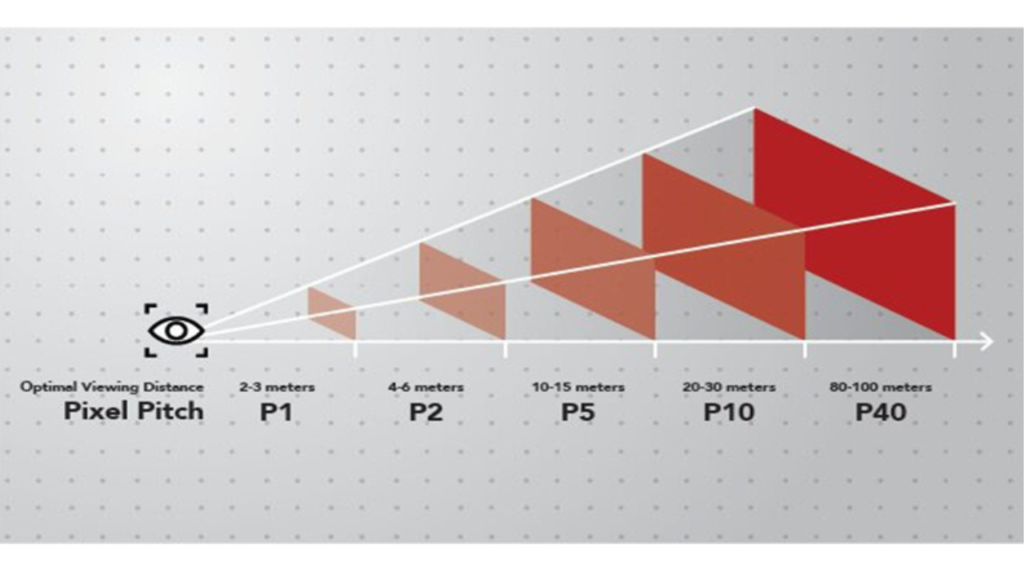
How They Relate
| Factor | Relationship |
| Larger size + same resolution | Lower pixel density (less sharp) |
| Larger size + smaller pixel pitch | Maintains sharpness at higher cost |
| Smaller pixel pitch | Higher resolution, closer viewing possible |
| Larger pixel pitch | Lower cost, requires farther viewing |
Recommended Combinations
| Screen size | Viewing distance | Recommended pixel pitch | Typical resolution |
| Small (under 2m width) | 1-3m | P1.2-P2.5 | 1080p-4K |
| Medium (2-5m width) | 3-10m | P2.5-P4 | 1080p-2K |
| Large (5-10m width) | 10-25m | P4-P8 | 2K-4K |
| Extra large (10m+ width) | 25-60m+ | P8-P16 | 2K-4K |
Part 6: Conversion Guide
Inches to Other Units
| Inches | cm | mm | feet | meters |
| 32″ | 81 cm | 813 mm | 2.7 ft | 0.8 m |
| 43″ | 109 cm | 1,092 mm | 3.6 ft | 1.1 m |
| 55″ | 140 cm | 1,397 mm | 4.6 ft | 1.4 m |
| 65″ | 165 cm | 1,651 mm | 5.4 ft | 1.7 m |
| 75″ | 191 cm | 1,905 mm | 6.3 ft | 1.9 m |
| 86″ | 218 cm | 2,184 mm | 7.2 ft | 2.2 m |
| 98″ | 249 cm | 2,489 mm | 8.2 ft | 2.5 m |
| 110″ | 279 cm | 2,794 mm | 9.2 ft | 2.8 m |
| 120″ | 305 cm | 3,048 mm | 10 ft | 3.0 m |
| 150″ | 381 cm | 3,810 mm | 12.5 ft | 3.8 m |
Standard Video Wall Sizes (16:9)
| Resolution | Pixel dimensions | Approximate physical size (P2.5) | Approximate physical size (P4) |
| HD (1280×720) | 1280 x 720 px | 3.2m x 1.8m | 5.1m x 2.9m |
| Full HD (1920×1080) | 1920 x 1080 px | 4.8m x 2.7m | 7.7m x 4.3m |
| 2K (2048×1080) | 2048 x 1080 px | 5.1m x 2.7m | 8.2m x 4.3m |
| 4K UHD (3840×2160) | 3840 x 2160 px | 9.6m x 5.4m | 15.4m x 8.6m |
| 8K (7680×4320) | 7680 x 4320 px | 19.2m x 10.8m | 30.7m x 17.3m |
Part 7: Step-by-Step Size Selection
Step 1: Define Your Application
| Question | What to consider |
| Where will the screen be installed? | Indoor, outdoor, or covered |
| How far is the farthest viewer? | Determines minimum size |
| How close is the closest viewer? | Determines maximum pixel pitch |
| What content will you display? | Text requires higher resolution |
| What is your budget? | Larger screens cost more |
Step 2: Calculate Minimum Size
Minimum height = Farthest viewing distance (meters) ÷ 6
Example: Farthest viewer at 18 meters → Minimum height = 3m → Minimum width (16:9) = 5.3m
Step 3: Calculate Maximum Pixel Pitch
Maximum pixel pitch (mm) = Closest viewing distance (meters)
Example: Closest viewer at 3 meters → Maximum pixel pitch = P3 (or smaller)
Step 4: Check Resolution Requirements
| Content type | Minimum recommended resolution |
| Text / data | Full HD (1920×1080) |
| Images / graphics | HD (1280×720) or higher |
| Video | HD or higher |
| PowerPoint / presentations | HD or higher |
Step 5: Verify Module Compatibility
Your desired size must be achievable with standard module sizes. Work with your supplier to find the closest possible dimensions.
Part 8: Common Size Mistakes to Avoid
| Mistake | Consequence | How to avoid |
| Screen too small for distance | Back row cannot read content | Calculate using distance ÷ 6 formula |
| Screen too large for space | Overwhelming, difficult to install | Match to room proportions |
| Pixel pitch too large for close viewing | Visible pixels, blocky image | Choose pitch ≤ closest viewing distance |
| Ignoring aspect ratio | Letterboxing or cropping | Stick to 16:9 unless you have custom content |
| Not accounting for bezels (LCD) | Visible gaps between screens | Use seamless splicing LED instead |
| Forgetting installation access | Cannot fit through doors | Measure access paths before ordering |
Ivan’s LED Displays
At IvanLED, we manufacture LED displays in all standard sizes:
Small indoor – 55″ to 120″ (conference, retail)
Medium indoor – 120″ to 200″ (lobby, church, events)
Large indoor – 200″ to 500″+ (auditorium, stadium)
Outdoor billboards – Custom sizes from 2m x 1m to 20m x 8m
Custom aspect ratios – Available upon request
What we offer:
Pixel pitches from P1.2 to P20
Indoor and outdoor ratings (IP65)
Standard 16:9 aspect ratio
Custom sizes for special applications
1-year warranty
Installation support
Tell us your viewing distance, application, and venue dimensions. We will recommend the optimal screen size and provide a free quote.
Frequently Asked Questions
Q: What is the standard LED screen size?
There is no single standard size. LED screens are modular and can be built to any dimension. However, common sizes include 2m x 1.5m (indoor), 3m x 2m (medium), and 6m x 3.5m (outdoor billboard). The best size depends on your viewing distance and application.
Q: How do I calculate the right screen size for my room?
Use the formula: Minimum screen height = farthest viewing distance ÷ 6. For a room where the back row is 12 meters away, you need a screen at least 2m tall. For 16:9 aspect ratio, that means approximately 3.6m wide.
Q: What is the most common aspect ratio for LED screens?
16:9 is the most common aspect ratio. It matches HD, 4K, and most video content. Other ratios like 4:3 (legacy) or 21:9 (ultrawide) are available but less common.
Q: How does pixel pitch relate to screen size?
For a given viewing distance, larger screens can use larger pixel pitch because viewers sit farther away. A 6m wide billboard viewed from 20m away can use P10. A 2m wide indoor screen viewed from 3m away needs P3 or smaller.
Q: What size LED screen do I need for a church?
For a church sanctuary, calculate based on the farthest seat. If the back row is 20 meters away, minimum height = 20 ÷ 6 = 3.3m. Width (16:9) = 5.9m. Pixel pitch should be P2.5-P3.9 for clear text readability.
Q: Does IvanLED offer custom sizes?
Yes. We manufacture LED displays in custom sizes. Because LED screens are modular, we can create virtually any dimensions. Provide your width and height requirements for a quote.