





Buyer Pain Points: Foldable Display Challenges
Rental companies and event producers face specific challenges when choosing foldable LED displays:Which type is more durable — flexible or hinge-connected? Flexible screens use bendable materials (FPC) that can fatigue over time. Hinge-connected screens are mechanically simpler but have moving parts that can wear out or rust.How many folds can the screen withstand? Quality foldable screens are rated for 50,000+ folds. For weekly use, this translates to 2-3 years of service. Cheaper screens may fail after just a few thousand folds.What maintenance should I expect? Hinge-connected screens require regular inspection of hinges, solder joints, and connections. Flexible screens may develop FPC fatigue or breakage over time.How do I transport foldable screens safely? Foldable screens are more fragile than rigid displays. Proper packaging — waterproof, dustproof, shockproof — is essential for protecting your investment.What about image quality? Flexible screens offer smoother transitions and better visual performance. Hinge-connected screens may have visible seams or uneven brightness at fold points.What Are Foldable LED Displays?
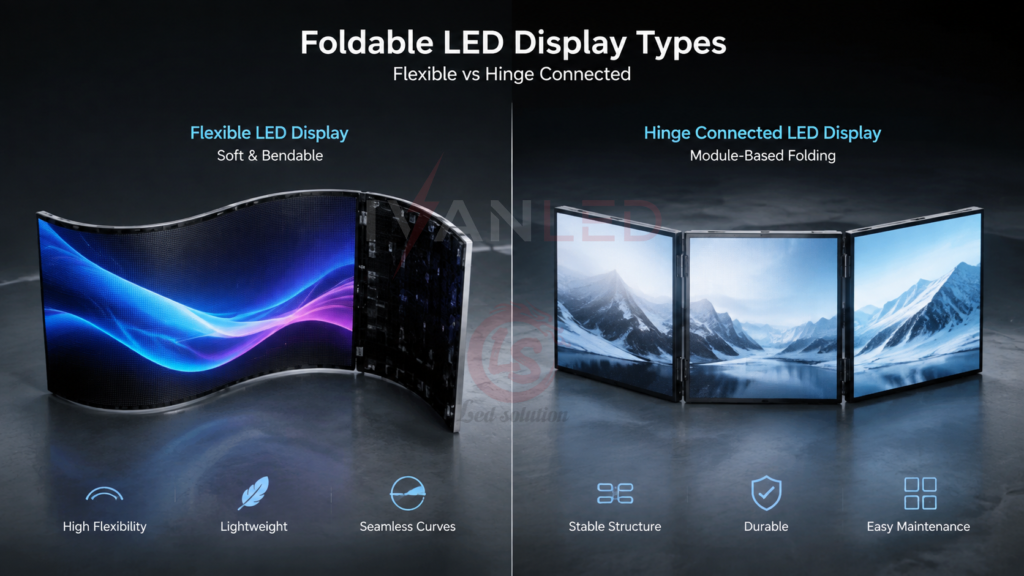
Foldable LED displays are screens designed to bend or fold for easier transport and storage. They come in two main types: flexible (using bendable materials) and hinge-connected (using mechanical hinges).The two types: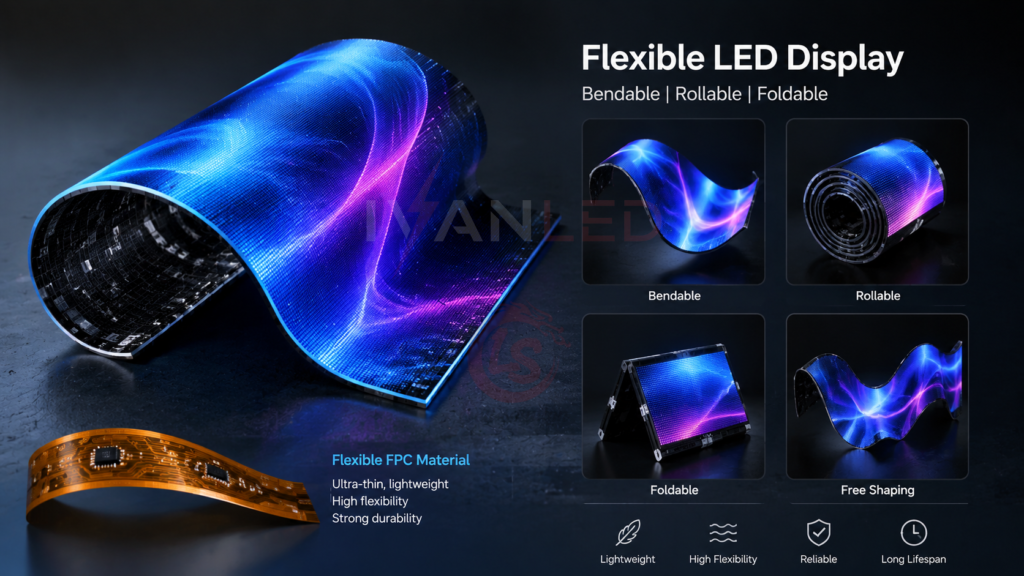
- Flexible LED screens: Use flexible materials to support circuit boards, allowing the screen to bend or roll. Better visual performance, but higher production and maintenance costs.
- Hinge-connected LED screens: Add mechanical hinges to the edges of rigid LED panels. Easier transportation and individual panel servicing. More affordable but requires regular hinge maintenance.
Foldable Display Applications
Foldable LED displays are ideal for temporary events, touring productions, mobile advertising, and any application where transportation and quick setup are priorities.
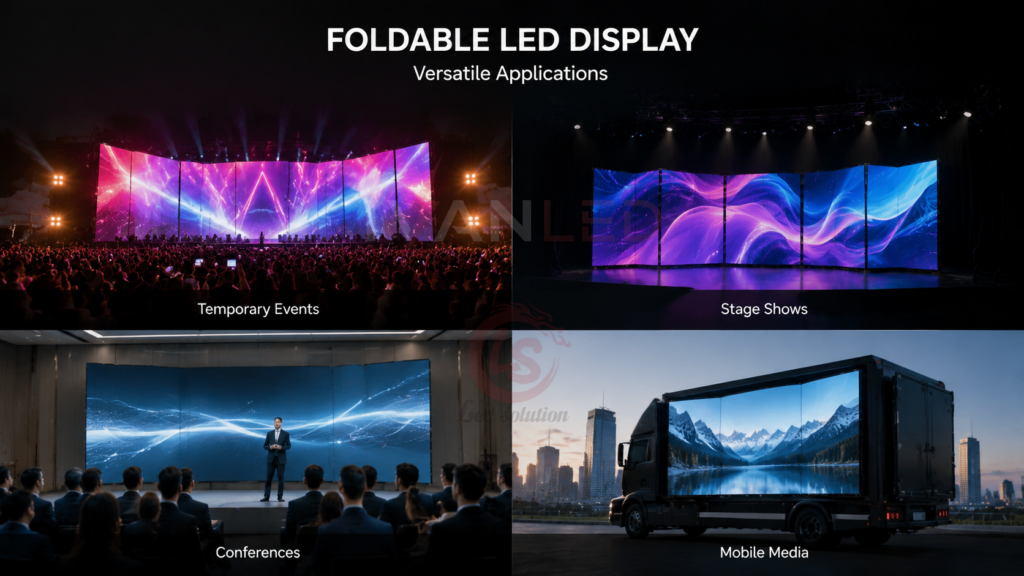
| Application | Why Foldable Works | Best Type |
| Temporary events (pop-up stores, weddings, festivals) | Lightweight, easy transport | Flexible |
| Stage productions | Flexible visual designs, immersive experiences | Flexible or hinge-connected |
| Large conference halls | Multi-angle product displays, wayfinding | Hinge-connected |
| Mobile media (advertising vehicles) | Multi-directional visibility (front, rear, sides) | Hinge-connected |
| Rental fleets | Frequent assembly, disassembly, transport | Hinge-connected (cost-effective) or flexible (premium) |
Key Selection Criteria for Foldable Displays
When choosing a foldable LED display, evaluate six key factors: pixel pitch, brightness and refresh rate, grayscale and contrast, folding angle, fold count and lifespan, and maintenance cost.
Pixel Pitch
Pixel pitch determines resolution and clarity. For foldable displays, match pixel pitch to viewing distance:
- Close viewing (under 3 meters): P2.5 – P4
- Medium viewing (3-8 meters): P4 – P6
- Long viewing (over 8 meters): P6 – P10
Brightness and Refresh Rate
Brightness: Indoor foldable screens need 800–1,500 nits. Outdoor mobile screens need 5,000–8,000 nits for sunlight visibility.
Refresh rate: For professional exhibitions or stage use, choose 1,920Hz+ for smooth video playback and flicker-free camera recording.
For more on brightness, see our candela vs lumens vs lux guide.
Grayscale and Contrast
Grayscale: 12-bit is sufficient for most indoor displays. 14-bit or 16-bit is recommended for premium content with smooth color transitions.
Contrast: Higher contrast produces more vivid images. For outdoor screens, brightness is more important than contrast due to ambient light.
Folding Angle
Choose a folding angle close to 180° for the best visual effect. A larger folding angle allows smoother transitions and reduces uneven brightness at fold points. Vehicle-mounted mobile screens may need smaller angles, but for most applications, 180° is ideal.
Fold Count and Lifespan
Quality foldable screens are rated for 50,000+ folds. For weekly use, this provides 2-3 years of service. Screens folded daily require higher fold counts.
Lifespan: Quality screens offer 50,000–100,000 hours of operation. For daily use, this translates to 5-10 years of service.
Maintenance Cost
Hinge-connected screens have lower upfront costs but higher maintenance costs. Hinges may rust, solder joints may loosen, and moving parts wear out. Flexible screens have higher upfront costs but lower maintenance if handled properly.
For more on maintenance, see our guide to slowing light attenuation.
Tips for Choosing Foldable LED Displays
Choose a reliable supplier, plan for proper transportation, and prepare backup components to protect your foldable display investment.
Choose a reliable supplier: Foldable screens require advanced technology. Experienced manufacturers offer better expertise, competitive pricing, and long-term after-sales support.
Proper transportation: Use waterproof, dustproof, and shockproof packaging. Secure the screen with brackets to prevent damage during transit.
Prepare backup components: For hinge-connected screens, keep spare hinges, LED modules, and power cables. For flexible screens, keep spare FPC components.
Expert Tips for Rental Companies
Tip 1: Match the type to your use frequency.
For weekly use, choose hinge-connected screens with 50,000+ fold rating. For daily use, invest in higher-quality flexible screens or premium hinge designs.
Tip 2: Prioritize fold endurance over initial cost.
A cheaper screen that fails after 10,000 folds costs more in repairs and downtime than a premium screen rated for 100,000 folds.
Tip 3: Plan for maintenance.
Regularly inspect hinges, solder joints, and connections. For flexible screens, check for FPC fatigue or cracking.
Tip 4: Order spare parts with your initial purchase.
Order spare hinges, modules, and cables with your initial purchase. LED batches change over time, and later purchases may not match color and brightness.
Tip 5: Test fold mechanism before each event.
Always test the folding mechanism before transporting to an event. Identify potential issues early to avoid on-site failures.
Frequently Asked Questions (FAQ)
What is the difference between flexible and hinge-connected foldable LED displays?
Flexible LED screens use bendable materials (FPC) that allow the screen to bend or roll, offering better visual performance but higher costs. Hinge-connected screens use mechanical hinges to connect rigid panels, making them more affordable but requiring regular hinge maintenance.
How many folds can a foldable LED display withstand?
Quality foldable LED displays are rated for 50,000+ folds. For weekly use, this provides 2-3 years of service. Premium displays may offer 100,000+ folds for daily use applications. Always check the fold rating with your supplier.
What brightness do I need for a foldable LED display?
Indoor foldable displays require 800–1,500 nits. Outdoor mobile screens need 5,000–8,000 nits for sunlight visibility. For shaded outdoor areas, 2,500–4,000 nits may be sufficient.
What maintenance do foldable LED displays require?
Hinge-connected screens require regular inspection of hinges, solder joints, and connections. Flexible screens require inspection of FPC for fatigue or cracking. Both types require regular cleaning and software updates. Order spare parts with your initial purchase.
Do extreme temperatures affect foldable LED displays?
Yes. High temperatures can cause hinge materials to expand and accelerate FPC fatigue. Low temperatures can make FPC brittle and reduce luminous efficiency. For extreme conditions, request high/low temperature-resistant materials and protective measures.
Does IvanLED offer foldable LED display solutions?
Yes. IvanLED manufactures custom foldable LED displays in both flexible and hinge-connected configurations, with various pixel pitches and folding mechanisms.
Conclusion: Choosing the Right Foldable Display for Your Fleet
Foldable LED displays offer significant advantages for rental companies, event producers, and mobile advertisers: easy transport, quick setup, and flexible configurations. The right choice depends on your use frequency, transport needs, and budget.
Our straightforward advice:
– For weekly use (rental, events): Choose hinge-connected screens with 50,000+ fold rating and 1,920Hz+ refresh rate.
– For daily use (touring, mobile media): Invest in premium flexible screens or high-quality hinge designs with 100,000+ fold rating.
– Always order spare parts (hinges, modules, cables) with your initial purchase.
– Test the fold mechanism before every event to avoid on-site failures.
– Work with a reliable supplier who offers technical support and after-sales service.
At IvanLED, we manufacture foldable LED displays in both flexible and hinge-connected configurations. We help rental companies and event producers select the right solution for their specific needs. Browse our commercial LED display solutions or contact us to discuss your project requirements.
Ready to add foldable LED displays to your rental fleet?
👉 Contact IvanLED for a free consultation and customized quote.