









Buyer Pain Points: Transparent LED Technology Confusion
Buyers face specific challenges when evaluating transparent LED screens:
How transparent are transparent LED screens really? Quality transparent LED screens achieve 60-90% transparency, meaning you can see through them clearly when they are off or displaying dark content.
Are they bright enough for daytime use? Yes. Self-emitting transparent LED screens can reach 5,000+ nits, making them visible in direct sunlight. Transparent LCDs are less bright and better for indoor use.
What is the difference between transparent LED and transparent LCD? Transparent LED is self-emitting (each pixel produces its own light) and offers higher brightness. Transparent LCD relies on backlight and is less bright but often more affordable.
Can they display high-resolution content? Yes. Transparent LED screens can achieve resolutions comparable to traditional LED displays with pixel pitches as small as P2.5–P4 for close viewing.
Are they difficult to install? Transparent LED screens are lightweight and thin (as little as 10mm thick), making them easier to install than traditional LED walls on glass surfaces.
What Are Transparent LED Screens?
Transparent LED screens are display devices that use LED technology to show dynamic content while maintaining 60-90% light transmittance, allowing viewers to see through the screen to the background behind it.
Key characteristics:
- High transparency: 60-90% light transmittance depending on pixel pitch and design
- Ultra-thin profile: As thin as 10mm
- Lightweight: Typically 10-20kg per square meter
- High brightness: Self-emitting models reach 5,000+ nits for outdoor use
- Modular construction: Customizable sizes and shapes
Transparent LED screens are widely used in retail windows, building facades, museum exhibits, and corporate lobbies where both visual impact and spatial openness are desired.
For more on transparent display applications, see our transparent LED wall guide.
How Does a Transparent LED Screen Work?
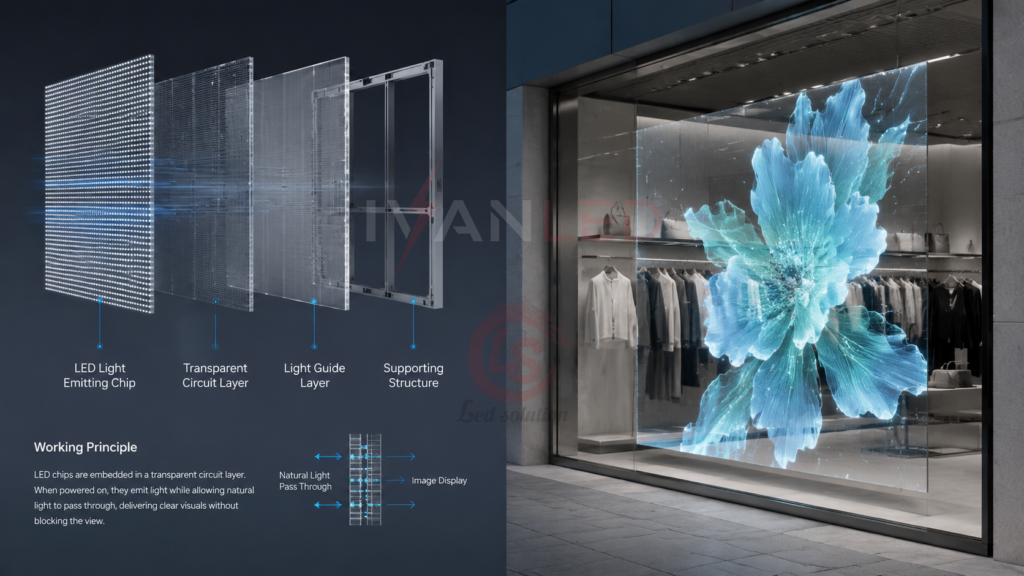
A transparent LED screen works by mounting LED chips on a transparent substrate (glass or acrylic) in a grid pattern with strategic gaps between the LEDs. These gaps allow light to pass through, creating transparency. When the LEDs are on, they create images; when off, the screen becomes nearly invisible.
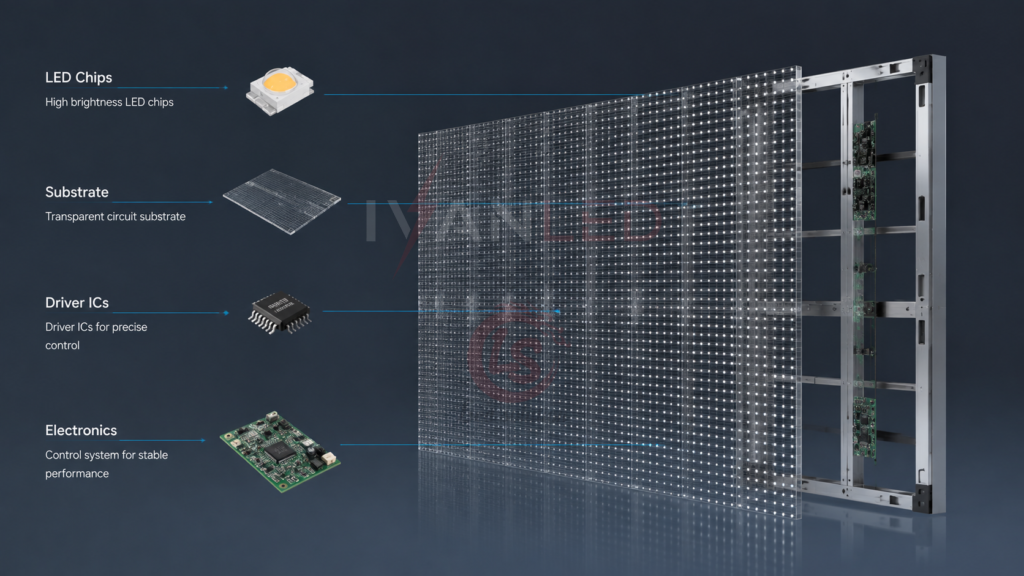
The core components:
- LED chips: Tiny light-emitting diodes mounted on the substrate
- Transparent substrate: Glass or acrylic that allows light transmission
- Circuitry: Transparent or nearly invisible wiring connecting the LEDs
- Driver electronics: Control the current, voltage, and timing of each LED pixel
When electricity passes through the LEDs, they emit light. The combination of light-emitting LEDs and transparent gaps creates the illusion of floating content on a glass surface.
For more on display technology, see our LED display functions guide.
Types of Transparent LED Technologies
There are four main types of transparent display technologies: self-emitting transparent LED, GOB transparent LED, OLED glass screens, and transparent LCD. Each has different strengths in brightness, transparency, and cost.
| Technology | How It Works | Brightness (nits) | Transparency | Best For |
| Self-emitting Transparent LED | Each pixel is its own light source; no backlight needed | 5,000+ | 60-80% | Outdoor, high-brightness environments |
| GOB Transparent LED | LEDs mounted with glue coating for durability | 4,000-6,000 | 70-85% | High-traffic, rental, outdoor |
| OLED Glass Screen | Organic compounds emit light; no backlight | 1,000-2,000 | 90%+ | Architectural, premium retail |
| Transparent LCD | Liquid crystal panel with backlight | 500-1,500 | 80-90% | Window displays, kiosks, cost-sensitive |
For more on LED packaging technologies, see our COB vs CSP comparison guide.
Self-Emitting Transparent LED Screens
Self-emitting transparent LED screens are the most common and versatile option. Each LED pixel produces its own light, eliminating the need for a backlight. This enables high brightness (5,000+ nits) and transparency.
Advantages:
- High brightness: Visible in direct sunlight
- Good transparency: 60-80%
- Thin profile: Minimal thickness for glass integration
- Wide viewing angles: Clear from multiple positions
Best for: Outdoor building facades, high-brightness retail windows, event spaces.
GOB Transparent LED Screens
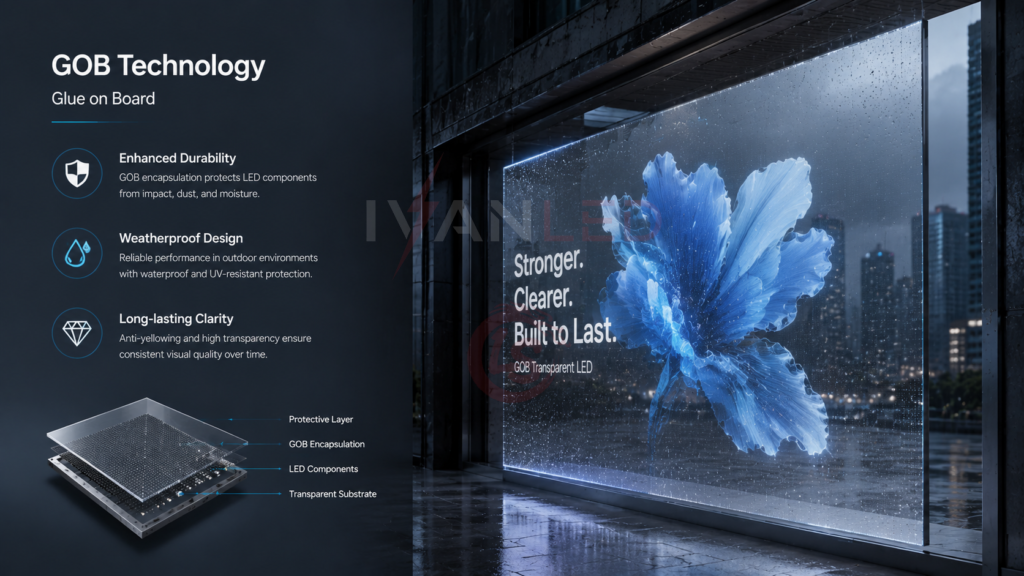
GOB (Glue on Board) transparent LED screens use a protective glue coating over the LEDs. This design increases durability, improves water resistance, and enhances brightness while maintaining high transparency.
Advantages:
- Durability: Impact and moisture resistant
- High transparency: 70-85%
- Better image quality: Uniform light distribution
- Outdoor capable: IP65+ weatherproofing available
Best for: High-traffic retail, rental displays, outdoor installations.
Transparent LCD Screens
Transparent LCD screens use liquid crystal technology on a transparent panel with a backlight. They are less bright than LED-based options but offer higher transparency (80-90%) and lower cost.
Advantages:
- High transparency: 80-90%
- Lower cost: More affordable than LED-based options
- Good for indoor use: Works well in controlled lighting
Limitations:
- Lower brightness: 500-1,500 nits
- Limited outdoor use: Not suitable for bright sunlight
- Lower contrast: Backlight can wash out colors
Best for: Indoor window displays, kiosks, cost-sensitive installations.
Key Selection Criteria for Transparent LED Screens
When choosing a transparent LED screen, evaluate four key factors: transparency percentage, brightness, pixel pitch, and environmental durability.
Transparency percentage: Higher transparency (80-90%) is better for retail windows where background visibility is critical. Lower transparency (60-70%) allows denser pixel placement for higher resolution.
Brightness: Indoor applications need 1,000-2,500 nits. Outdoor installations need 4,500+ nits for sunlight visibility.
Pixel pitch: For viewing distances under 3 meters, choose P3–P4. For distances over 5 meters, P5–P8 is sufficient.
Environmental durability: Outdoor screens need IP65+ weatherproofing and UV-resistant materials.
For more on pixel pitch selection, see our pixel pitch selection guide.
Expert Tips for Transparent LED Screen Buyers
Tip 1: Match the technology to your environment.
Self-emitting LED for outdoor or high-brightness. GOB for durability. Transparent LCD for indoor, cost-sensitive applications.
Tip 2: Test content on the screen.
Transparent screens perform best with dark backgrounds and high-contrast content. Test your actual content before finalizing the purchase.
Tip 3: Consider the viewing position.
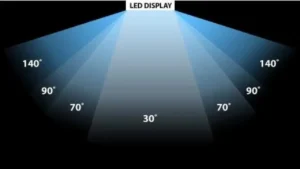
Transparent screens have an optimal viewing position. Design your installation to maximize visibility from the most trafficked areas.
Tip 4: Plan for maintenance access.
Most transparent LED screens support front maintenance, allowing quick access without removing the screen from the glass.
Tip 5: Order spare modules.
Order 5-10% spare modules with your initial purchase. LED batches change over time, and spare parts purchased later may not match.
Frequently Asked Questions (FAQ)
What is the difference between transparent LED and transparent LCD?
Transparent LED is self-emitting (each pixel produces its own light) and offers high brightness (5,000+ nits) for outdoor use. Transparent LCD relies on a backlight and offers lower brightness (500-1,500 nits) but higher transparency (80-90%) at a lower cost. Choose LED for outdoor; LCD for indoor.
How transparent are transparent LED screens?
Quality transparent LED screens achieve 60-90% transparency. Higher transparency (80-90%) is better for retail windows. Lower transparency (60-70%) allows denser pixel placement for higher resolution. Balance transparency with resolution based on your application.
Can transparent LED screens be used outdoors?
Yes, but only self-emitting transparent LED screens with high brightness (4,500+ nits) and IP65+ weatherproofing are suitable for outdoor use. Transparent LCD screens are designed for indoor use and will not be visible in direct sunlight.
What pixel pitch do I need for a transparent LED screen?
For retail windows with viewing distances under 3 meters, choose P3–P4. For building facades with distances over 5 meters, P5–P8 is sufficient. Match pixel pitch to your typical viewing distance to avoid overpaying.
Does IvanLED offer transparent LED screen solutions?
Yes. IvanLED manufactures transparent LED screens in self-emitting and GOB configurations, with custom sizes, resolutions, and transparency levels. Browse our commercial LED display solutions or contact us to discuss your project requirements.
Conclusion: Transparent LED Technology for Modern Visuals
Transparent LED screens offer a unique combination of digital content and spatial openness that traditional displays cannot match. Whether you are designing a retail window, a museum exhibit, or a building facade, transparent LED technology allows you to display vibrant content while maintaining visibility through the screen.
Our straightforward advice:
– For outdoor or high-brightness applications: Choose self-emitting transparent LED with 5,000+ nits brightness and IP65+ weatherproofing.
– For indoor retail windows: Choose GOB transparent LED for durability or self-emitting LED for brightness.
– For cost-sensitive indoor installations: Consider transparent LCD as an alternative.
– Always test your content on the actual screen before finalizing your purchase.
At IvanLED, we manufacture high-quality transparent LED screens for retail, architectural, and event applications.
Ready to bring transparent LED technology to your project?
👉 Contact IvanLED for a free consultation and customized quote.