








Buyer Pain Points: 8K Confusion
Distributors and buyers face specific challenges when evaluating 8K displays:
Is 8K actually better than 4K in real-world use? For most commercial applications with viewing distances over 2 meters, the human eye cannot tell the difference. You are paying for pixels your client cannot see. Understanding the difference between HD and UHD is the first step to making the right call.
How much more does 8K cost? An 8K LED display typically costs 5-10x more than a 4K display of the same size. The screen itself is only part of the cost — you also need 8K-capable controllers, cables, and content. For a complete picture, check our LED display price guide 2026.
Is there enough 8K content available? Currently, very little commercial content is produced in native 8K. Most 8K displays spend 95%+ of their time showing upscaled 4K or 1080p content.
Can my client’s existing equipment handle 8K? 8K requires HDMI 2.1 cables, powerful GPUs, and significant bandwidth (50-100 Mbps for streaming). Many clients underestimate these hidden requirements.
Will 8K become the standard soon? 8K adoption is progressing slowly. Major streaming platforms (Netflix, Disney+) still do not support 8K content. For commercial LED displays, 4K remains the practical standard.
What Is 8K Resolution?
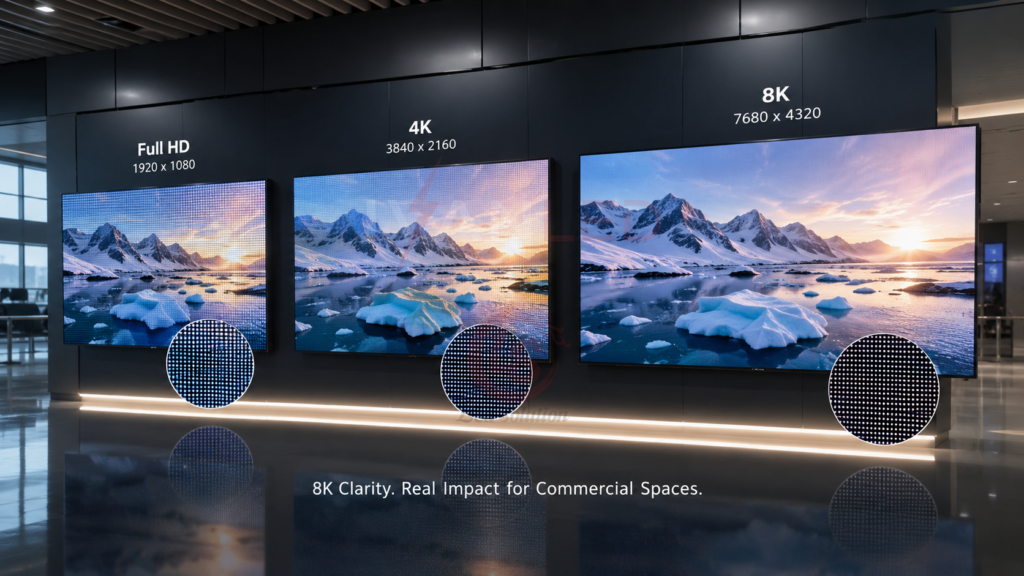
8K resolution is 7680×4320 pixels — approximately 33 million pixels total. This is four times the pixel count of 4K (3840×2160) and sixteen times that of Full HD (1920×1080).
For LED displays, achieving 8K resolution requires either:
- Ultra-fine pixel pitch (P0.6–P0.9): For a typical 16:9 screen, an 8K LED wall requires approximately 208 inches diagonal with P0.6–P0.9 pixel pitch. To understand why pixel pitch matters, read our how to choose pixel pitch guide.
- Large screen area: An 8K screen with P1.2 would be approximately 10m wide × 5.6m high — a massive installation suitable only for stadiums or large venues.
This means 8K LED displays are physically large and technically demanding. They are not practical for small or medium-sized installations.
8K vs 4K vs Full HD: What Are the Real Differences?
The real difference between 8K, 4K, and Full HD is pixel count, which determines how close viewers can sit without seeing individual pixels.
| Resolution | Pixel Count | Pixel Pitch Equivalent (LED) | Min Viewing Distance | Typical Application |
| Full HD (1080p) | 2.07 million | P4 – P6 | 3-5 meters | Outdoor billboards, large venue displays |
| 4K UHD | 8.29 million | P1.2 – P2.5 | 1.5-3 meters | Corporate lobbies, retail, conference rooms |
| 8K UHD | 33.18 million | P0.6 – P0.9 | Under 1.5 meters | Control rooms, luxury retail, virtual production |
The key takeaway: At viewing distances over 2 meters, the human eye cannot distinguish 8K from 4K on screens under 100 inches. 8K only delivers visible benefits when viewers are very close (under 1.5 meters) or the screen is extremely large (over 150 inches). For most commercial LED display projects, 4K offers the best balance of quality and cost.
When Does 8K Actually Make Sense?
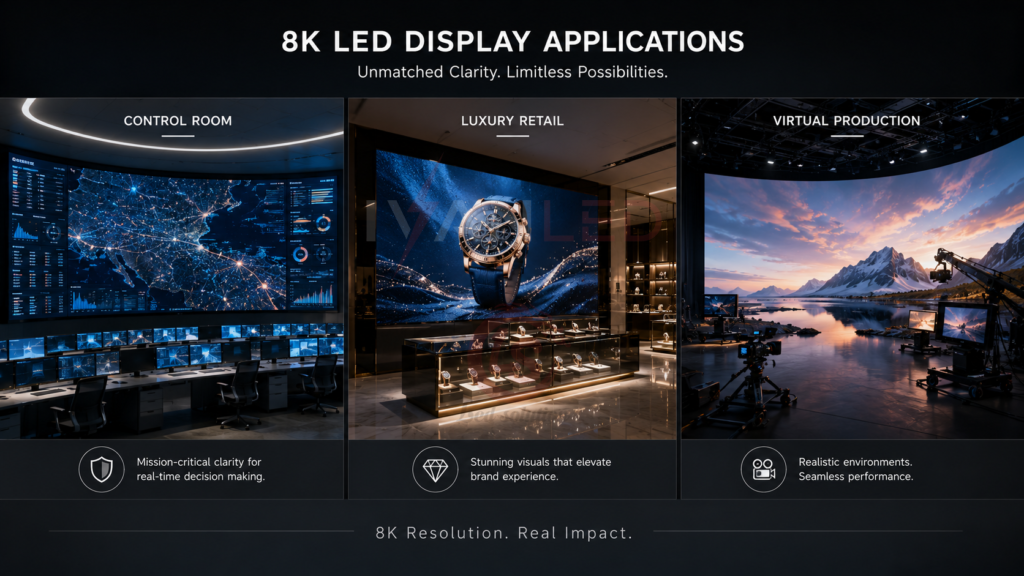
8K makes sense in three specific scenarios: ultra-close viewing, massive screen sizes, and professional content production where cropping is required.
Consider 8K for:
- Control rooms and command centers: Operators sit close to the screen and need to see fine text and data details.
- Luxury retail and showrooms: Close-up product displays where image perfection is critical for brand image.
- Virtual production and broadcast studios: Where cameras zoom in and crop footage, 8K provides flexibility for post-production.
- Museum and exhibition spaces: Where visitors view screens from very close distances (under 1 meter).
Stick with 4K for:
- Digital signage (retail, malls, airports): Viewing distances typically 2-5 meters.
- Corporate lobbies and conference rooms: Standard viewing distances over 2 meters.
- Churches and event venues: Audiences sit at varying distances, but rarely under 2 meters. See our stage rental LED screen guide for event applications.
- Outdoor billboards: Viewing distances over 10 meters make 8K completely wasted.
What Are the True Costs of 8K?
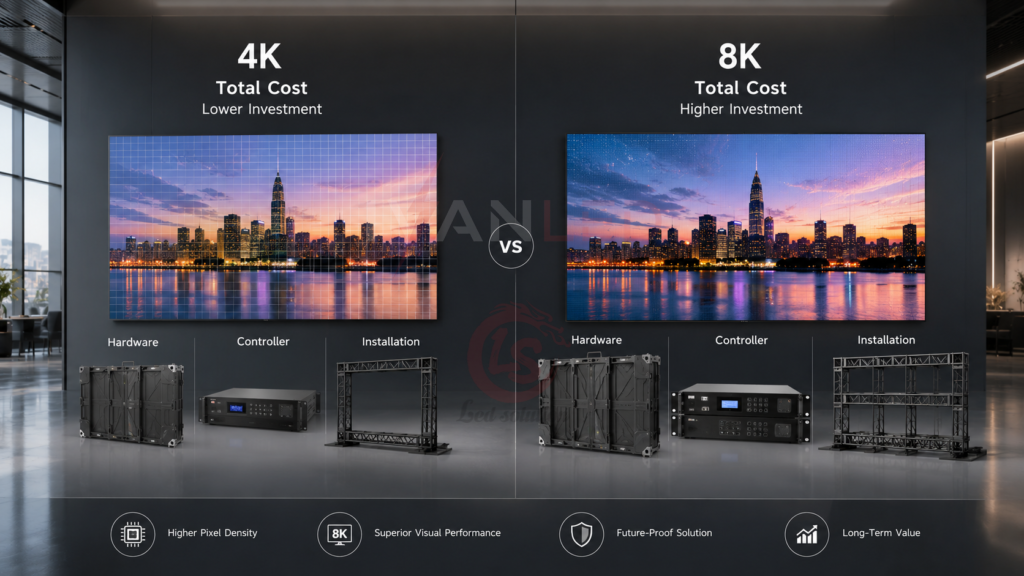
An 8K LED display typically costs 5-10x more than a 4K display of the same size, and the total system cost is even higher when you factor in controllers, cables, and content creation.
Cost breakdown for a 10m² 8K LED display:
- Screen hardware: $40,000 – $80,000+ (P0.6–P0.9 COB)
- 8K controller: $10,000 – $25,000+ (specialized processors)
- Cabling and infrastructure: $5,000 – $15,000 (fiber optic, HDMI 2.1)
- Content creation: $15,000 – $50,000+ (8K native content is expensive to produce)
- Total system cost: $70,000 – $170,000+
Compare to 4K for the same 10m² screen:
- Screen hardware: $12,000 – $20,000 (P1.2–P1.5 SMD or COB)
- 4K controller: $3,000 – $8,000
- Cabling: $1,000 – $3,000
- Content creation: $5,000 – $15,000
- Total system cost: $21,000 – $46,000
For a complete breakdown of LED display costs, see our LED display price guide 2026.
What Equipment Do You Need for 8K?
8K requires a complete ecosystem — not just an 8K screen. Your client needs an 8K-capable controller, HDMI 2.1 cables, a powerful GPU, and native 8K content to see any benefit.
Essential components:
- 8K display: P0.6–P0.9 pixel pitch LED screen
- 8K controller: Must support 7680×4320 input and output
- HDMI 2.1 cable: Labeled “Ultra High Speed” or “48Gbps” — standard HDMI 2.0 cannot handle 8K
- GPU: NVIDIA RTX 30/40 series or AMD RX 6000/7000 series
- Network bandwidth: 50-100 Mbps for streaming 8K content
- Storage: 8K video files are enormous — up to 500GB per hour of raw footage
Many buyers forget these hidden requirements and end up with a screen that cannot display 8K content because their existing infrastructure cannot support it. Learn more about LED display functions and control systems to understand the full ecosystem.
Common Mistakes When Buying 8K LED Displays
The most common mistake is buying 8K for applications where the viewing distance makes the extra resolution invisible.
Other frequent errors:
- Underestimating total system cost: The screen is only 40-60% of the total investment. Controllers, cables, and content often cost as much as the screen.
- No native content: An 8K screen showing upscaled 4K content looks like a 4K screen. The extra pixels are wasted without native 8K content.
- Overlooking infrastructure: Most existing AV infrastructure (cables, switchers, processors) is not 8K-capable. Upgrading adds significant cost.
- Forgetting about pixel pitch: 8K resolution requires P0.6–P0.9 pixel pitch. Many buyers think any LED screen can display 8K — they cannot. Refer to our LED lamp bead selection guide for more on component quality.
- Not considering content creation: 8K content is expensive to produce, edit, and store. Many buyers forget this ongoing cost.
Expert Tips for Distributors
Tip 1: Help clients calculate viewing distance first.
Measure the distance from screen to closest viewer. If it is over 2 meters, 8K offers no visible benefit over 4K. Save your client the premium.
Tip 2: Match pixel pitch to resolution.
8K on an LED wall requires P0.6–P0.9 pixel pitch. 4K requires P1.2–P2.5. Ensure your client understands the pixel pitch requirements before pricing 8K.
Tip 3: Quote the complete system, not just the screen.
8K requires controllers, cables, and infrastructure that most clients do not have. Always quote the complete system to avoid budget surprises.
Tip 4: Discuss content availability.
Ask clients: “What content will you display in native 8K?” If the answer is “none,” recommend 4K and save them money.
Tip 5: Recommend 4K for 95% of projects.
For most commercial LED display projects, 4K delivers excellent image quality at a fraction of the cost of 8K. Position 8K as a specialist solution for specific use cases.
Frequently Asked Questions (FAQ)
Is 8K better than 4K for LED displays?
8K offers four times the pixel count of 4K, but the human eye can only see the difference at very close viewing distances (under 1.5 meters) or on extremely large screens (over 150 inches). For most commercial applications, 4K provides excellent image quality at a much lower cost.
What pixel pitch do I need for 8K resolution?
8K resolution on an LED display requires P0.6–P0.9 pixel pitch. For reference, 4K requires P1.2–P2.5, and Full HD requires P4–P6. The smaller the pixel pitch, the higher the resolution — and the higher the cost.
How much does an 8K LED display cost?
An 8K LED display typically costs 5-10x more than a 4K display of the same size. For a 10m² screen, 8K hardware costs $40,000–$80,000+, compared to $12,000–$20,000 for 4K. The total system cost is even higher once you add controllers, cables, and content.
Is there enough 8K content available?
Currently, very little commercial content is produced in native 8K. Major streaming platforms (Netflix, Disney+) do not support 8K. YouTube and Vimeo offer some 8K content, but most 8K displays spend 95%+ of their time showing upscaled 4K or 1080p content.
Can an 8K LED display show 4K content?
Yes. An 8K screen will automatically upscale 4K content to fill the display. However, upscaled 4K content does not look like native 8K — it looks like 4K. The extra pixels are only beneficial with native 8K content.
Does IvanLED offer 8K LED displays?
Yes. IvanLED manufactures custom 8K LED displays with ultra-fine pixel pitches (P0.6–P0.9). We also provide 4K and Full HD options. Contact us to discuss your project requirements and determine the optimal resolution for your application.
Conclusion: Is 8K Right for Your Project?
8K resolution is an impressive technology, but it is not the right choice for most commercial LED display projects. The premium cost — 5-10x higher than 4K — is only justified in specific scenarios where viewers are exceptionally close to the screen or the screen is extremely large.
Our straightforward advice:
– For 95% of commercial projects: 4K is the sweet spot — excellent image quality at a reasonable cost.
– For 8K projects: Verify the viewing distance (under 1.5m) and content availability before recommending.
– Always quote the complete system — not just the screen.
– Help clients understand that 4K content on an 8K screen looks like 4K, not 8K.
At IvanLED, we manufacture LED displays in all resolutions — Full HD, 4K, and 8K. We help distributors and resellers select the right resolution for each project based on viewing distance, budget, and content requirements. Browse our commercial LED display solutions or contact us to discuss your project.
Ready to specify the right resolution for your client?
👉 Contact IvanLED for a free consultation and customized quote.