










What is Pixel Pitch?
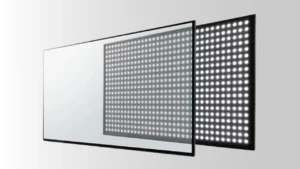
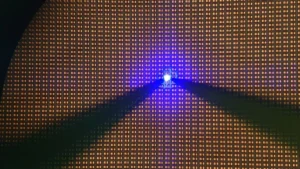
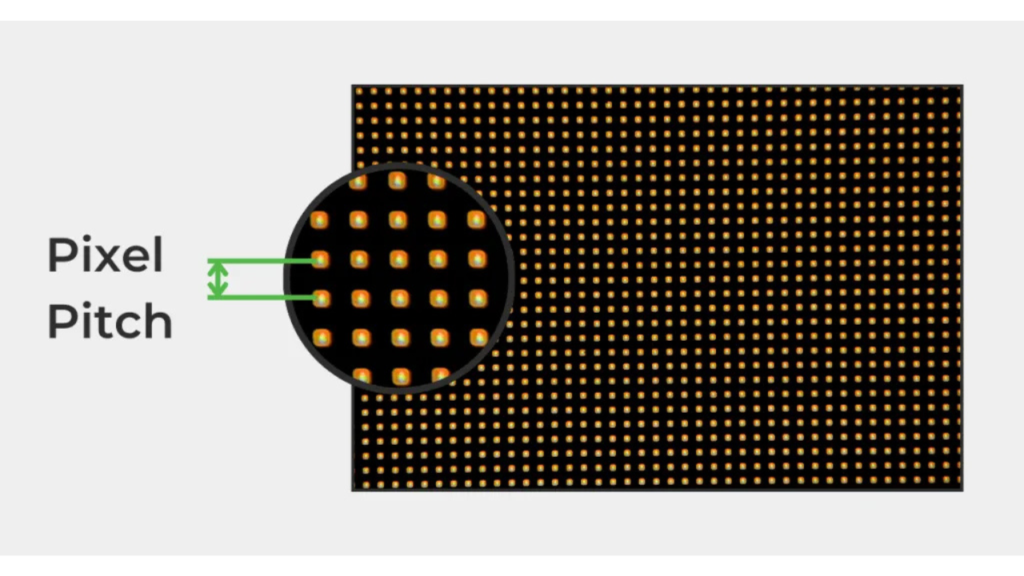
The pixel pitch refers to the millimeters that separate the center of one pixel and the center of the other adjacent pixel found on the same LED screen. We can also refer to the same as dot pitch or simply pitch.
With this in mind, it is worth noting that a smaller pitch implies that the pixels are crowded in close. The result is an improved pixel, and the display resolution is increased.
On the other hand, a larger pixel pitch signifies that pixels are being separated further. This tends to diminish the sharpness of an image, particularly when viewed at a close range.
We can take an example of a P2.5 pixel pitch, which implies that the distance between the pixels is 2.5mm. A pixel pitch of P10 implies that there is a distance of 10mm between two consecutive pixels.
It is now clear that your pixel pitch is what should identify how high the details of your screen will be. It also determines how close you, as an audience must step to view a clear image.
How to Calculate Pixel Pitch for LED Display
Once you find your way around, getting an accurate calculation of the pixel pitch of your LED screen gives you an advantage. You’re at liberty to determine the required resolution and viewing distance.

Pixel Pitch Measurement
We measure the pixel pitch by taking the distance between the centers of two adjacent pixels in millimeters. When you opt for SMD (surface-mount diode) LED’s then you consider the distance between the centres of each diode package of LEDs.
You can still use the same logic when you’re handling DIP LEDs (dual-in-line package). We can achieve this using the formula below:
Pixel Pitch (mm) = Distance between the Center of one pixel and the center of the next pixel
The above is a clear indication that the LED screen you will go for will have clarity based on this factor.
Determining Pixel Density
We can describe this as the concentration of pixels, and we usually measure it per square meter. Having a pixel density that is higher results in a tighter pixel pitch.
We can calculate this using the formula below:
Pixel Density = (1000/ Pixel pitch in mm)²
Let us take an example using a P5 LED Display:
The P5 LED display has:
Pixel density = (1000/5) ²
= 40, 000 pixels/m²
Calculating Pixel Pitch
We can easily find the e pixel pitch if we have the pixel density using an inverse approach. This will clearly indicate the dependence of your image clarity on it.
Pixel Pitch = 1000 ÷ √ (Pixel Density)
How Pixel Pitch Affects LED Display Quality
Pixel Pitch vs Resolution
We can define resolution simply as the number of pixels that are contained in a defined length and width of the display screen. This means that having less pixel pitch gives more pixels on a panel, thereby producing a clearer picture.
Nevertheless, this high resolution can be useful only when viewing is close. The high resolution tends to be costly without benefits at long-range viewing (as on a highway billboard).
The major takeaway here is that having a reduced pixel pitch creates a greater resolution. This also means that all images you view close-up are of high quality.
Viewing Distance
There is a direct relationship between the pixel pitch and optimal viewing distance. We can define the optimal viewing distance as how close you can view a display without pixelation becoming obvious.
We can roughly estimate your minimum viewing distance to be approximately equal to the pixel pitch. We measure this viewing distance in meters with the pixel pitch in mm.
LED Screen Color Brightness
Although pitch does not have a direct impact on brightness, brighter displays (containing fewer pixels per unit area) can afford to use larger LEDs. This means that they are capable of producing a higher luminance.
You will find this useful when dealing with outdoor displays. They require a high pitch that is capable of optimizing brightness and readability in full sunlight.
Display Color Accuracy
The pixel pitch affects stability in color perception and contrast perception. The densely placed pixels minimize gaps and enhance even shades of varied color blending, on curved or non-patterned walls.
When the pitch spacing is poor, it may result in either color banding or pixelations. Another impact of this is unnatural gradients in environment which require demanding visual settings.

Type of Content to Display on LED Display
The pixel pitch you go for should be determined by what you want to LED Display to display. As an example, if you’re going for low spec graphic such as a scoreboard, then a high pixel pitch of about P6-P10 is recommended.
For regular videos such as those used on digital billboard, then a medium pixel pitch of around P3-P6 would give you the best quality image. Comprehensive images such as broadcast of an event, require a low pixel pitch of about P1.2-P3.
However, for Ultra-HD or control that require 1080p or 4K/8K, you will require an ultra-low pitch. This can be anything sub-P1.5 to ensure crystal clear images.
Comparing Pixel Pitch for Different LED Displays
| Type of LED Display | Recommended Pixel Pitch | Applications |
| Indoor LED Display | 1.2 to 4 | Exhibitions, church displays, boardrooms |
| Outdoor LED Display | 4 to 10 | Stadiums, billboards |
| Ultra-fine Pitch | 0.6 to 1.2 | Security control rooms, broadcasting studios |
| Rental Digital Signage | 2 to 5 | Mobile displays |
| Command or Control Rooms | 0.9 to 1.5 | Real-time data |
| OLED | Not Pixel-pitched | Consumer Televisions |
| QD-LED | Qountum dot tech | Next-gen displays |
Conclusion
Pixel pitch is not a purely technical figure, it is such an essential parameter that determines the effectiveness, clear, and impressive use of your LED display. The appropriate pixel pitch guarantees success when deploying your monster outdoor billboard or when the staging is an indoor video wall of small dimensions:
Simply put, Pixel pitch acts as a make or break estimate in relation to your investment. Pitch should always be matched with the viewing distance as well as the complexity of the content.
FAQs
Does higher pixel pitch mean better quality?
No. Actually, low pixel pitch results in high quality because it puts more pixels in a smaller space giving it a better resolution and high clarity.
How does pixel pitch affect image quality?
Bigger pitch can be pixelated when viewed close, but its visibility remains alright in the long range.
How does pixel pitch vs pixel density compare?
Reduction in the pixel pitch leads to an increase in the pixel density and vice versa.
Should your choose higher pixel pitch or lower pixel pitch?
It varies with your application: Reduced pitch of indoors, high-resolution and close viewing with the latter for use in large scale, long distance viewing screens
What is the difference between pixel pitch and pixel per inch (PPI)?
Pixel Pitch: Pixel screen space (in mm)
PPI: dots per inch (pixels)
Both indicate a resolution but the former is applied in mobile and print whereas the latter is the LED display.
How does pixel pitch affect the cost of video wall?
Lower pixel pitches have higher prices since they need more LEDs and a higher processing power.