









What is an LCD (Liquid Crystal Display)?

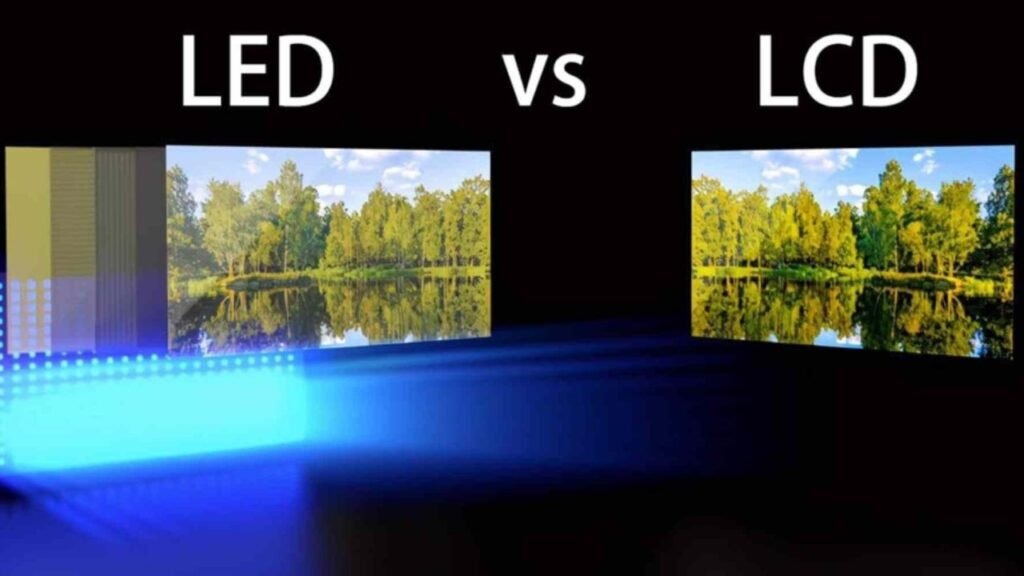
LCD stands for Liquid Crystal Display. It uses liquid crystals to produce images, with a backlight (usually fluorescent or older LED) shining through the crystals.
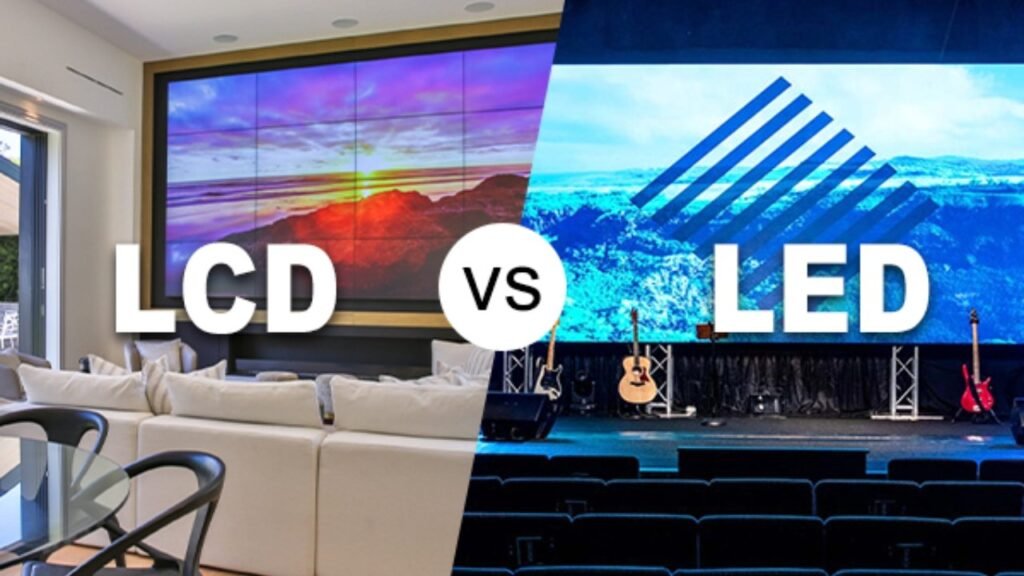
For commercial use, LCDs are often tiled together to create video walls. However, they have visible bezels (gaps between screens) , which can ruin the visual effect.
Common commercial LCD uses:
- Retail store signage (small to medium size)
- Indoor menu boards
- Conference room displays
- Security monitor walls
What is an LED (Light Emitting Diode) Display?

LED stands for Light Emitting Diode. An LED display uses thousands of tiny LEDs as individual pixels to create an image. Unlike LCDs, they do not need a separate backlight.
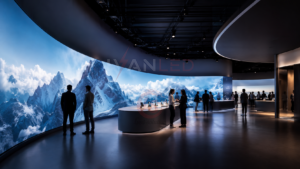
For commercial use, LED displays are modular. You can connect multiple panels to create any size or shape – without any visible gaps.
Common commercial LED uses:
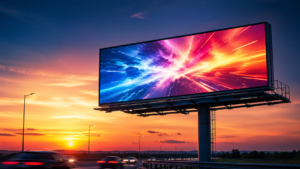
- Outdoor billboards and highway signs
- Concert stage backgrounds
- Rental screens for events and weddings
- Shopping mall centerpieces
- Church sanctuary screens
- Sports stadium scoreboards and ribbon boards
Key Differences for Commercial Use
Here are the most important differences when choosing for a business project.
1. Seamless Splicing vs. Visible Bezels
| Feature | LCD Video Wall | LED Display |
| Gaps between panels | Yes – visible bezels (3.5mm to 5.5mm) | No – completely seamless |
| Best for | Small indoor signs (2-4 panels) | Large screens, immersive experiences |
| Visual impact | Lines break the image | One continuous image |
Winner: LED – No bezels means a true seamless display.
2. Brightness (Important for Outdoor & High Ambient Light)
| Feature | LCD Display | LED Display |
| Typical brightness | 300 – 700 nits | 1,000 – 6,000+ nits |
| Outdoor visibility | Poor in sunlight | Excellent, even in direct sun |
| Best for | Indoor, low-light environments | Outdoor, semi-outdoor, bright lobbies |
Winner: LED – For any location with natural light, LED is the only choice.
3. Power Consumption
| Feature | LCD Display | LED Display |
| Power use per sqm | Higher (backlight always on) | Lower to moderate (depends on content) |
| Long-term cost | Higher electricity bills | Lower electricity bills |
Winner: LED – Especially for large screens running 12+ hours a day.
4. Lifespan and Durability
| Feature | LCD Display | LED Display |
| Typical lifespan | 50,000 – 60,000 hours | 100,000 hours (over 11 years of 24/7 use) |
| Outdoor rating | Limited (IP44 or lower) | Available (IP65 – waterproof and dustproof) |
| Heat tolerance | Moderate | High (solid-state design) |
Winner: LED – Longer lifespan and better durability.
5. Viewing Distance and Pixel Pitch
| Feature | LCD Display | LED Display |
| Minimum viewing distance | Any distance (high pixel density) | Depends on pixel pitch (e.g., P3 = 3 meters) |
| Best for | Close-up viewing (retail, menus) | Medium to long distance (stages, billboards, arenas) |
Winner: Tie – LCD for close-up indoor, LED for medium to long distance.
6. Initial Cost vs. Long-Term Value
| Feature | LCD Display | LED Display |
| Initial cost per sqm | Lower ($300 – $800) | Higher ($800 – $2,500+) |
| Maintenance cost | Higher (backlight replacement, bezel alignment) | Lower (modular – replace individual panels) |
| Best for | Tight budget, small indoor projects | Long-term investment, large or outdoor projects |
Winner: LED for long-term value – Higher upfront, lower total cost over 5+ years.
Advantages and Disadvantages of LCD Displays (Commercial)
Advantages
| Advantage | Why It Matters |
| Lower initial cost | Good for small budgets |
| High pixel density | Clear image at close range |
| Widely available | Easy to find suppliers |
| No visible pixels up close | Works for countertop or shelf displays |
Disadvantages
| Disadvantage | Why It Matters |
| Visible bezels when tiled | Breaks the image – not immersive |
| Lower brightness (300-700 nits) | Cannot be used outdoors |
| Shorter lifespan (50k hours) | Needs replacement sooner |
| Backlight degrades over time | Colors become uneven |
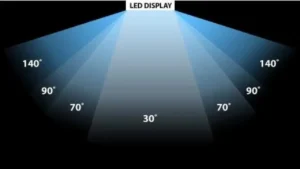
| Poor viewing angles | Color shifts off-center |
Advantages and Disadvantages of LED Displays (Commercial)
Advantages
| Advantage | Why It Matters |
| Seamless splicing | One continuous image – immersive |
| High brightness (1,000 – 6,000+ nits) | Visible in direct sunlight |
| Long lifespan (100k+ hours) | Lower total cost of ownership |
| Outdoor rating (IP65 available) | Withstands rain, dust, and heat |
| Modular design | Easy to repair – replace one panel |
| Flexible shapes | Curved, floor, ceiling, or custom sizes |
Disadvantages
| Disadvantage | Why It Matters |
| Higher initial cost | Needs larger upfront budget |
| Minimum viewing distance | Not for very close viewing (depends on pixel pitch) |
| Requires professional installation | Not a DIY project |
Which One Should You Choose for Your Business?
Use this simple decision flow:
| Your Scenario | Recommended Display | Why |
| Outdoor billboard or highway sign | LED | Brightness and weatherproofing |
| Concert stage or rental for events | LED | Seamless, fast setup, high impact |
| Shopping mall centerpiece | LED | Immersive, no bezels |
| Church sanctuary screen | LED | Long lifespan, bright, reliable |
| Sports stadium scoreboard | LED | High brightness, wide viewing angle |
| Retail shelf display (small, indoor) | LCD | Lower cost, close-up viewing |
| Restaurant menu board (small, indoor) | LCD | Good enough, cheaper |
| Conference room display (single screen) | LCD | Sufficient for small groups |
| Any outdoor or bright indoor location | LED | Non-negotiable – LCD won’t work |
Final recommendation for most commercial projects:
For outdoor advertising, large-scale events, stadiums, and any application requiring high brightness or seamless visuals – LED is the superior choice. For small indoor signs viewed up close, LCD may be sufficient.
Conclusion
For most commercial applications—especially outdoor advertising, large-scale events, and high-ambient-light environments—LED displays are the superior choice. They offer higher brightness, seamless splicing, and better long-term durability.
Ready to upgrade your business signage or event visuals?
At IVANLED, we specialize in providing high-quality, commercial-grade LED display solutions. Contact us today to get a free quote for your specific project.
FAQs for Commercial Buyers
Q1: Can I use an LCD video wall outdoors?
A: No. Most LCDs are not bright enough (300-700 nits) and lack weatherproofing. You need an outdoor LED display with at least 4,000-6,000 nits and IP65 rating.
Q2: What is the lifespan of a commercial LED display?
A: Typically 100,000 hours – that is over 11 years of 24/7 operation.
Q3: Are LCD video walls seamless?
A: No. Even “narrow bezel” LCDs have gaps of 3.5mm to 5.5mm between screens. LED displays are completely seamless.
Q4: Which is more cost-effective for a 5-year billboard rental?
A: LED. While the upfront cost is higher, the lower electricity bill, minimal maintenance, and longer lifespan make LED cheaper over 5+ years.
Q5: What pixel pitch do I need for an event stage?
A: For a stage where the audience is 5+ meters away, P3.9 or P4.8 is standard. For closer viewing (2-3 meters), choose P2.5 or smaller.
Q6: Does IVANLED offer installation services?
A: Yes. We provide installation guides, technical support, and can connect you with local installers in North America and Mexico.