





1. What Is a Sphere LED Screen?
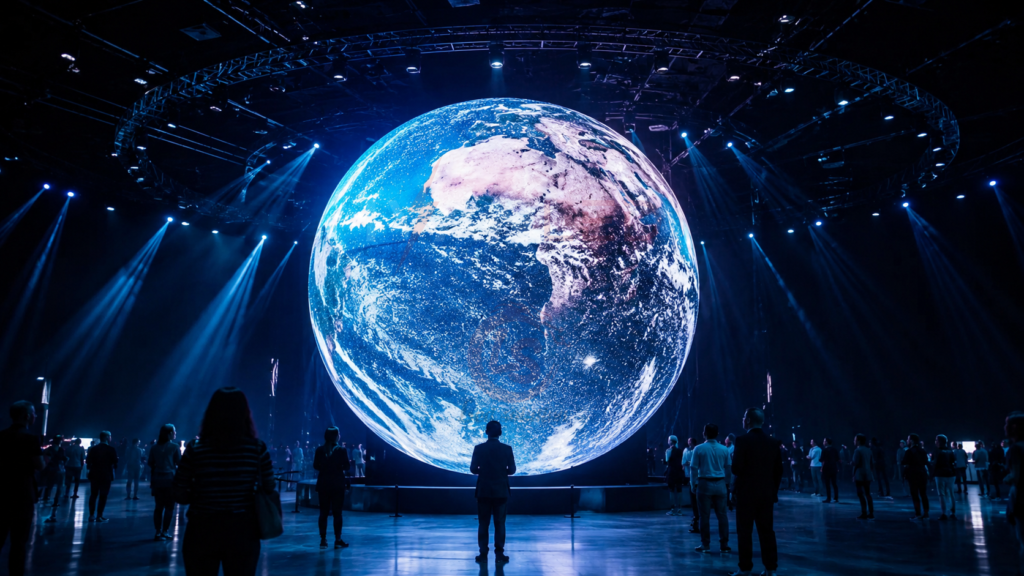
A sphere LED screen (also called LED ball display or globe LED screen) is a spherical display that provides full 360-degree visuals. Unlike traditional flat-panel displays, sphere LED screens are designed to create immersive, engaging visual experiences that can be viewed clearly from any angle.
Key characteristics:
- 360-degree viewing – Visible from all angles
- Immersive visuals – Creates a sense of depth and engagement
- Customizable sizes – From 0.5m to 50m+ diameters
- High brightness – Indoor and outdoor variants available
- Creative impact – Makes a lasting impression on audiences
Sphere LED screens are widely used in museums, shopping malls, corporate events, exhibitions, stage productions, and public art installations.
2. How Sphere LED Screens Work
2.1. Core Components
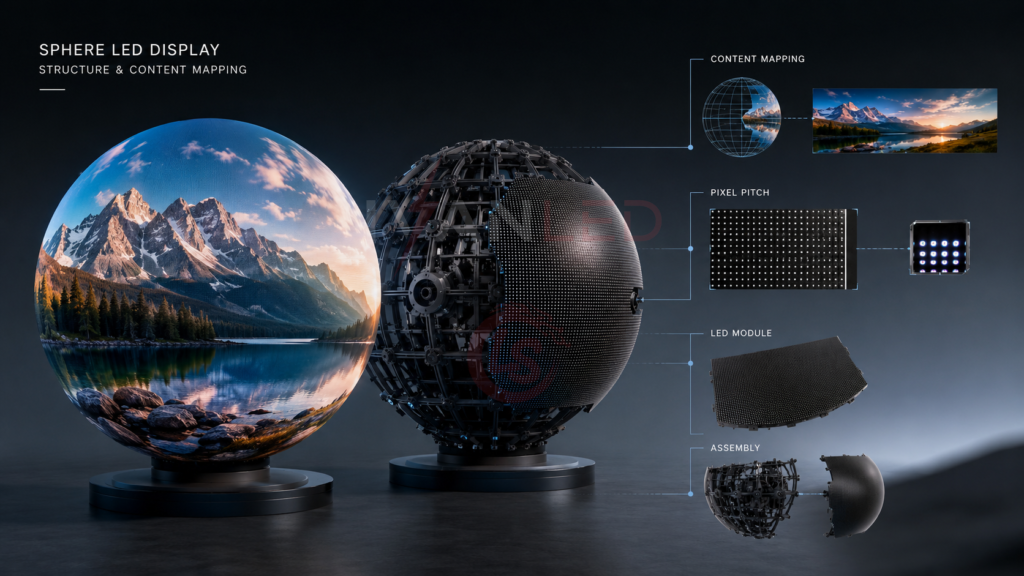
| Component | Function |
| LED modules | Individual LED panels mounted on a spherical frame |
| Spherical frame | Rigid structure that holds the LED modules in a sphere shape |
| Control system | Manages content playback, mapping, and synchronization |
| Content mapping software | Maps flat content onto the curved spherical surface |
| Power supply | Provides stable power for LED modules and control systems |
2.2. Content Mapping and Processing
Sphere LED screens require specialized content mapping software to display video and images correctly on a curved 3D surface. Without proper mapping, content appears distorted. Advanced processors adjust images in real time to match the sphere’s curvature, ensuring seamless, distortion-free visuals.
For more on LED display control systems, see our LED display functions guide.
3. Types of Sphere LED Screens
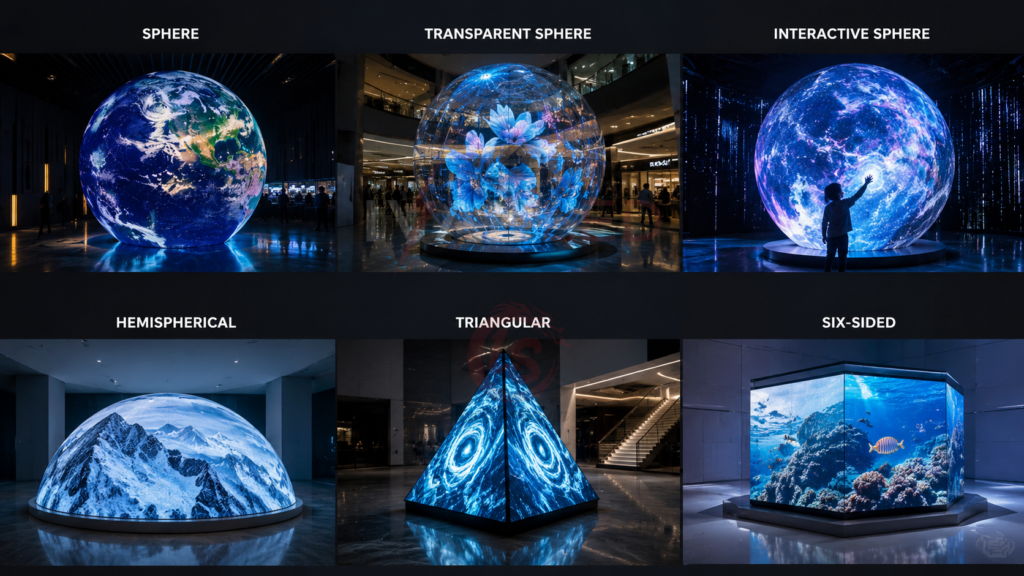
| Type | Description | Best For |
| Transparent sphere LED | See-through LED technology; visible through the sphere | Advertising, visual merchandising, public art |
| Interactive sphere display | Sensors detect user movement or touch; content responds in real time | Interactive exhibitions, trade shows, science centers |
| Hemispherical LED display | Dome-shaped; covers only the top half | Planetariums, theaters, simulation centers |
| Triangle sphere LED | Constructed from flat triangular PCBs (“football screen” design) | Full sphere displays with no pole distortion |
| Six-sided sphere LED | Composed of quadrilateral PCBs; modular assembly | Custom sphere installations, scalable designs |
4. Key Features of Sphere LED Screens
- 360-degree viewing angle – Content is visible from every direction
- Creative spherical design – Captures attention and enhances brand visibility
- Seamless visuals – No visible seams or gaps between panels
- High resolution – Fine pixel pitch for sharp images on curved surfaces
- Customizable – Size, resolution, and shape tailored to project requirements
- Flexible installation – Suspended, freestanding, or integrated into structures
- 3D capability – Displays 3D visuals without special glasses
- Content mapping – Specialized software for distortion-free spherical projection
5. Applications Across Industries
| Industry | Application | Key Benefit |
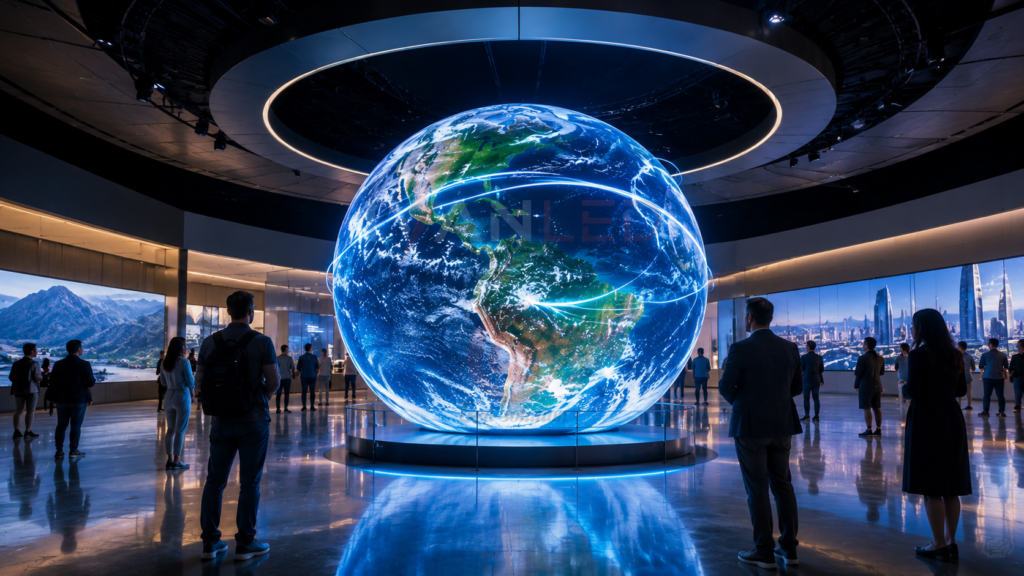
| Events and exhibitions | Immersive brand activations, product launches, stage installations | Enhanced engagement, social media shareability |
| Museums and science centers | Educational exhibits, interactive displays, immersive storytelling | Visitor engagement, memorable experiences |
| Retail and brand environments | Window displays, flagship store installations, brand experiences | Increased dwell time, brand differentiation |
| Entertainment and nightlife | Club installations, stage productions, immersive venues | Atmosphere creation, enhanced guest experience |
| Corporate and public spaces | Lobby installations, brand storytelling, wayfinding | Modernization, brand impression, visitor engagement |
6. Sphere LED Screen Pricing Factors
Sphere LED screen prices vary significantly based on several factors. The following are general market reference prices for planning purposes.
6.1. Pixel Pitch and Pricing
| Pixel Pitch | Pixel Density (per m²) | Price Range (per m²) | Typical Use |
| P1.5 | 428,000 | $2,500 – $3,000 | Close viewing, high-end indoor |
| P2.5 | 160,000 | $1,500 – $2,000 | Indoor events, retail, museums |
| P3 – P4 | 62,500 – 111,111 | $1,000 – $1,500 | Medium-distance viewing |
| P5+ (outdoor) | 40,000+ | $800 – $1,200 | Outdoor installations, long-distance viewing |
6.2. Size and Installation Complexity
Larger sphere screens require more LED modules, more complex engineering, and specialized installation:
- Small sphere screens (0.5–2m diameter): $2,000 – $15,000
- Medium sphere screens (2–5m diameter): $15,000 – $50,000+
- Large sphere screens (5–10m+ diameter): $50,000 – $200,000+
- Mega spheres (10m+ diameter): $200,000 – $1,000,000+
Additional costs to consider:
- Content mapping and software: $2,000 – $10,000+
- Installation and rigging: $5,000 – $50,000+
- Annual maintenance: 5–10% of initial installation cost
For a custom quote, contact our sales team with your specific requirements.
7. How to Choose the Right Sphere LED Screen
7.1. Define Your Purpose and Application
Consider whether the sphere will be used for advertising, interactive exhibitions, entertainment, or immersive experiences. Determine if it will be installed indoors or outdoors, and whether it will be viewed by large groups or individuals at close range.
7.2. Select the Right Pixel Pitch
Match pixel pitch to viewing distance:
- Close viewing (under 2m): P1.5 – P2.5
- Medium viewing (2–5m): P2.5 – P4
- Long viewing (over 5m): P4 – P6+
7.3. Evaluate Brightness and Durability
Indoor sphere screens typically require 1,000–1,500 nits. Outdoor sphere screens require 4,500+ nits and IP65+ weatherproofing to withstand sunlight and environmental conditions. See our indoor vs outdoor comparison for more details.
7.4. Consider Interactive and 3D Capabilities
For high-engagement installations, consider sphere screens with:
- Interactive sensors – Responds to touch, movement, or gestures
- 3D content support – Displays depth effects without special glasses
- Cloud-based content management – Remote updates and scheduling
7.5. Assess Installation and Maintenance
Sphere LED screens require specialized installation. Consider:
- Mounting type – Suspended, freestanding, or integrated
- Access for maintenance – Front or rear access for repairs
- Modular design – Easier to assemble and service
8. Choosing a Reliable Sphere LED Screen Supplier
Selecting the right manufacturing partner is critical for a successful sphere LED project. Look for a supplier with:
- Proven experience in spherical LED display manufacturing — with verifiable case studies
- High-quality, durable products with verified IP ratings and brightness specifications
- Comprehensive warranties and responsive technical support
- Customization capabilities for size, resolution, and shape
- Content mapping expertise and software support
- Global shipping and logistics support
IvanLED is a professional LED display manufacturer with over a decade of experience. We offer custom sphere LED screen solutions for events, retail, museums, and entertainment venues. Our sphere displays feature high-quality LEDs, precise content mapping, and durable construction.
We provide competitive wholesale pricing, custom design support, and comprehensive technical documentation. Browse our commercial LED display solutions or contact our sales team to discuss your project requirements.
9. Frequently Asked Questions (FAQ)
What is the difference between a sphere LED screen and a standard LED display?
A sphere LED screen is a 360-degree spherical display that provides immersive visuals from every angle. Standard LED displays are flat and have a limited viewing angle. Sphere screens require specialized content mapping software to display content correctly on a curved 3D surface.
Can sphere LED screens be used outdoors?
Yes, but they must be specifically designed for outdoor use. Outdoor sphere LED screens require high brightness (4,500+ nits), IP65+ weatherproofing, UV-resistant materials, and robust structural support. Always verify the IP rating and brightness specifications for your environment.
What pixel pitch is best for a sphere LED screen?
For close viewing (under 2 meters), choose P1.5–P2.5. For medium distances (2–5 meters), P2.5–P4 is recommended. For long distances (over 5 meters), P4–P6+ is cost-effective. Match pixel pitch to your typical viewing distance.
How much does a sphere LED screen cost?
Sphere LED screens typically range from $2,000 to $200,000+ depending on size, pixel pitch, and customization. Small spheres (0.5–2m) cost $2,000–$15,000. Medium spheres (2–5m) cost $15,000–$50,000+. Large spheres (5m+) start at $50,000+.
Does IvanLED offer sphere LED screen solutions?
Yes. IvanLED provides custom sphere LED screen solutions for events, retail, museums, and entertainment venues. Our range includes transparent, interactive, hemispherical, and full-sphere displays. Contact our sales team to discuss your project requirements and request a wholesale quote.
10. Conclusion: Elevate Your Events with Sphere LED Screens
Sphere LED screens are powerful tools for creating immersive, unforgettable visual experiences. Whether you are designing a brand activation, a museum exhibit, a stage installation, or a permanent venue feature, the right sphere screen solution can transform any space and captivate audiences.
IvanLED’s straightforward advice for 2026:
– For indoor installations, choose P1.5–P2.5 sphere screens with 1,000–1,500 nits brightness.
– For outdoor installations, prioritize 4,500+ nits brightness and IP65+ weatherproofing.
– For maximum engagement, consider interactive sphere screens with motion or touch sensors.
– Budget for content mapping software and professional installation — these are critical for a successful sphere display.
At IvanLED, we manufacture high-quality sphere LED screens designed for the demands of commercial use. Contact our sales team to discuss your project requirements and request a wholesale quote.
Ready to bring a sphere LED screen to your next project?
👉 Contact IvanLED’s sales team for a free consultation and customized quote.