









Buyer Pain Points: Why Display History Matters for Your Purchase
B2B buyers sourcing LED displays often encounter these questions:
- Why do some displays cost 5x more than others for the same pixel pitch?
- Is “newer” technology always better for my application?
- How long will this display technology stay relevant before becoming obsolete?
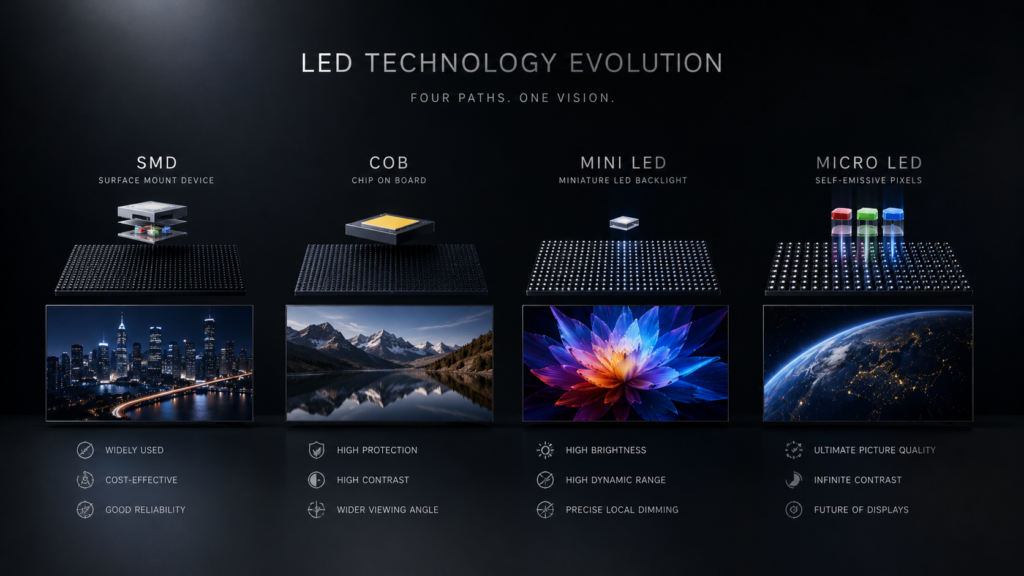
- What is the real difference between SMD, COB, and Micro LED for direct-view displays?
At IvanLED, we combine decades of display manufacturing experience with the latest technology. We help buyers choose the right technology for their specific application, not just the newest trend.
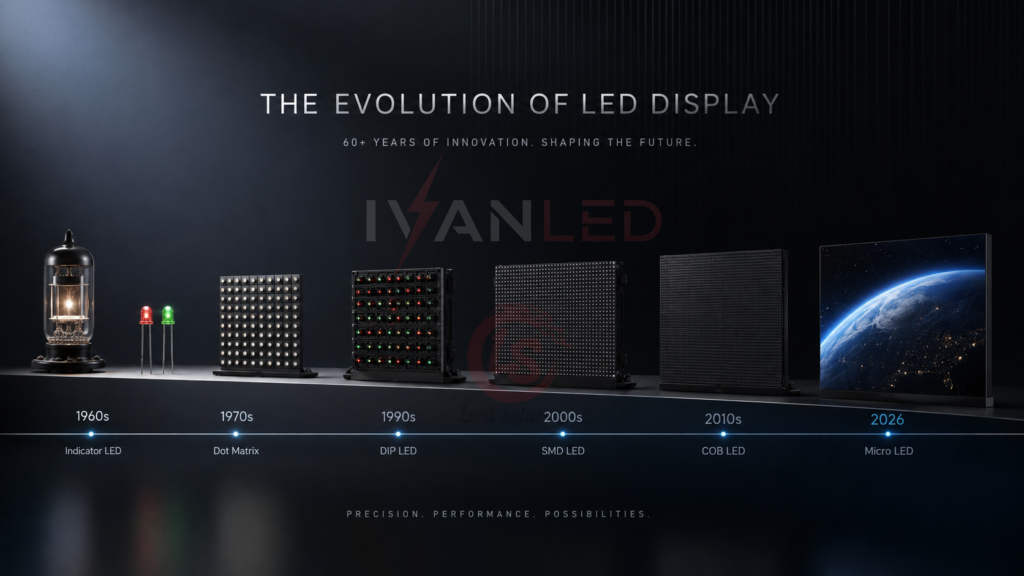
1960s–1980s: The Birth of LED Displays
1962 – First visible LED
Nick Holonyak Jr. invented the first practical visible red LED (GaAsP). This was the foundation for all future LED displays.
1970s – Early LED displays emerge
LEDs began appearing in small numerical displays (calculators, clocks) and indicator lights. These were single-color, low-resolution devices — barely displays by today’s standards.
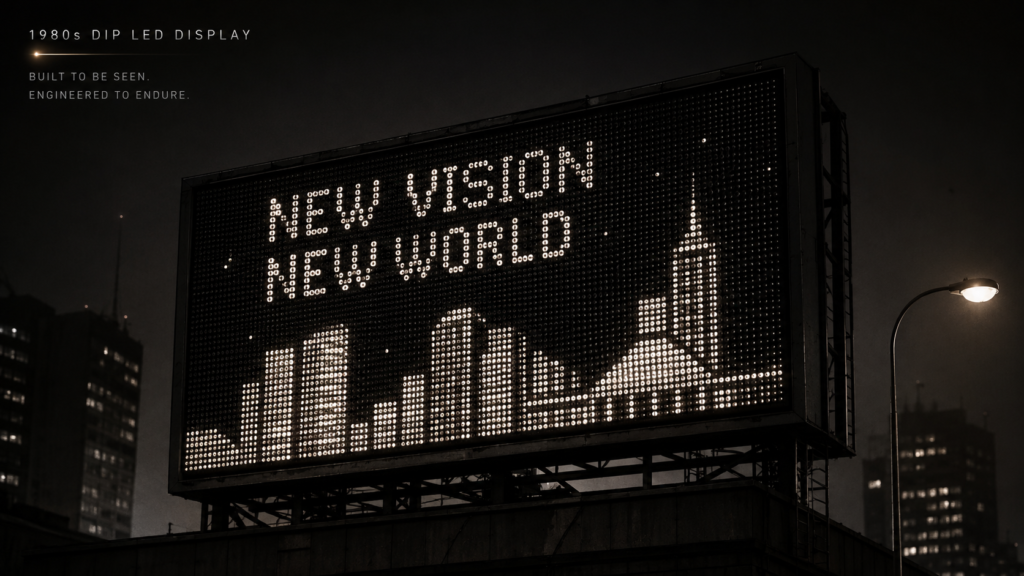
1980s – DIP LEDs for outdoor signage
Dual In-line Package (DIP) LEDs became the standard for large outdoor displays. DIP offered high brightness and durability, making it suitable for early billboards and scoreboards. However, pixel pitches were large (P10–P20+), resolution was low, and the displays were heavy and power-hungry.
What this meant for buyers: Displays were expensive, low-resolution, and limited to simple text and graphics. Only large venues with high budgets could afford them.
1990s: The Blue LED Breakthrough and Full-Color Displays
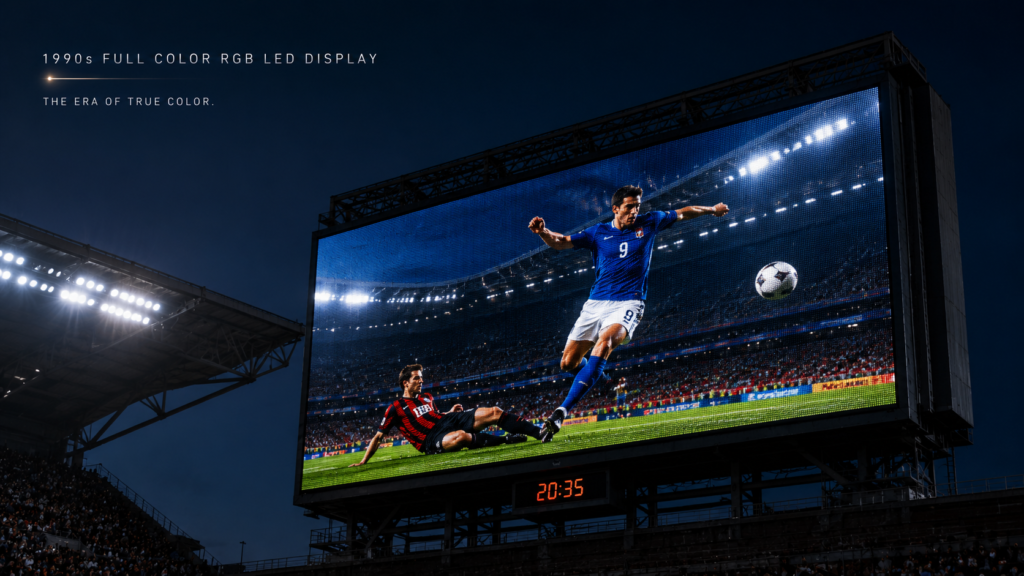
1993 – High-brightness blue LED invented
Shuji Nakamura’s invention of the blue LED (GaN) was the single most important milestone for LED displays. Without blue, full-color displays were impossible — you cannot create white or the full color spectrum without it.
Mid-1990s – First full-color LED displays
Combining red, green, and blue (RGB) LEDs enabled the first true full-color video walls. These were large-pitch (P10–P20) outdoor displays, used primarily for stadiums and billboards.
What this meant for buyers: For the first time, LED displays could show video, colorful graphics, and dynamic content. This opened up advertising and live event applications.
2000s: The Rise of SMD and Indoor LED Displays
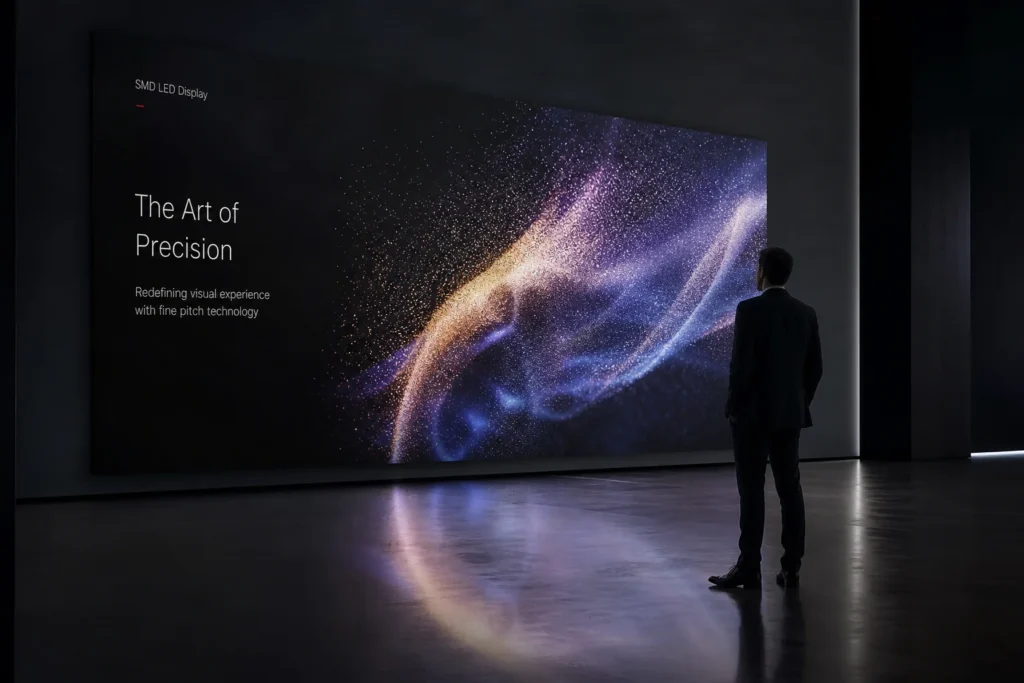
Surface Mount Device (SMD) packaging matures
SMD LEDs could be much smaller than DIP LEDs. This allowed finer pixel pitches and higher resolution displays. SMD also improved color mixing and viewing angles.
2005–2009 – Indoor LED displays become viable
SMD technology brought pixel pitches down to P4–P6, making indoor LED displays practical for the first time. Retail, corporate lobbies, and event venues began adopting LED walls.
Improved thermal management
Better heat sinks, aluminum cabinets, and optimized PCB designs extended display lifespan significantly. L70 ratings (hours until brightness drops to 70%) reached 50,000 hours.
What this meant for buyers: LED displays were no longer just for outdoor billboards. Indoor applications became cost-effective, and SMD became the industry standard for most commercial projects.
2010s: The Era of Fine Pitch and High-Resolution Displays
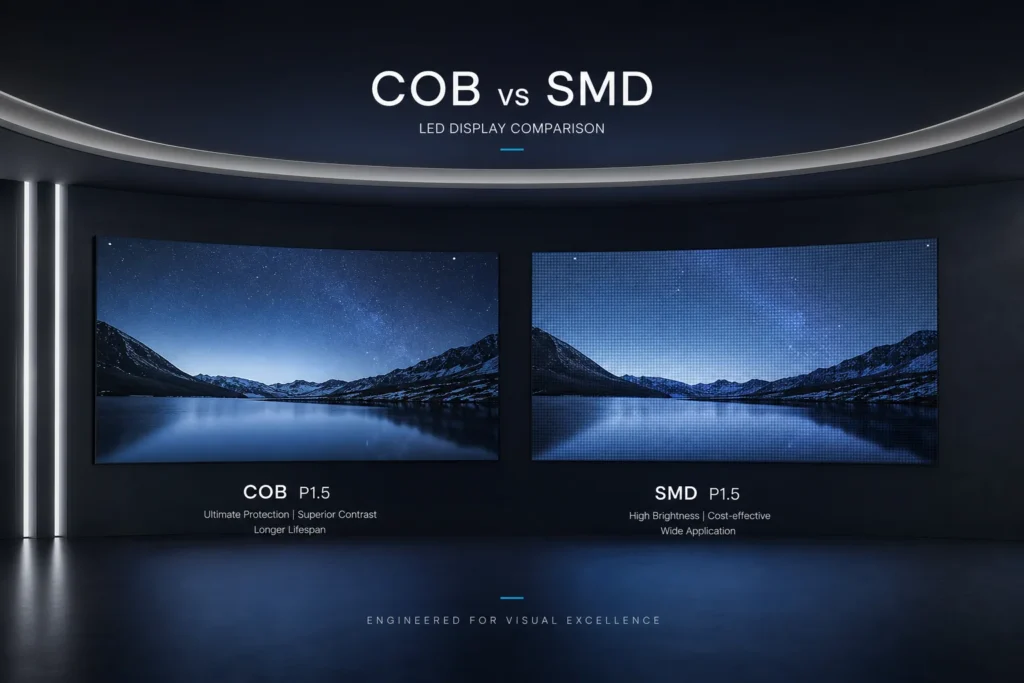
2010–2012 – Fine-pitch displays enter the market
Pixel pitches dropped below P3, then P2, then P1.5. High-end indoor displays achieved resolutions rivaling LCD video walls — but with seamless scaling and no bezels.
COB (Chip on Board) technology introduced
COB offered superior durability, deeper blacks, and wider viewing angles compared to SMD. However, higher cost limited it to premium applications (control rooms, broadcast studios, luxury retail).
GOB (Glue on Board) as a middle-ground solution
GOB added a protective epoxy layer over SMD LEDs, increasing impact resistance and weather protection. This became popular for rental displays and semi-outdoor applications.
Global market growth
The LED display market expanded rapidly as costs fell and performance improved. LEDs became the default choice for large-format displays, replacing projection and LCD walls in many applications.
What this meant for buyers: The 2010s made high-resolution LED displays affordable for mainstream commercial use. SMD became the cost-effective workhorse; COB became the premium option.
2020s: Mini LED, Micro LED, and AI Integration
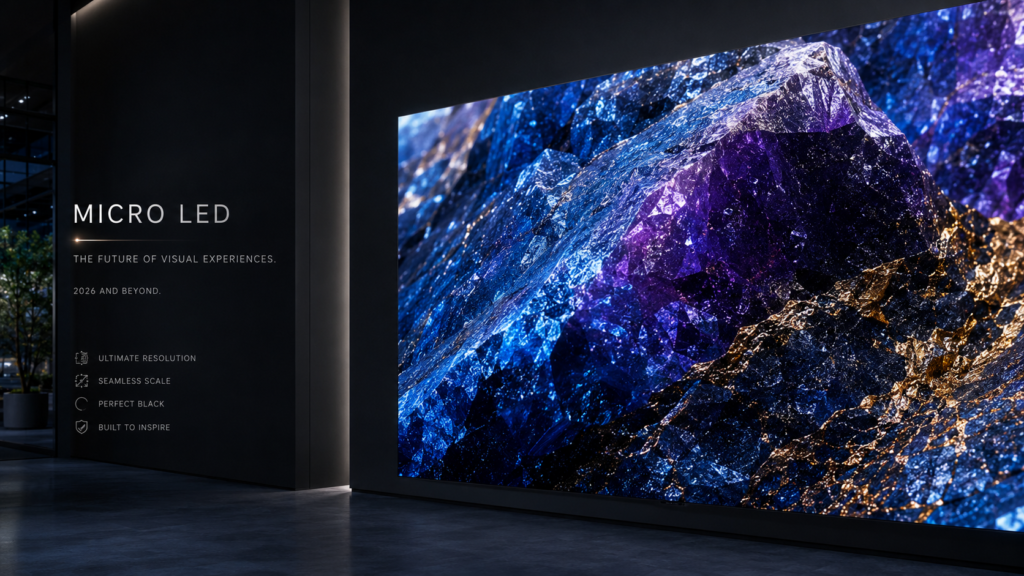
Mini LED direct-view displays
Mini LED (chips under 200 microns) enabled even finer pixel pitches (P0.7–P1.2) with better contrast and brightness uniformity. This technology is now used in high-end commercial displays.
Micro LED – the future of direct-view displays
Micro LED (chips under 100 microns) offers pixel-level self-emission, perfect blacks, high brightness, and long lifespan. However, high manufacturing costs and low yields limit it to early adopter projects (luxury retail, high-end residential, specialized broadcast).
AI-powered controllers
AI algorithms now enhance image quality (upscaling, noise reduction, dynamic contrast) and enable predictive maintenance — reducing downtime and extending lifespan.
What this means for buyers: Micro LED is the future, but SMD and COB remain the practical choices for most commercial projects. AI-enhanced controllers provide tangible performance benefits today.
Key LED Display Technologies Compared (2026)
| Technology | Typical Pixel Pitch | Durability | Color Uniformity | Cost (per m²) | Best For |
| SMD | P1.5 – P10+ | Moderate | Good (with bin matching) | $600 – $1,800 | Digital signage, outdoor, rental, churches |
| GOB (SMD + glue coating) | P1.8 – P8 | High | Good | $900 – $2,200 | Rental, interactive floors, high-traffic indoor |
| COB | P0.6 – P1.5 | Very high | Excellent | $2,000 – $4,500+ | Control rooms, broadcast, luxury retail |
| Mini LED (direct-view) | P0.4 – P1.2 | High | Excellent | $3,000 – $6,000+ | High-end broadcast, virtual production, premium installations |
| Micro LED | P0.3 – P0.6 | Very high | Exceptional | $10,000+ (early adopter pricing) | Luxury residential, specialty retail, early-adopter projects |
What Does This History Mean for Your Next Purchase?
1. Technology Maturity
LED display technology is highly mature. SMD and COB are proven, reliable, and well-understood. You are not buying experimental technology — you are buying refined products with decades of improvement.
2. Cost-Performance Sweet Spot
For most commercial projects, SMD offers the best balance of quality and cost. COB is worth the premium for close viewing or durable applications. Micro LED is still an early-stage investment — only consider it if the application truly demands the best possible image.
3. Lifespan and Reliability
Modern displays routinely achieve L70 50,000–100,000 hours. With proper thermal management and operation at 70–80% current, your display can last 8–12+ years in commercial use.
4. Future-Proofing
AI integration is the next major trend. Controllers with AI-enhanced processing are available now and provide better image quality with lower bandwidth. Ask your supplier about AI capabilities in their latest controllers.
Expert Tips from 10+ Years in LED Display Manufacturing
Tip 1: Match technology to viewing distance.
SMD is sufficient for most applications where viewers are 2+ meters away. COB or Mini LED is justified only when viewers are under 2 meters and image quality is critical.
Tip 2: Do not buy Micro LED for commercial use in 2026.
It is still too expensive and unproven for most B2B projects. SMD and COB offer better ROI for 99% of applications.
Tip 3: Prioritize thermal management.
History shows that heat is the #1 lifespan killer. A display with slightly lower brightness but excellent cooling will outlast a hotter, brighter display.
Tip 4: Ask about bin matching and batch consistency.
SMD displays rely on consistent LED batches. Ensure your supplier provides bin matching — otherwise, you risk patchy color uniformity.
Frequently Asked Questions (FAQ)
Q1: What is the most important milestone in LED display history?
The 1993 invention of the high-brightness blue LED by Shuji Nakamura. Without blue, full-color LED displays would not exist. This breakthrough enabled all modern video walls and large-format displays.
Q2: What is the practical difference between SMD and COB for LED displays?
SMD displays use individual packaged LEDs on a PCB. They are cost-effective and offer good image quality for most applications. COB (Chip on Board) mounts LED chips directly onto the substrate, creating a seamless surface with better durability, deeper blacks, and wider viewing angles. COB costs significantly more but is recommended for close viewing and high-reliability environments.
Q3: When should I consider Micro LED for my project?
Only for projects where budget is not a constraint and the absolute best image quality is required — typically luxury residential, premium retail flagship stores, or specialized broadcast applications. For most commercial projects, SMD or COB technology offers a better ROI and is proven reliable.
Q4: How has LED display lifespan improved over time?
Early LED displays in the 1970s–80s lasted only a few thousand hours. By the 2000s, L70 50,000 hours became standard. Today, quality displays achieve L70 80,000–100,000 hours. Improvements in chip quality, thermal management, and encapsulation materials have driven this progress.
Q5: Is SMD technology outdated for LED displays?
No. SMD remains the most widely used technology for indoor and outdoor LED displays. It offers excellent performance at a competitive cost. For most commercial applications — digital signage, outdoor billboards, churches, rental, and events — SMD is the standard choice. COB and Mini LED are premium alternatives for specialized use cases.
Q6: Does IvanLED offer SMD, COB, and Mini LED displays?
Yes. We manufacture displays using SMD (standard and GOB), COB, and Mini LED technologies. We help buyers select the right technology based on their application, viewing distance, and budget — not just the latest trend.
Conclusion: LED Display Technology in Perspective
LED display technology has evolved from single-color indicators to seamless, high-resolution video walls in just over 50 years. The pace of change accelerated dramatically after the 1993 blue LED breakthrough, and today’s products are reliable, efficient, and cost-effective.
Key takeaways for B2B buyers:
- SMD is the proven workhorse for most applications. It offers the best balance of performance, cost, and reliability.
- COB is worth the premium for close viewing, high-durability, or premium image quality applications.
- Micro LED is not yet practical for most commercial projects — it remains a niche, early-adopter technology.
- AI-powered controllers are the next major performance upgrade — ask about them.
IvanLED’s straightforward advice for 2026:
– For 80% of commercial LED display projects, SMD is the right choice. It is mature, cost-effective, and delivers excellent image quality.
– For close viewing (under 2 meters) or premium applications, COB provides superior durability and image quality at a higher cost.
– Do not pay for “bleeding edge” technology unless your application truly demands it.
At IvanLED, we combine decades of display manufacturing experience with the latest technology. We help buyers select the right display for their specific application and budget.
Ready to specify a display built with the right technology for your project?
👉 Contact IvanLED with your application, viewing distance, and performance requirements. We will recommend the optimal technology and provide full specifications.