









Buyer Pain Points: Choosing Between Legacy and Modern Technology
B2B buyers sourcing large-scale displays face specific challenges:
Terminology confusion: Some suppliers still use “Jumbotron” loosely. You may not know whether you are being quoted outdated technology.
Hidden long-term costs: A cheaper upfront price may hide higher maintenance, power, and replacement costs that add up over 10 years.
Installation complexity: Large displays require structural engineering, permits, and specialized labor. Not all suppliers provide full support.
Image quality expectations: Modern audiences expect crisp, high-resolution displays. Older technology looks dated and unprofessional.
Future-proofing concerns: Will the display become obsolete in a few years? Can it be expanded or reconfigured?
What Are Jumbotrons and LED Video Walls?
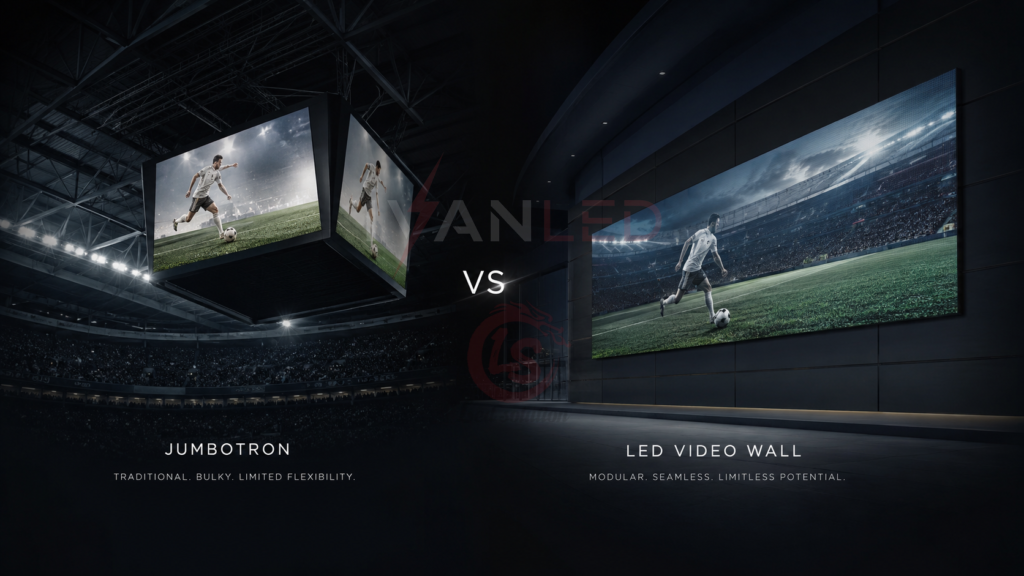
Jumbotrons are large-screen displays using CRT or early LED technology with large pixel pitches (P10–P20+), built as single massive units. LED video walls are modular displays composed of individual cabinets, offering fine pixel pitches (P0.9–P10), seamless splicing, and flexible shapes.
Key distinctions:
- Jumbotron: Single massive unit; P10–P20+ pixel pitch; rigid rectangle only; high maintenance; 5-7 year lifespan
- LED video wall: Modular cabinets; P0.9–P10 pixel pitch; curved, cylindrical, or custom shapes; low maintenance; 8-12+ year lifespan
For more on display technology, see our commercial LED display solutions.
Jumbotron vs LED Video Wall: Key Differences
LED video walls outperform Jumbotrons in every category: resolution, flexibility, cost, maintenance, energy consumption, and lifespan.
| Comparison Factor | Traditional Jumbotron | Modern LED Video Wall |
| Pixel pitch | P10 – P20+ (visible pixels up close) | P0.9 – P10 (fine to standard) |
| Image quality | Low, grainy, blurry at close range | High-definition, sharp even up close |
| Shape flexibility | None (rigid rectangle only) | Flat, curved, cylindrical, custom shapes |
| Upfront cost (20m²) | $25,000 – $50,000+ | $15,000 – $40,000 |
| Maintenance cost (10 years) | $5,000 – $15,000 | $2,000 – $5,000 |
| Annual energy cost | $1,500 – $3,000 | $800 – $1,800 |
| Actual lifespan | 5–7 years | 8–12+ years |
Why LED Video Walls Are Winning
LED video walls offer six competitive advantages over Jumbotrons: superior image quality, modular flexibility, lower total cost of ownership, easier maintenance, lower energy consumption, and longer lifespan.
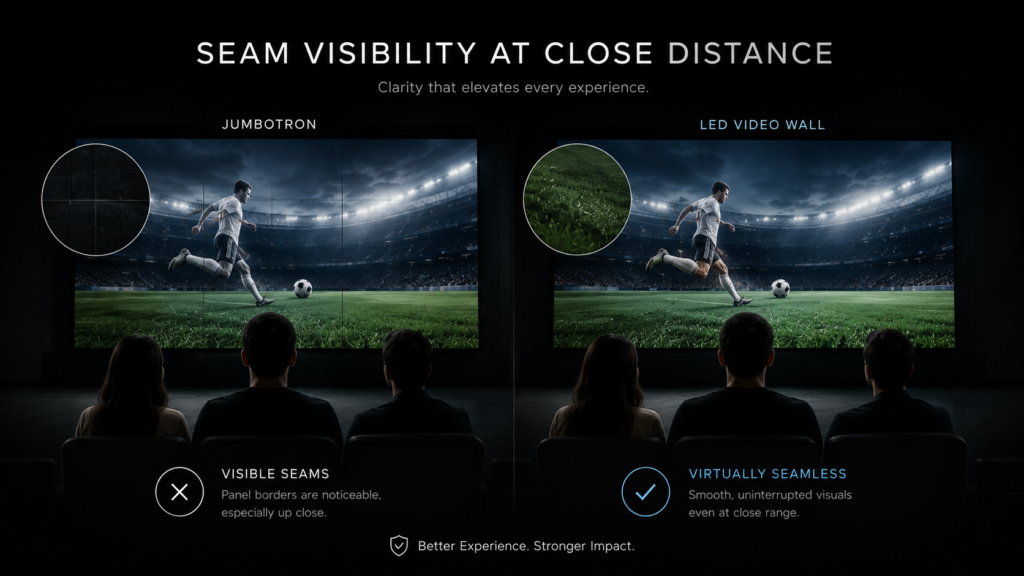
1. Superior image quality: LED video walls achieve pixel pitches as low as P0.9, meaning viewers can stand 1-2 meters away and see sharp images. Jumbotrons with P10–P20 pixel pitches look pixelated at any distance under 10-20 meters.
2. Modular flexibility: Add cabinets to expand; remove to downsize. Create curved, cylindrical, or spherical displays. Replace older cabinets without replacing the entire wall.
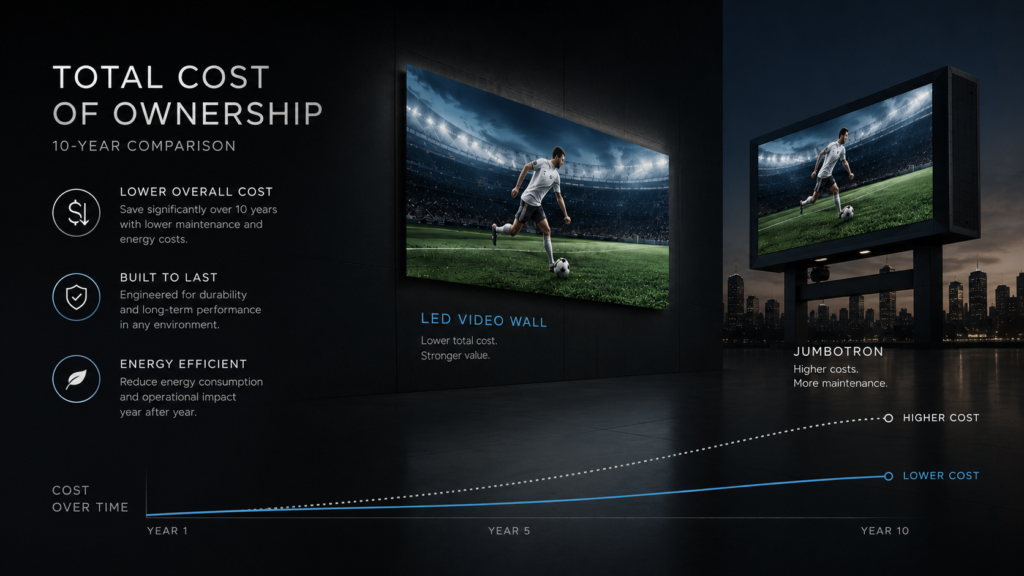
3. Lower total cost of ownership: LED video walls cost 30-50% less over 10 years than Jumbotrons. Installation is faster and simpler with standard labor and modular assembly.
4. Easier maintenance: Failed modules are swapped from the front in under 1 hour. Jumbotron repairs take days or weeks and require specialized technicians.
5. Lower energy consumption: LED video walls consume 30-50% less power than Jumbotrons at the same brightness level, saving thousands annually.
6. Longer actual lifespan: Jumbotrons run LEDs at high current, generating heat and accelerating dimming within 3-5 years. LED video walls operate at 70-80% current with better thermal management, lasting 8-12+ years.
For a complete LED display price guide 2026, see our detailed breakdown.
When Does a Jumbotron Still Make Sense?
Jumbotrons are only viable for extreme long viewing distances (50+ meters), temporary installations, or legacy replacement scenarios where retrofitting is cost-prohibitive.
Niche scenarios:
- Extreme long viewing distances: For stadium screens viewed from 50+ meters, pixel pitch becomes less critical
- Temporary installations: If a screen is only needed for a few months and will be scrapped
- Legacy replacement: If existing infrastructure is designed specifically for a Jumbotron
For new projects or long-term investments, LED video walls are the superior choice.
Current Limitations of LED Video Walls
LED video walls have four remaining challenges: visible seams between modules, brightness and color uniformity issues, complex installation for large walls, and high system integration complexity. Reputable suppliers address these with batch-matching, calibration, pre-engineering, and complete system design.
Solutions:
- Seams: Ultra-thin bezel cabinets (sub-1mm gaps) minimize visibility
- Uniformity: Batch-matched modules and annual calibration prevent patchiness
- Installation: Pre-engineering and modular frames simplify assembly
- Integration: Complete system design from a single supplier avoids compatibility issues
Expert Tips for Buyers
Tip 1: Upgrade size and resolution when replacing a Jumbotron.
Modern LED video walls allow you to go larger, higher resolution, or curved. Use the replacement as an opportunity to enhance the venue, not just swap old for new.
Tip 2: Ask for batch-matched modules.
Brightness and color vary between production batches. Ensure all modules come from the same batch to prevent “patchwork” appearance.
Tip 3: Plan for front access.
If the screen mounts on a wall with no rear space, choose front-access cabinets for easy maintenance.
Tip 4: Buy spare modules (5-10%) with your initial order.
LED batches change every 1-2 years. Spare modules purchased later will have color mismatch. This 10% add-on is the best insurance you can buy.
Tip 5: Calculate total cost of ownership, not upfront price.
A cheaper Jumbotron may look attractive initially, but higher energy, maintenance, and replacement costs often make it more expensive over 10 years.
Frequently Asked Questions (FAQ)
Are Jumbotrons completely obsolete?
For new large-scale display projects, yes. LED video walls offer better image quality, lower total cost, and greater flexibility. Existing Jumbotrons may remain in use until they fail, but LED video walls are the clear choice for new purchases.
Can an LED video wall be curved or custom-shaped?
Yes. Flexible and curved LED modules allow for concave, convex, cylindrical, and spherical displays. Custom shapes require specialized engineering but are achievable. Discuss your shape requirements with the supplier during the design phase.
How long does it take to install an LED video wall vs a Jumbotron?
A large Jumbotron may take weeks to manufacture and days to install. An LED video wall of the same size takes 2-5 days using modular cabinets and standard labor. For very large walls (>100m²), installation time is comparable.
What pixel pitch do I need to replace an old Jumbotron?
For a stadium screen viewed from 20-50 meters, P4–P8 is usually sufficient — much sharper than the old P10–P20 Jumbotron. For closer viewing (under 10 meters), consider P2.5–P3.9. Your supplier can recommend based on specific distances.
Does IvanLED offer direct replacements for Jumbotrons?
Yes. We provide modular LED video walls in custom sizes, shapes, and resolutions to replace existing Jumbotrons.
Conclusion: Make the Switch to LED Video Walls
For virtually every large-scale display application, LED video walls outperform traditional Jumbotrons across cost, image quality, flexibility, and longevity. The evidence is clear: LED video walls offer superior image quality, modular flexibility, lower total cost of ownership, easier maintenance, lower energy consumption, and longer lifespan.
Our straightforward advice:
– Do not buy a new Jumbotron. The technology is outdated, and you will pay more over time for inferior image quality.
– For new large-screen projects: Invest in a modular LED video wall. The upfront cost is competitive, and total cost of ownership is significantly lower.
– For replacing an existing Jumbotron: Use the opportunity to upgrade in size, resolution, or shape — not just a 1:1 replacement.
– Always calculate total cost of ownership — not just upfront price — before deciding.
At IvanLED, we manufacture high-quality modular LED video walls for stadiums, billboards, public squares, and commercial venues worldwide. We provide batch-matched modules, front-access options, and complete system design. Browse our products or contact us to discuss your project requirements.
Ready to replace your old Jumbotron with a modern LED video wall?
👉 Contact IvanLED with your current screen size, viewing distances, and venue photos for a free replacement assessment and quote.