







Average Cost of an LED Wall
You can have a rough idea of LED prices from the below table.
| Screen Size (meters) | P1.25 Price Range | P2.5 Price Range | P4 Price Range |
| 3×2 (Small) | $30,000 – $45,000 | $18,000 – $27,000 | $12,000 – $18,000 |
| 5×3 (Medium) | $50,000 – $75,000 | $30,000 – $45,000 | $20,000 – $30,000 |
| 10×5 (Large) | $150,000 – $250,000 | $90,000 – $150,000 | $60,000 – $100,000 |
To get a more accurate quote for your LED video wall, it’s helpful to look at the size and pixel pitch. For example, a 3×2 meter screen with P1.25 may cost between $30,000 and $45,000. An average sized 5×3 meter LED wall system can be approx. fifty thousand dollars to seventy five thousand dollars.
If you’re okay with slightly lower image quality, P2.5 LED displays can save your money. A small 3×2 meter screen may cost between $18,000 and $27,000. For a 5×3 meter setup, the price usually falls between $30,000 and $45,000.
Based on our personal recommendations, P4 LED displays (the highly affordable options in the market) are the best option for you. They still work well in bigger spaces but come at a lower cost. A 3×2 meter screen with P4 might range from $12,000 to $18,000. Medium-sized options like 5×3 meters can cost between $20,000 and $30,000. Large LED installations, for example 10×5 meters, according to our experience are usually sold from $60000 to $100000.
Factors Affecting the Cost of LED Wall

When calculating the cost of an LED wall, there are a few things to keep in mind. Now’s the time to examine your business’s needs and decide what products and features to include in your non negotiables list.
LED Size & Design
When you request a larger LED screen size, it is usual for the total cost of your quote to rise. Every additional panel you need to complete your show will increase the overall cost. As is common with many items, the more you buy, the more costly it gets.
Pixel Pitch & Viewing Distance
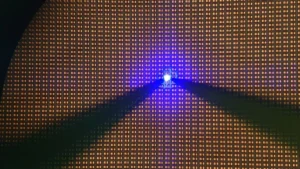
Determine the ODV for your video wall as it is critical. Upon closer inspection of an LED module, you can determine the individual pixels as distinct blocks. You’ll notice that these blocks’ shapes are getting more diffused and hazy as you pull back.
The out-of-view distance (OVD) is how far you need to be from the screen. At this distance, you start seeing smooth images instead of individual pixels. In contrast, smaller pitches can reduce the ideal viewing distance. More pixels means more cost.
Refresh Rate & Resolution

The visual quality of your material is greatly affected by the refresh rate you choose for your LED screen. For the majority of indoor and outdoor displays, whether permanent or temporary, 3840 Hz is a good choice if you are unsure of what to get.
More frequent refreshes are required for certain use cases, such as computer-on-board displays. In addition, 3D naked-eye displays & augmented reality virtual production require more frequent refreshes. For these scenarios, the minimum refresh rate is 3840 Hz, while the optimal frequency for creating XR is typically 7680 Hz.
Receiving Card
An LED receiving card is a major part of LED display systems. It transforms video data into images that can be shown on LED video wall panels.
Its high quality display is guaranteed by features like brightness adjustment, color correction and gray scale calibration. It controls the color, contrast & brightness of each pixel on the led display. This results in a crisp and high quality picture or 4K/8K HD video. Therefore, premium receiving cards can be quite pricey.
Additional Features
Manufacturers producing LED panels have what we call “bells & whistles” choices. These special features include removable cabinet doors, extra knobs and temperature gauges. You might also find corner guards and rear display screens in these examples.
Are all of your LED panels front loadable? If that’s the case, it’s best to have front access to the LED wall. This lets you reach the HUB board, receiving card, power supply unit and modules easily. The maintenance and future gadget repair greatly depend on this feature.
Installation & Maintenance
The cost of items also depends on the site of your video wall. External displays are sometimes more complicated to install. Therefore, they need particular characteristics to resist rain and other environmental factors.
Naturally, the explanation also clarifies why outdoor displays often cost a little more than their interior alternatives. If you want a solution that meets both criteria, this is another option to investigate with a group like Refresh.
Final Thoughts
Hence we can say the final pricing of LED wall screens is influenced by many factors. These include size, resolution, installation complexity and maintenance requirements. If you want to buy LED screens, you need to know these factors to make informed choices & maximize your investment.
FAQs
What is the Cost of a 4K LED Wall?
An LED wall price is set by its size, panel quality, installation technique and pixel count. Usually, a 4K LED video wall costs anywhere from $600 to $3,000.
Why Do LED Walls Cost So Much?
LED video panels cost more because they use better tech and strong materials. They’re also customizable, made of many panels & don’t need much maintenance.