












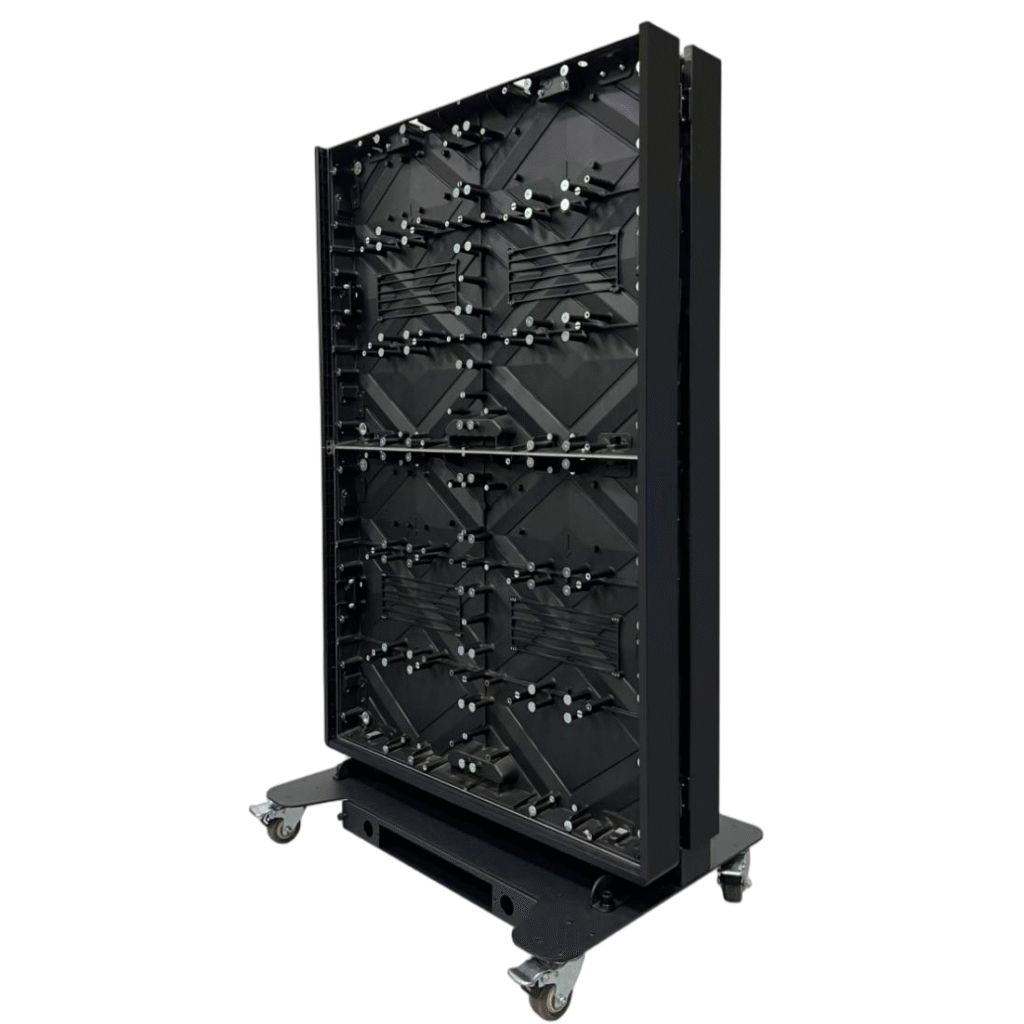
Buyer Pain Points: What Makes Commercial LED Display Sourcing Difficult
B2B buyers face several challenges when sourcing commercial LED displays:
- Spec overload – Pixel pitch, brightness, IP rating, refresh rate, cabinet material… which specs actually matter for your use case?
- Unclear ROI – Higher upfront cost vs. longer lifespan – how to calculate total cost of ownership?
- Installation complexity – Hidden costs for mounting, cabling, processors, and permits.
- Supplier reliability – Many vendors offer low prices but poor after-sales support or inconsistent quality.
- Technology confusion – SMD vs. GOB vs. COB, synchronous vs. asynchronous control, indoor vs. outdoor specifications.
At IvanLED, we simplify commercial LED display selection by matching technology to your specific application, budget, and environment.
What Is a Commercial LED Display?
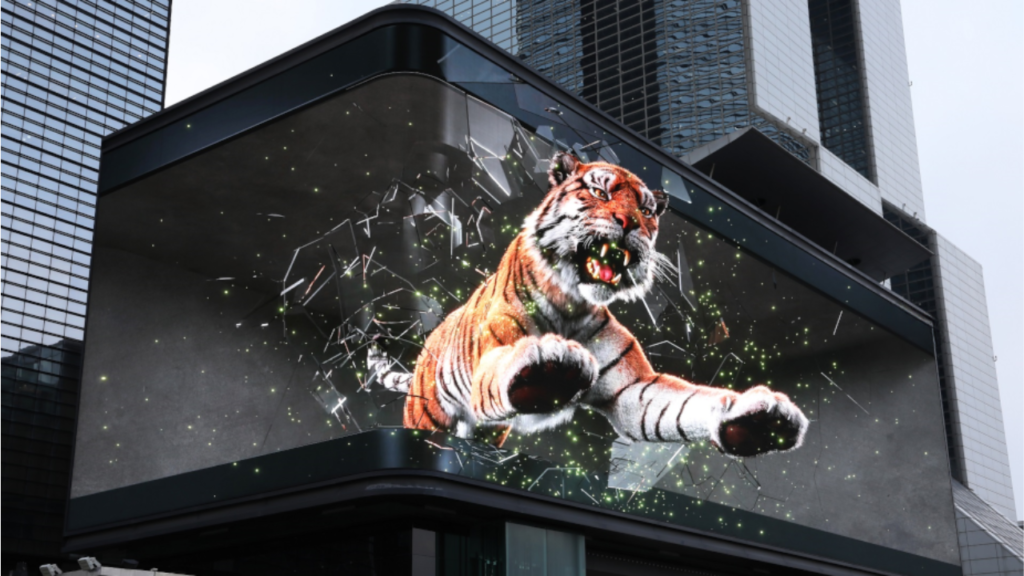
A commercial LED display is a large-format digital screen designed for business environments. Unlike consumer televisions, commercial LED displays offer:
- Higher brightness – 1,500–6,000+ nits for visibility in daylight
- Longer lifespan – 50,000–100,000 hours (5–10+ years of commercial use)
- Weather resistance – IP65-rated for outdoor installations
- Seamless scaling – Unlimited size with no bezels
- 24/7 operation capability – Built for continuous use
Commercial LED Display vs. TV: Key Differences
| Feature | Commercial LED Display | Consumer TV |
| Brightness | 800–6,000+ nits | 300–500 nits |
| Lifespan | 50,000–100,000 hours | 30,000–50,000 hours |
| Weather protection | IP20–IP65 | None (indoor only) |
| Size | Fully customizable, seamless | Fixed sizes, bezels |
| 24/7 operation | Yes | No (risk of burn-in/overheating) |
| Typical use | Advertising, signage, events | Home entertainment |
Commercial LED Display vs. Other Technologies
LED vs. LCD: Why LED Wins for Commercial Use
| Factor | LED Display | LCD Display |
| Brightness | 1,500–6,000+ nits | 300–1,000 nits |
| Viewing angle | 140–160° | 80–120° |
| Contrast ratio | 3,000:1 – 10,000:1 | 1,000:1 – 3,000:1 |
| Power consumption | 150–400W/m² | 300–600W/m² |
| Seamless splicing | Yes (no bezels) | No (visible bezels) |
| Lifespan | 50,000–100,000 hrs | 30,000–50,000 hrs |
| Custom shapes | Yes (flexible) | No (rigid) |
LED vs. Projectors: Projectors suffer from low brightness in ambient light, require dark environments, have shorter lamp life (2,000–5,000 hours), and need regular maintenance. For commercial signage, LED is the superior choice.
3 Key Benefits of Commercial LED Displays for Business
1. Content Versatility & Real-Time Updates
Display videos, images, text, live feeds, and social media. Change content instantly via software – no reprinting costs like traditional billboards.
2. Revenue Generation & High ROI
Run advertising 24/7, sell sponsorship slots, or promote your own products. With a 50,000+ hour lifespan, commercial LED displays typically pay for themselves within 12–24 months.
3. Remote Management & Automation
Schedule content, monitor performance, and update screens across multiple locations from a single dashboard. Reduce labor costs and human error.
Types of Commercial LED Displays: Indoor vs. Outdoor
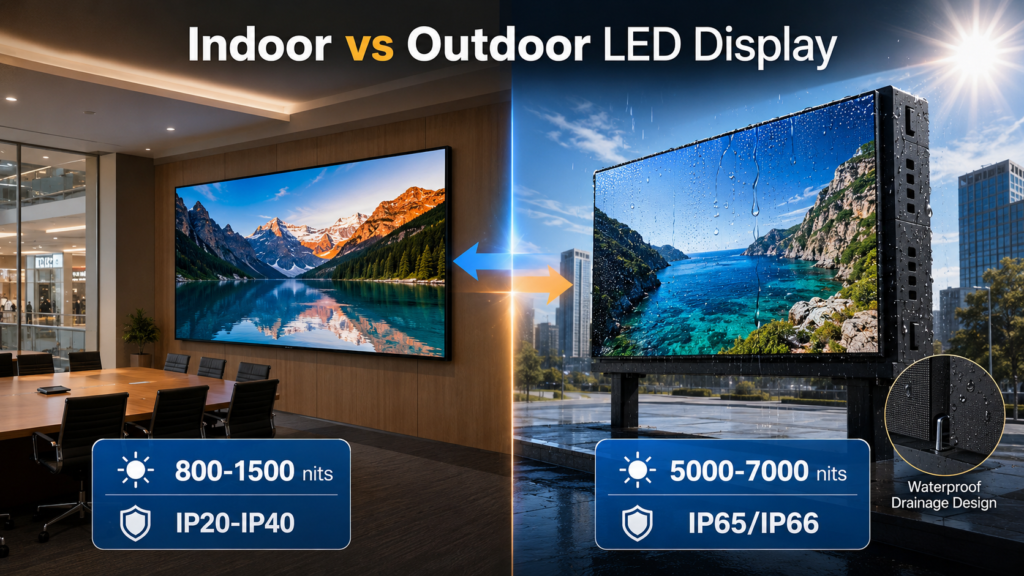
| Feature | Indoor Commercial LED Display | Outdoor Commercial LED Display |
| Brightness | 800–1,500 nits | 4,500–6,500 nits |
| Pixel pitch range | P0.9 – P4 | P3.9 – P16 |
| Protection rating | IP20–IP43 | IP65 (waterproof, dustproof) |
| Typical applications | Retail, malls, hotels, lobbies, trade shows, control rooms | Billboards, stadiums, transit stations, building facades |
| Viewing distance | Close (1–10 meters) | Medium to far (5–50+ meters) |
| Price range (per m²) | $700–$3,000+ | $900–$2,500+ |
Commercial LED Display Applications by Industry
| Industry / Application | Recommended Type | Typical Pixel Pitch | Key Requirement |
| Retail & shopping malls | Indoor | P2.5–P3.9 | High brightness, slim cabinet |
| Outdoor billboards | Outdoor | P4–P10 | IP65, high brightness (5,000+ nits) |
| Hotels & conference centers | Indoor | P1.8–P2.5 | Fine pitch, aesthetic design |
| Airports & train stations | Indoor/Outdoor | P2.5–P4 | 24/7 reliability, remote management |
| Banks & corporate lobbies | Indoor | P1.5–P2.5 | Premium image quality, slim bezel |
| Stadiums & sports venues | Outdoor | P4–P8 | High brightness, wide viewing angle |
| Trade shows & events | Indoor (rental) | P2.5–P3.9 | Lightweight, quick installation |
| Control rooms | Indoor | P1.2–P1.9 | 24/7 operation, low latency |
| Churches & worship centers | Indoor | P2.5–P3.9 | High uniformity, easy control |
| Virtual production studios | Indoor | P1.2–P1.9 | High refresh rate (3,840Hz+), color accuracy |
How to Choose the Right Commercial LED Display: 6 Key Factors
1. Pixel Pitch – Match to Viewing Distance
Rule of thumb: Minimum viewing distance (meters) ≈ Pixel pitch (mm)
- Under 2 meters: P0.9–P1.5
- 2–4 meters: P1.8–P2.5
- 4–8 meters: P2.5–P4
- 8+ meters: P4–P10
2. Brightness – Match to Environment
- Indoor: 800–1,500 nits (sufficient for most indoor lighting)
- Outdoor (direct sunlight): 4,500–6,500 nits (required for daytime visibility)
- Semi-outdoor (covered but bright): 2,500–4,000 nits
3. Protection Rating (IP Code)
- Indoor: IP20–IP43 (basic dust protection)
- Outdoor: IP65 minimum (waterproof, dustproof)
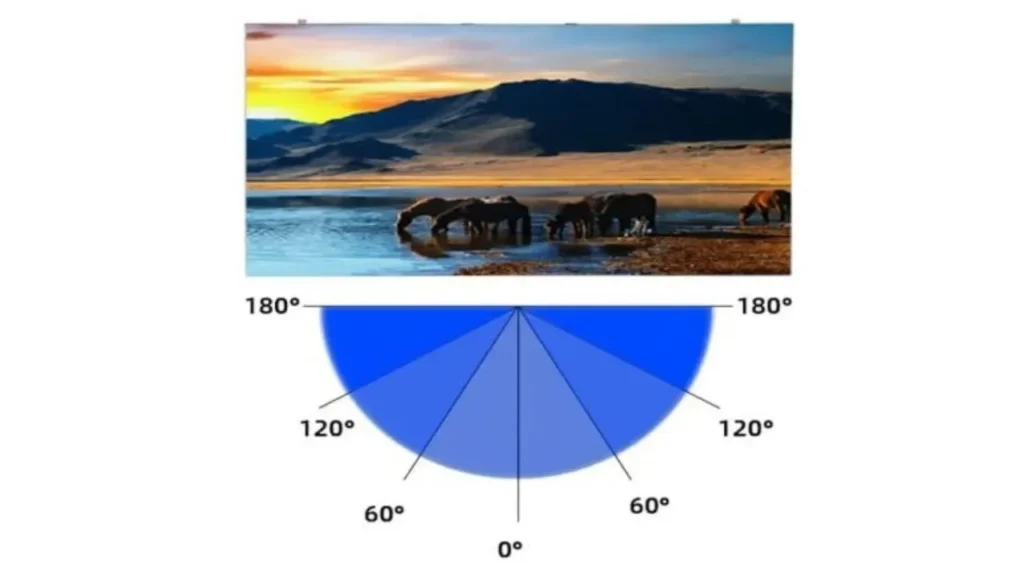
4. Viewing Angle
- Commercial LED displays typically offer 140–160° horizontal and vertical viewing angles.
- For corner installations or wide spaces, demand 160°+.
5. Refresh Rate
- Minimum for video/broadcast: 1,920Hz
- Recommended for camera recording: 3,840Hz+ (no flicker on video)
6. Total Cost of Ownership (Not Just Initial Price)
- Initial screen cost
- Controller, cables, mounting structure
- Installation labor
- Power consumption (5–10 year cost)
- Maintenance and spare modules
- Warranty and support
Commercial LED Display Pricing Guide (2026)
Price ranges per square meter (estimates):
- Indoor P2.5–P3.9 (SMD): $700–$1,200/m²
- Indoor P1.5–P1.8 (Fine pitch): $1,500–$2,500/m²
- Indoor P0.9–P1.2 (Ultra-fine): $2,500–$4,000+/m²
- Outdoor P4–P8 (SMD/GOB): $900–$1,600/m²
- Outdoor P10+ (Large pitch): $600–$1,000/m²
Additional system costs (20–40% of screen price):
- Sending card / controller: $500–$3,000
- Receiving cards: $10–$30 per cabinet
- Cabling (power, data, fiber): $500–$2,000
- Mounting structure (wall/ground/rigging): $500–$5,000+
- Installation labor: $500–$3,000+
- Media player / PC: $300–$1,500
Installation & Maintenance Best Practices
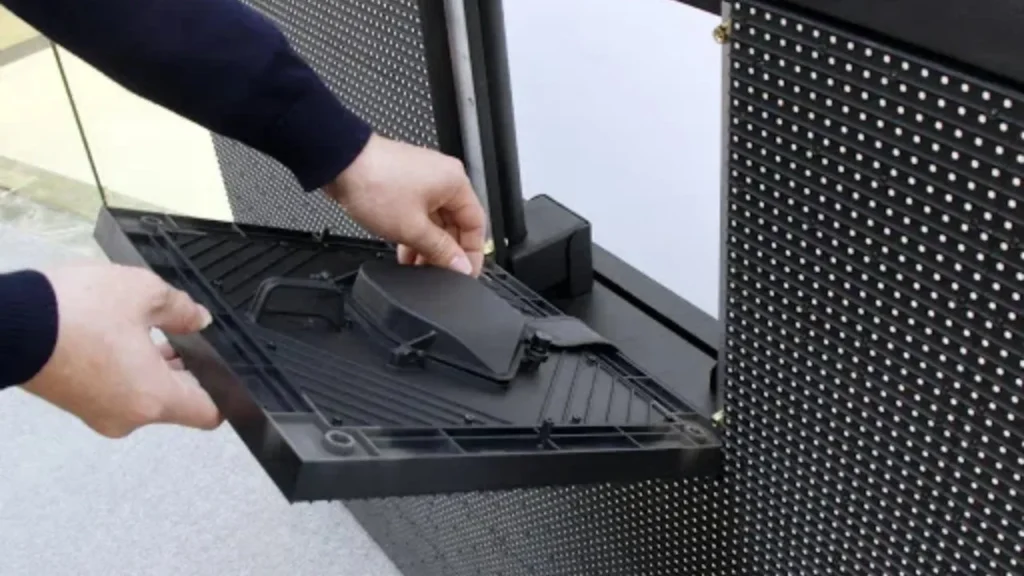
Installation Process
- Site survey – Assess location, viewing angles, power availability, structural support.
- Design & engineering – Determine screen size, resolution, and mounting method (wall, ground, flown).
- Mounting structure – Install steel frame or cabinet mounts.
- Cabinet installation – Attach LED panels, connect power and data cables.
- Calibration – Adjust brightness, color uniformity, and gamma.
- Testing – Run content, check for dead pixels or flickering.
Maintenance Tips
- Regular cleaning – Use soft, lint-free cloth. For outdoor screens, clean every 1–3 months.
- Software updates – Keep controller firmware and management software current.
- Spare modules – Buy 5–10% spare modules at time of purchase (production changes make matching later difficult).
- Seasonal checks – For outdoor screens, inspect weather seals and cable connections before rainy seasons or extreme heat.
Common Issues & Troubleshooting
- Flickering screen – Check power supply, data cables, or refresh rate settings.
- Dead or stuck pixels – Replace individual modules (spares recommended).
- Color mismatch – Recalibrate brightness and color uniformity via controller software.
- No signal – Verify sending card, receiving card, and cable connections.
- Overheating – Clean fans/vents, reduce brightness, or add cooling fans for outdoor screens in summer.
Control Methods: Synchronous vs. Asynchronous
| Feature | Synchronous Control | Asynchronous Control |
| Real-time display | Yes (mirrors computer screen) | No (plays pre-loaded content) |
| Computer required | Must be on and connected | No (standalone operation) |
| Content update speed | Instant | Requires upload (seconds to minutes) |
| Best for | Live feeds, interactive displays, control rooms | Advertising, digital signage, repeated content |
| Network dependency | Requires stable connection | Minimal (upload only) |
Recommendation: Most commercial signage uses asynchronous control (lower cost, simpler operation). For live events, broadcast, or real-time data (stock prices, flight info), synchronous control is required. Dual-mode players (supporting both) offer maximum flexibility.
Common Mistakes When Buying Commercial LED Displays
- Choosing pixel pitch too small for viewing distance – Wastes budget with no visible benefit.
- Using indoor screens outdoors – Will fail within weeks (no IP rating, insufficient brightness).
- Forgetting spare modules – After 2–3 years, matching color and size becomes difficult.
- Under-budgeting for installation – Mounting, cabling, and processors often add 20–40% to total cost.
- Ignoring after-sales support – Cheap suppliers often disappear after sale; verify warranty and local support.
- Skipping pre-purchase testing – Always ask for a live demo or test run before shipping.
Expert Tips from 10+ Years in Commercial LED Display Manufacturing
Tip 1: Calculate total viewing distance before choosing pixel pitch.
Measure from screen to closest viewer. Use: Pixel pitch (mm) = Viewing distance (m). Example: 5 meters = P5 (P4–P6 is sufficient; P2.5 is overkill).
Tip 2: For outdoor screens, demand IP65 AND 5,000+ nits.
IP65 ensures waterproofing; 5,000+ nits ensures daytime visibility. Many suppliers offer one without the other.
Tip 3: Buy 10% spare modules at time of purchase.
LED manufacturers change LED batches every 1–2 years. Spare modules guarantee color match for future repairs.
Tip 4: Test refresh rate with your phone camera.
Point any smartphone camera at the screen. If you see horizontal lines or flickering, refresh rate is below 1,920Hz – unacceptable for video or camera recording.
Tip 5: For rental or high-traffic areas, choose GOB over SMD.
GOB (Glue on Board) coating protects against dust, moisture, and physical impact – reduces dead pixels by 70–90% compared to SMD.
Frequently Asked Questions
Q1: What is the average lifespan of a commercial LED display?
50,000–100,000 hours depending on technology (SMD: 50,000–70,000 hrs; GOB/COB: 80,000–100,000 hrs). That equals 5–10+ years of normal commercial use (10–16 hours/day).
Q2: Can I use an indoor commercial LED display outdoors?
No. Indoor displays lack waterproofing (IP20 vs. IP65) and sufficient brightness (1,500 vs. 5,000+ nits). They will fail quickly outdoors from moisture, dust, and sun damage.
Q3: How much does a commercial LED display cost per square meter?
Indoor: $700–$3,000+/m²; Outdoor: $900–$2,500+/m². Final price depends on pixel pitch, technology (SMD/GOB/COB), brightness, and brand. Get a detailed quote with all components.
Q4: What maintenance does a commercial LED display require?
Regular cleaning, software updates (1–2x/year), and visual inspections. For outdoor screens, check weather seals and cable connections seasonally. Always keep spare modules on hand.
Q5: How do I control a commercial LED display remotely?
Via cloud-based or LAN-connected control software. Upload content, schedule playback, monitor status, and receive fault alerts from any computer or mobile device.
Q6: What warranty does IvanLED offer on commercial LED displays?
3-year standard warranty covering manufacturing defects. Extended warranty options available. We also provide spare parts and technical support worldwide.
Why IvanLED for Your Commercial LED Display Project
- 10+ years of experience – 1,000+ projects completed globally, from outdoor billboards to indoor fine-pitch video walls.
- Full in-house manufacturing – 1,200m² production facility with strict quality control (ISO-certified processes).
- Premium components – LED beads from Nationstar, Kinglight, San’an; power supplies from Meanwell or G-Energy.
- End-to-end support – Consultation, design, manufacturing, shipping, installation guidance, and after-sales support.
- 3-year warranty – Peace of mind with reliable local support channels.
- Custom solutions – Tailored pixel pitch, size, shape, and control systems for your exact application.
Conclusion & Call to Action
Choosing the right commercial LED display requires balancing pixel pitch, brightness, environment, control method, and total budget. Focus on your specific application (indoor/outdoor, viewing distance, content type) rather than chasing the highest specs.
Your next steps:
- Define your application (retail, outdoor advertising, hotel, control room, etc.)
- Measure viewing distance and ambient light conditions
- Set a realistic total budget (screen + installation + controller)
- Request a detailed quote with all components listed separately
At IvanLED, we provide free consultation, application-specific recommendations, and transparent pricing – no hidden fees, no over-selling.
Ready to upgrade your commercial visual communication?
👉 Contact IvanLED today for a customized commercial LED display quote.