









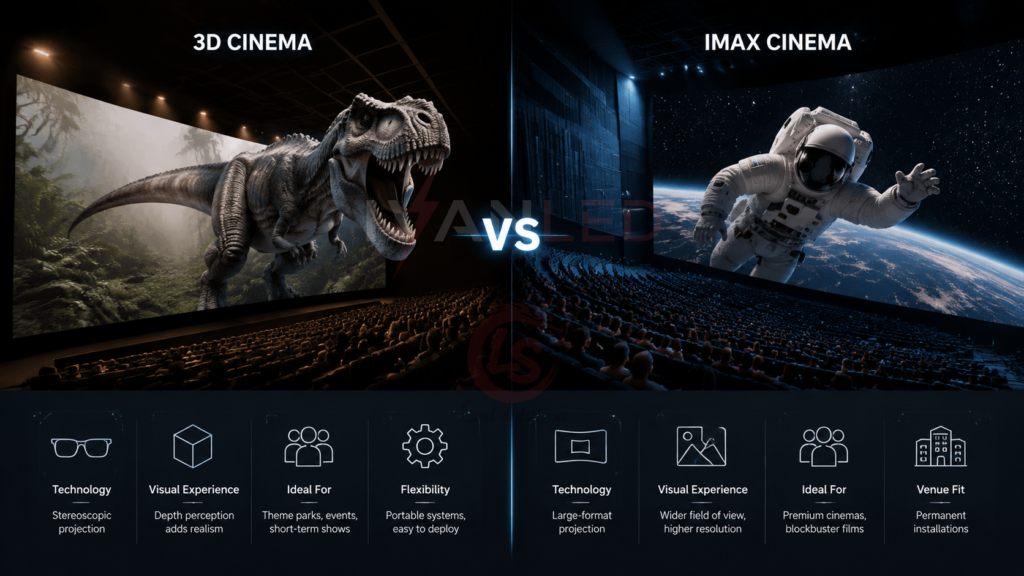
Buyer Pain Points: 3D vs IMAX Confusion
Venue operators and event planners face specific challenges when choosing between 3D and IMAX:
Is IMAX just a bigger 3D screen? No. IMAX is a complete cinema system with proprietary projectors, sound systems, and screen geometry. It can show 2D or 3D content. 3D is a content format that adds depth perception.
Which one costs more to install and maintain? IMAX requires significantly higher investment — specialized projectors, 12-channel sound systems, and ongoing calibration. 3D requires only basic projection equipment with polarizing filters and glasses.
Which one attracts more audiences? IMAX commands premium ticket prices and attracts audiences seeking blockbuster experiences. However, it requires a steady flow of high-demand content to be profitable.
What about LED displays? Many commercial venues are replacing projection systems with LED displays for better brightness, lower maintenance, and more versatile content options.
Which is better for events? For events, LED displays offer more flexibility than fixed projection systems — they work in daylight, can be curved, and support interactive content.
What Is 3D Technology?
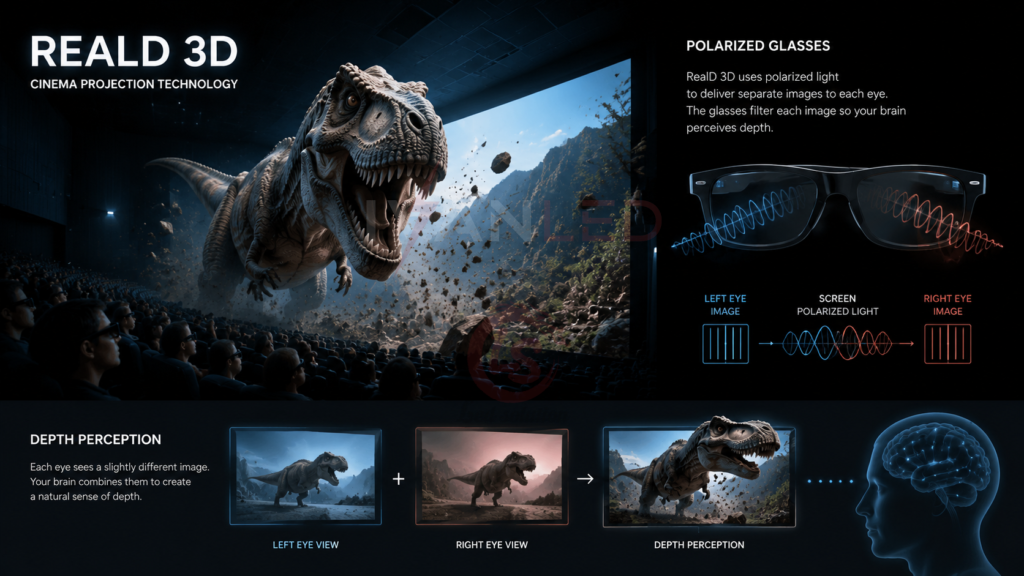
3D (Three-Dimensional) technology creates the illusion of depth by showing slightly different images to each eye. The brain combines these images to perceive a three-dimensional scene.
Key 3D formats include:
- RealD 3D: The most common cinema format (over 80% of 3D screenings) using circular polarization
- Active Shutter 3D: Uses battery-powered glasses that alternate between left and right eye images
- Dolby 3D: Uses color filtering to separate left and right eye images
- Glasses-Free 3D: Uses lenticular lenses or parallax barriers for viewing without eyewear
RealD 3D works by projecting images through a circular polarizer. The glasses ensure each eye sees only its corresponding image, creating the depth illusion.
What Is IMAX?
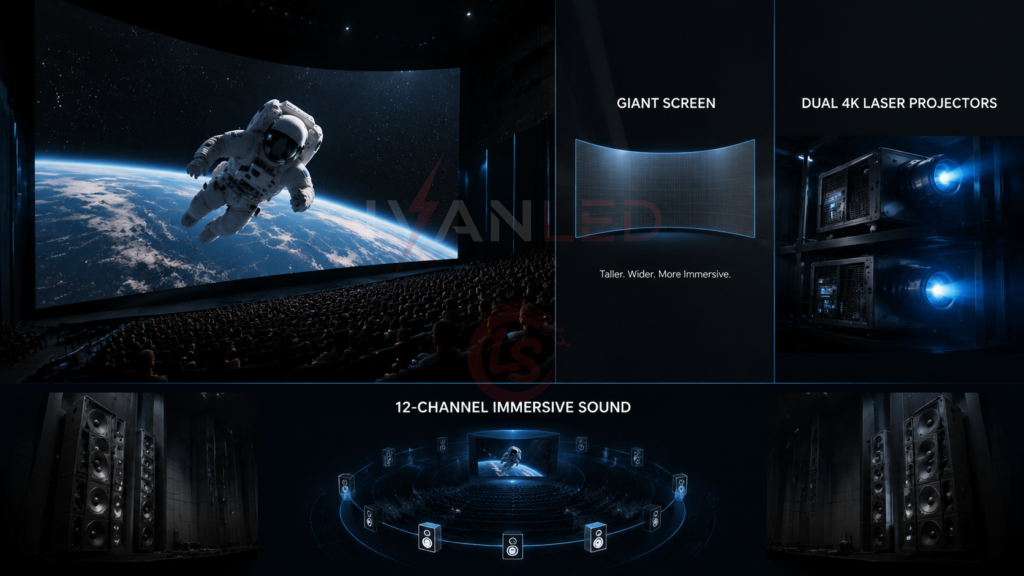
IMAX (Image Maximum) is a complete cinema technology standard developed by IMAX Corporation, featuring giant screens (over 630 inches wide), specialized projectors, immersive 12-channel sound systems, and optimized seating layouts.
IMAX formats include:
- Digital IMAX: Two 2K projectors combined for 4K resolution
- IMAX Laser GT: 4K laser projectors with superior brightness and color
- IMAX Dome: Curved screen for planetariums and immersive experiences
- IMAX 3D: IMAX showing 3D content (uses the same 3D principles but with IMAX’s scale and sound)
IMAX can show both 2D and 3D content. Its key advantage is the combination of massive scale, high brightness, and immersive sound.
3D vs IMAX: The Real Differences
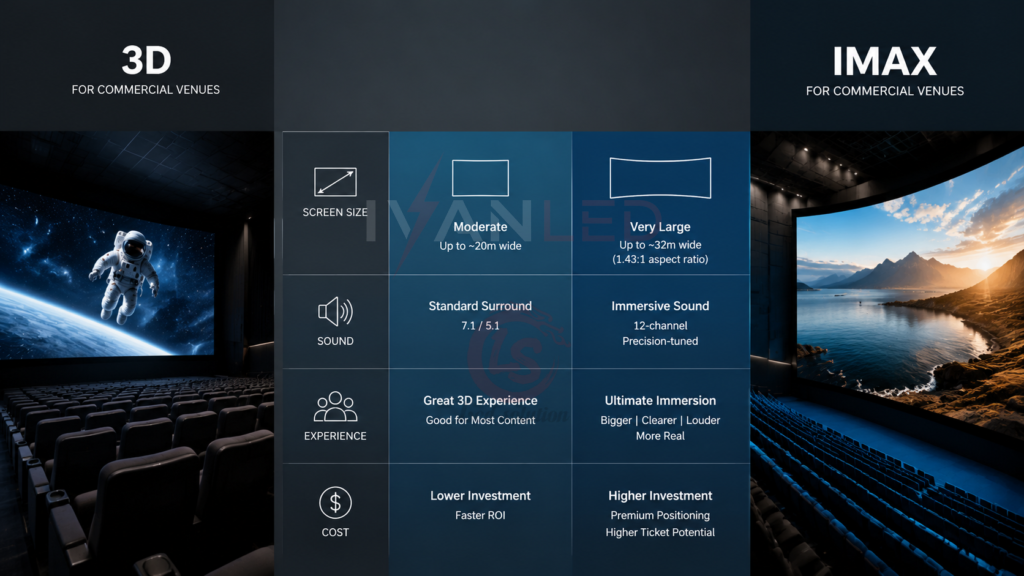
The key difference is that 3D is a content format that adds depth, while IMAX is a complete cinema system that delivers scale, immersion, and premium audio.
| Factor | 3D (RealD) | IMAX 3D |
| Screen size | 400 inches wide × 200 inches high | 630+ inches wide × 400+ inches high |
| Projection system | Single or dual standard projectors | Dual 4K laser or specialized projectors |
| Sound system | 5.1 channels | 12+ channels |
| Brightness | Lower (3D reduces brightness) | Higher (maintains brightness in 3D) |
| Glasses required | Yes (polarized) | Yes (polarized) |
| Installation cost | $50,000 – $150,000 | $500,000 – $1,500,000+ |
| Ticket price premium | 20-40% above standard | 50-100% above standard |
| Best for | Standard cinemas, varied content | Blockbusters, premium experiences |
Which Movies Are Better Suited for IMAX?
IMAX is best suited for visually spectacular films with epic scope — sci-fi, action, and animated features with high-resolution visuals and immersive soundtracks.
Consider IMAX for:
- Sci-Fi films: Space scenes, futuristic worlds, and large-scale visual effects benefit from IMAX scale
- Action movies: Fast-paced sequences and wide shots are more immersive on giant screens
- Animation films: High-resolution animation showcases detail and color on large screens
- Documentaries: Nature and space documentaries benefit from immersive scale
For more on display technology for commercial venues, see our commercial LED display solutions.
3D vs IMAX: Which Should You Choose?
Your choice between 3D and IMAX depends on your venue size, budget, content strategy, and target audience.
Choose 3D (Standard) if:
- Your budget is limited
- Your venue is standard size
- You screen a variety of content
- You want to offer depth effect without premium investment
Choose IMAX if:
- You have high budget for premium experience
- Your venue is large (over 500 seats)
- You focus on blockbuster films
- You want to command premium ticket prices
LED Displays: The New Standard for Commercial Venues
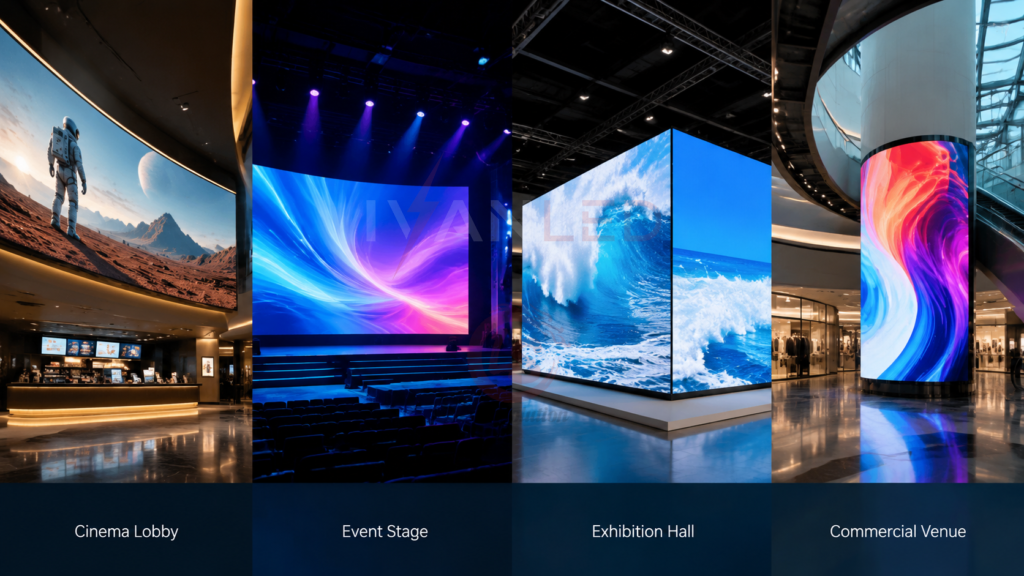
While 3D and IMAX are projection-based technologies for cinemas, LED displays are becoming the preferred visual solution for commercial venues — offering higher brightness, longer lifespan, and greater flexibility.
LED displays are increasingly used in:
- Cinema lobbies: Advertising, ticket information, promotional content
- Event spaces: Stage backdrops, live streaming, immersive environments — see our stage rental LED screen guide
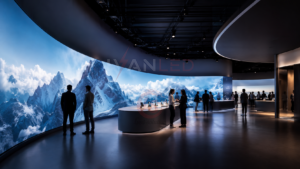
- Exhibition halls: Interactive displays, brand storytelling, wayfinding
- Retail environments: Digital signage, brand activation, immersive experiences
For a complete LED display price guide 2026, see our detailed breakdown.
Expert Tips for Venue Operators
Tip 1: Match technology to your business model.
If you are a multiplex cinema showing varied content, 3D projection is sufficient. If you are a premium destination focused on blockbusters, IMAX can be a differentiator.
Tip 2: Consider LED displays for ancillary spaces.
Cinema lobbies, event spaces, and exhibition halls benefit from LED displays for advertising, wayfinding, and immersive experiences — at a fraction of the maintenance cost of projection systems.
Tip 3: Evaluate content availability.
IMAX requires a steady stream of films released in IMAX format. 3D content is more widely available. Ensure your content pipeline matches your technology investment.
Tip 4: Factor in ongoing costs.
Projection systems require regular lamp replacement and calibration. LED displays require minimal maintenance and have longer lifespans (100,000+ hours).
Tip 5: Think about versatility.
LED displays can show any content — 2D, 3D, live feeds, advertising, interactive elements. Projection systems are primarily for cinema content.
Frequently Asked Questions (FAQ)
What is the difference between 3D and IMAX?
3D is a content format that creates the illusion of depth by showing different images to each eye. IMAX is a complete cinema technology standard with giant screens, specialized projectors, and immersive 12-channel sound. IMAX can show both 2D and 3D content.
Is IMAX 3D better than regular 3D?
IMAX 3D offers a more immersive experience — larger screen, higher brightness, better sound, and deeper depth perception. However, it costs significantly more to install and maintain. Regular 3D is more affordable and accessible.
What equipment is needed for 3D screening?
3D screening requires a 3D-capable projector, a polarizing filter, silver screen, 3D glasses for audiences, and a content server with 3D content. Costs range from $50,000 to $150,000 for a standard installation.
Can IMAX play 3D content?
Yes. IMAX can play both 2D and 3D content. IMAX 3D uses the same 3D principles but with IMAX’s larger scale, higher brightness, and more immersive sound system for a premium experience.
Are LED displays replacing projection systems in cinemas?
LED displays are increasingly used in cinema lobbies, event spaces, and commercial venues. For main cinema screens, projection remains the standard, but LED technology is advancing and may see wider adoption in the future. LED displays offer higher brightness, lower maintenance, and longer lifespan.
Does IvanLED offer LED displays for cinemas and events?
Yes. IvanLED manufactures LED displays for cinema lobbies, event stages, exhibition halls, and commercial venues. We offer custom sizes, resolutions, and configurations for indoor and outdoor applications. Contact us to discuss your venue requirements.
Conclusion: Choosing the Right Visual Technology for Your Venue
3D and IMAX serve different purposes in the cinema world. 3D adds depth; IMAX adds scale and immersion. The right choice depends on your venue size, budget, and content strategy. Increasingly, LED displays are becoming a versatile alternative for commercial venues — offering brightness, flexibility, and lower maintenance costs.
Our straightforward advice:
– For multiplex cinemas: 3D projection is sufficient and cost-effective.
– For premium large-format venues: IMAX offers a distinct competitive advantage.
– For ancillary spaces (lobbies, events, exhibitions): LED displays are the best solution.
– Always consider total cost of ownership — not just installation cost.
At IvanLED, we manufacture high-quality LED displays for commercial venues, event spaces, and exhibition halls. Browse our commercial LED display solutions or contact us to discuss your venue requirements.
Ready to upgrade your venue’s visual experience?
👉 Contact IvanLED for a free consultation and customized quote.